Adventure Tourism, Birds, Blessings, Camping, Faithful Living, God, Home, Nature, Prayer, Religion, River, Uncategorized, wisdom

With a Honk and a Prayer

On our meandering way home last week, we camped near a lake in northern Kentucky.  We went on a rainy walk before supper, so glad to stretch our legs, gladder still to see geese on the water, which, like robins, I prefer to interpret as another sign of spring.

After dinner and washing up in the RV, we settled into our bunk with our books, lulled by the sound of rain on the roof. Outside was a deepening twilight. Faintly at first, then growing louder, the honking of an army of geese approached the lake for the night, answered robustly by the birds already in residence.  The honking was a roar at splashdown.

At first I thought the geese were honking to establish some kind of hierarchy, a kind of threat between resident and intruder. But my reading revealed that geese make such a racket in their dusky landings and dawn takeoffs so that other geese will know where they are.  They don’t honk in threat, or greeting, or goodbye. They honk to be “seen” in the dark, to prevent accidentally colliding with one another. Our church has become so crowded of late that I laugh to think about honking in the vestibule so that no one accidentally elbows me while drinking hot coffee! Still,

we can use our hearing as a kind of sonar, to listen for people’s stories, hopes, fears, and needs.

The other time geese routinely honk is while migrating. Bird experts think it is a form of encouragement. It reminds me of they way players on the bench, and the fans behind them cheer on their team on the court and field. My church family is truly my flock in this regard.

In returning to our home church for worship, it felt wonderful to be welcomed by our church family… the honking of landing back in our fold, of encouragement in the questions about our trip, our welfare, what we learned, how it went. And we learned what had been happening at home in our absence.

The Bible calls this being surrounded by a great cloud of witnesses… people on both sides of the river, alive and dead, who greet us, enfold us, encourage us, pray with us, and then send us back out into God’s world with a honk and a prayer.

Who is in your flock to encourage you, to see you safely home? Listen for them!


~J.A.P. Walton

Photo credit: bestof:canada geese branta canadensis …snappygoat.com

adventure, Affirmation, Cancer, canoeing, Creator, death, God, Hardiness, Hope, Life's Storms, Outdoor Adventures, Peace, Perseverence, Prayer, Religion, Risk Taking, Sea Canoe, Uncategorized, Water, wilderness

All Things ARE Possible with God

At the recent Quiet Water Symposium, QWS  we were thrilled when Hugh was recognized with the Verlen Kruger Award for his years of encouraging others to take up their paddles, and for his ongoing volunteer work on water quality issues in his county. In the nominator’s words, “Hugh believes in the power of water to challenge, teach, and heal.”

At the event, one of Verlen’s original Sea Wind canoes was on display, with the ever present Scripture, “ All things are possible with God,” Verlen’s favorite verse from the Bible.[1]

When you launch out into the current of life with God, anything, even all things are possible right there in the middle of your life, your sickness, your challenges, even your death-God prevails.

Verlen took his faith across 100,000 miles of paddling not just in Michigan, but from the Arctic Circle to Cape Horn, up the Colorado River through the Grand Canyon, from Montreal to the Bering Sea, and many more. He was an inspiration in vision, perseverance, courage and faith. And he was humble enough to admit his mistakes. For more about Verlen, click here

In receiving the award, Hugh spoke about having to move home to Michigan after his leukemia diagnosis, and his desire to fully explore the Great Lakes by canoe. To do so, especially given his illness, he would need a canoe that could take on “big water.” Verlen’s sea-tested design was reputed to be the toughest canoe ever made. In 1999, Hugh visited Verlen and ordered what would become Sea Wind #125.

When the canoe was ready, Mark went with Hugh to pick it up and meet Verlen, who consulted with them about their upcoming trip to the Apostle Islands. When Verlen found out that Mark was taking a family canoe, he insisted that they take one of his old Sea Winds.  When Mark returned the borrowed canoe, he immediately ordered his own Sea Wind. That was the beginning of the Walton brothers’ Kruger Expeditions, and a blossoming friendship with the man behind these boats.

What neither of them knew was that Verlen himself was living with cancer at the time.  Shortly before he died in 2004, he told his biographer, “I’ll fight this thing as long as I’m able, but if God wants me now, I’m ready.”[2]

Hugh had the same philosophy over the ten years of treatments he endured before the curative bone marrow transplant. In those years, he paddled in spite of the fatigue, in spite of the drug-induced flu-like symptoms, and in the face of long odds.  A day didn’t pass that he wasn’t grateful for life, and for the opportunity to paddle with his brother, unwavering in his own belief that all things are possible with God.

~J.A.P. Walton

[1]See accompanying photo of the bow of Sea Wind #3

[2]Phil Peterson. All Things are Possible:  The Verlen Kruger Story. 2006. p.284.

adventure, Affirmation, Creation, Creator, Faithful Living, God, Lessons from the Wilderness, Light, Nature, Peace, Ralph Waldo Emerson, Silence, Starry Skies, sunsets, Uncategorized, wilderness, wisdom

The Unsaid Nightly Prayer

When you are simultaneously reading books about wisdom, nature, and brokenness, your mind swirls in eddies of hope-drenched enchantment.  This despite so much evidence to the contrary; seeing our world with despair-tinged eyes, where the sights only confirm our overlord mentality in regards to creation care; studying the metrics that confirm a warming planet and melting polar icecaps; watching ‘progress’ chew up farmland and forest for pre-fab, over-mortgaged, faux-rich plywood houses.

Yet, I remain swaddled in hope.  It is a hope born in an infantile understanding of creation as beauty, of nature as God’s artistry, of the stranger’s face as an image of God.

As a physiologist by training, it is natural for me to misunderstand the “whole” of things for spending too much time in the weeds of all the contributing parts. A stunning sunset becomes a thought-train of the influence of polluting forest fires to the west creating atmospheric conditions for super-red hues; a cloudbank over the water wraps the sunset in royal robes of purple and crimson, while my mind delves into the barometer’s dive signaling an approaching storm.

Truth is, the beauty of the whole of creation is best appreciated not when you can reduce each strand to its explainable source, but when you can understand that it is a cosmic marriage of what we know (reason) with what we cannot know (holiness). That sunset? It is love, and Spirit, and unity that only my lack of understanding tries to fracture into discordant parts. Paul Griffiths calls this the “vice of curiosity.”[1]

And that gets us to the notion of understanding, something we humans almost never achieve because we are too engrossed in overstanding. By this I mean that, in our drive to subdue the earth, we take on a superior stance that towers over all creation in ruthless domination rather than a shepherding dominion. To stand under something requires a willed humility, acceptance of the role of steward, caretaker.

So, when I see a particularly lovely sunset, I must hush my instinct to overstand it, to explain it, to force its harmony into vile little shards of scientific reason. Instead,

I remind myself of the holiness of the moment, as God prepares both me and his creation for rest while the sun withdraws on tiptoe, because everything I see, in its wholeness, is painted glorious with hope for a new and better day to come. It is an unsaid nightly prayer…

, a “sally of the soul into the unfound infinite…kindl[ing] science with the fire of the holiest affections…[in which] the invariable mark of wisdom is to see the miraculous in the common.”[2]  Oh, that I could be that wise.

~J.A.P. Walton

[1]Paul Griffiths. The Vice of Curiosity: An Essay on Intellectual Appetite.2005.

[2]Ralph Waldo Emerson. Nature. 1836.

adventure, Affirmation, Birds, Creation, Creator, Faithful Living, Forest, God, Hardiness, joy, Lessons from the Wilderness, Life's Storms, Nature, Peace, Perseverence, Praise, Prayer, Sigurd Olson, Silence, Uncategorized, virtue, wilderness, Winter

Bring on the Ice!

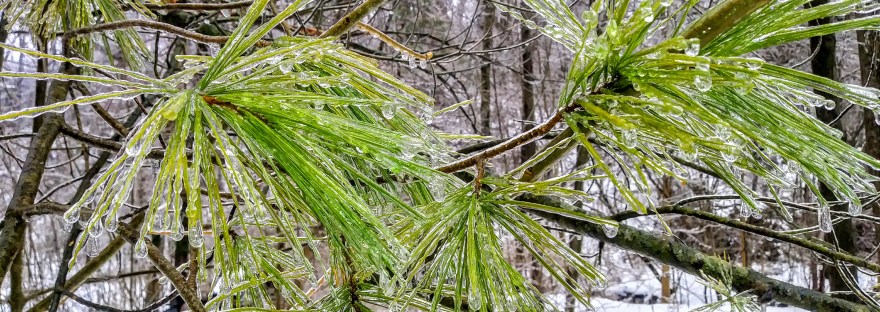
It is icy at Trout Creek this February morning from the overnight sleety rain suspended in millions of icicles off branches and eves. I have the window open a crack to soak in the music of the silence.  The creek riffles on, but the rest of the landscape is a still life, no deer, and no squirrels. Perhaps it is too early yet. Perhaps they ‘ve hit their own version of the snooze alarm, and are rolled over in their roosting cavities for another 10 minutes.

I go make coffee, and sit back down to marvel at the way nature stills itself. The trees have nothing to say, though they are adorned in crystal gowns just waiting for the dance to begin. The tall grasses are bent in prayer. You can feel the hush, as if you are in a great, empty cathedral. The silence is pregnant with expectancy.

Just then the bold, brassy wren who habits the tamarack tree chirrups his, “I’m here, I’m here, I’m heeeerrrre!”

Over and over  he chants his solo, as if inviting the world to join the chorus. Maybe he’s shouting, “Wake up, wake up, wake uuuupppp!”

The wren’s chatter works: the squirrels are carefully heading downtree.  The titmice family swoops in to the feeder for brunch. The deer are out there pawing the snow in the fallen maple’s atrium to belly down for a morning nap.

In his book, The Singing Wilderness,  Sigurd Olson writes about the winter blue jay, with its “brazen call, more of a challenge than a song, a challenge to the storm and cold.

There was a jauntiness and fortitude, announcing to me and to the whole frozen world that where there is wine and sparkle in the air, it is joy to be alive. I liked that jay and what he stood for; no softness there, pure hardiness and disregard of the elements.”

I think that’s how I want to embrace this cold, frozen world we live in. With a cheerful fortitude and strength of character that encourages people to wake up from their numbing technology, their frozen minds, their careless thoughts, their selfish motives. To embrace the joy that life brings, whether it be storm or stillness.  I want to be hardier, and heartier in the face of both challenge and delight. Perhaps, though, a bit less brazen than the wren or jay, with a meekness learned from saints, and a thankfulness wrought by God’s great mercies.

Bring on the ice! (May it give us pause).

~J.A.P. Walton

adventure, Affirmation, Cancer, canoeing, Creation, Creator, Darkness, death, God, Henry David Thoreau, Hope, Lessons from the Wilderness, Life's Storms, Nature, Peace, Perseverence, Praise, Ralph Waldo Emerson, Religion, Silence, Transcendentalism, Uncategorized, wilderness, Wilderness Paddling

The Ecstasy in Being Brave

I have been reading about transcendent philosophy espoused by the likes of Emerson and Thoreau. Its main tenets are that man and (N)ature are inherently good, emphasizing the prime importance of the individual and individual freedom, as well as oneness with the universe. At its most basic, the idea teaches that there is a power deep inside of us that, when we tap it, allows us to become one with what we see, whether it’s a mountain, a constellation, a river, a sunset, a storm, or an animal.  It teaches that we have a light inside us that banishes darkness, leading us to know Truth, wisdom, and goodness. And, when all of this aligns within us, a deep delight, a visceral ecstasy-or transcendence-results.

As a student of the Bible, and the God who wrote it, it is disturbing to me that many of these transcendentalist ideas are woven into the weft and warp of the minds of people who seek out the wilderness. Why?  Because it gets everything horribly backwards.  I will let a simple chart do the talking:

Bible Transcendentalism
Sin is real, both in people and Nature All people and Nature are inherently good
God is light and Truth Each person is his own source of light & Truth
Worship of anything other than God is idolatry Nature and beauty should be worshiped
Knowing God brings delight Delight is a direct result of knowing myself
God is the only and the great, holy I AM I am God, my own deity and salvation

Still, to believe what the Bible says about all of this, you first have to believe in the reality of sin and evil in this world, and, more directly, in your own heart.

People who don’t know the God of the Bible don’t accept that we live in the tension between God’s goodness and the evil he has allowed.

They only want a loving God. They only want the light, the happiness, and the good things of God. But, for humans to have perfect freedom to choose how they live and what they believe, there has to be a choice. Life or death. Light or darkness.  Goodness or evil.  It is no wonder that these people cannot fathom how something so evil as the attack on the World Trade Center could happen in this day and age. People who know God, and understand that most of the world has chosen to reject him think, how could it not?

When Hugh got cancer we were all devastated. Sickness has a way of letting big questions scream at us. Why would God allow this suffering, especially for someone as good as Hugh? But our goodness is irrelevant –and irreverent- in the face of a holy, just, and good God. Sickness is just part of what it means to be human. So is death.  Mark and Hugh had been paddling together long before the leukemia showed up. They kept paddling during ten long years of treatments. Why?  What did the wilderness have to offer in dark and confusing times? It offered the chance to leave the distractions and torments behind: the doctor visits and hospital stays, the long, long road to an outcome that no one could predict, the fear, the hopeless feelings- all of it dropped out of sight the minute the two brothers stepped into their canoes.

We can go to Nature to be wowed. We can go to get away from the world’s brokenness. We can go to seek out the quiet places where God’s voice can be heard, where there are “moments when [we] can sense Him near [us], and [we] can never quite believe it.

He never condemns, He just sustains. He doesn’t judge, He understands. He gives [us] hope again, and says be brave.”[1]

The Walton brothers went out, not to find themselves, not to be their own light, not to become one with Nature, but to bathe in the balm of the unsullied wilderness, perfect in its minute and grand designs, just as God created it.

They went in brotherliness, to be bolstered with strength enough to be brave together in the dark shadow of Hugh’s illness.

They never went to attain ecstasy through oneness with a brilliant sunset. It was to know and treasure that they were one with the very God who made that sunset, knowing that they were loved, held and nurtured in spite of the specter of illness and death. If that’s not ecstasy, what is?

~J.A.P.Walton

[1]Bear Grylls.Facing the Frozen Ocean. Pan Books, UK.2013 (digital edition). p.105.