adventure, Affirmation, Creation, Creator, Faithful Living, Lessons from the Wilderness, Nature, Peace, Praise, Prayer, Silence, Uncategorized, wilderness, Wilderness Paddling, wisdom

Hush Yourself

The Walton brothers leave in two days for their epic paddle on the Colorado River through the Grand Canyon, and as they pack and plan, I find myself wondering how Mark and Hugh will adapt to a group setting, because when it’s just the two of them, the trips are filled with long, contented, contemplative silence.  A group of 16-20 paddlers is sure to be filled with whoops and the idle yakking that an exciting adventure can bring out in boisterous, bombastic ways.

Silence and wilderness are comfortable companions.  Big, wide, primitive, and timeless spaces like the Grand Canyon almost demand our reverent silence. So much so that the human tendency toward ceaseless chatter is nearly a sacrilege. I say ‘nearly’ because there are times when a gasp or sigh just won’t do, when, in our inability to find the words to describe God’s perfect creation, we can only utter an awe-filled, praise-pregnant, “Wow.”

A few weeks ago, at a gorgeous state campground in Michigan’s Upper Peninsula, we were surrounded by such surreal beauty that we could hardly speak at times. Yet, there were our neighbors, blasting their base-thrumming music right up to the stroke of the start of quiet hours. Beautiful wilderness, birdsong, chipmunk chirrups, the wide river lapping the shore, thunder in the distance- all crowded out by someone’s idea of a sound so beloved that it just had to be shared with everyone.

We seem to have arrived at a cultural norm in which it is another person’s right to fill “my” personal space with any sound, at any volume they choose, and if I don’t like it, I can leave. I get to listen to their cell phone conversations, their music, and their video movies on line at the store, in waiting rooms, restaurants, and, yes, even wilderness campgrounds. They may find it entertaining. I find it immensely thoughtless- storms, earthquakes and fires of our own destructive making.  But, God told Elijah that he was not in the earthquake, wind, or fire. God was a whisper so low that Elijah had to go outside and be silent to hear it. (1Kings 19)

Where in this whole, big world can we go to find real silence-that quietness of space and soul that God can speak into with his whispers?

And why do we shun God’s silent places with noise that distracts and numbs us while overflowing into our neighbors’ lives?  I find this mindless and endless self-absorption disheartening at best, a habit-forming and careless* practice of escapism that effectively shuts God’s voice right out of our lives, and, what’s more,  intrusively does so to the people around us.

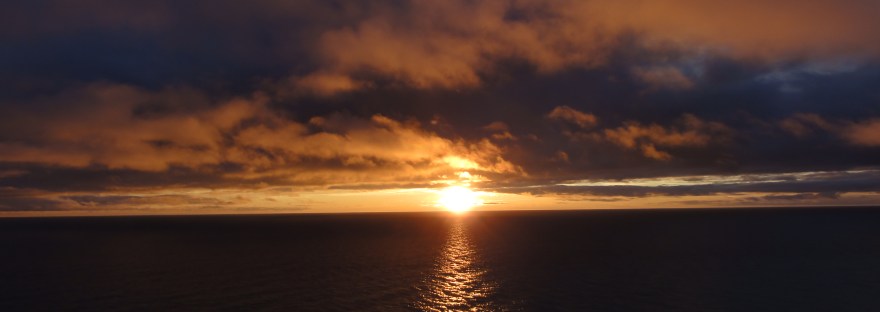
Just look to the creation! The sun rises and sets without a sound. The caterpillar curls up and noiselessly becomes a whispering butterfly, the trees mutely leaf out in a stunning welcome to spring, and the snowflake somersaults in freefall in glorious silence.

I think this is why I gravitate toward rowing, sailing, paddling, fishing, and beach walks. No, these are never silent, but the music is God-given, rarely brassy, harsh, or discordant. The rills of water against the oars, the foaming gossip of a white-capped wave spilling onto the beach, the scree of the hungry hawk, the wind like a cellist’s bow against the cedar boughs, and the laugh of the blue jay- now this is a symphony of harmonious delight, free for the listening. The wilderness preserves silence on this busy planet, which is one big reason it is important for us to be committed to the preservation of the wilderness.

The wilderness can give you the concert of a lifetime if you’ll learn to hush yourself.

Happy listening!

Sign up to FOLLOW and you will join a growing list of regular readers who get an email push each time a blog post is published. As always, thanks for reading as I continue on this writing journey into the wilderness.

~J.A.P. Walton

  • by careless, I mean that a person could care less
adventure, canoeing, Creation, death, Faithful Living, Lessons from the Wilderness, Life's Storms, Outdoor Adventures, Peace, Perseverence, Ralph Waldo Emerson, River, Sacrifice, Travel, Uncategorized, Water, wilderness, Wilderness Paddling, wisdom

The Cosmic Indifference of the Wilderness

It takes months of planning for a paddling journey into the wilderness.  The Walton brothers toss around ideas, the maps come out, the routes, and access to them are studied, dates are penciled in, then, finally, train and campground reservations are made. In the month preceding any trip, my husband begins an internal transition from here to there as the necessary equipment comes out of storage to join the growing pile in our living room. Sleeping pad and bag. Cook stove. Dry bags. Bear bag. Throw bag. Cooler. Camp chair. Hammock. Swiss army knife. Food list. Boots. Water shoes. Dri-fit clothing. Camera. Tent and fly. Fishing pole. Hat. Rain gear. Maps. You get the idea.  Just now, Mark and Hugh and two more of their brothers are in the early phase of staging their September trip down the Colorado River through the Grand Canyon, a trip three years in the planning.

Why so much planning? The wilderness is, by necessity, wild and weathered, unsympathetic to the needs of a paddler. The wilds don’t care about your life or your death.

I call this the cosmic indifference of the wilderness.

Yes, the wilderness is untamed and unfettered. And all around, usually invisible in the  forest deeps, and the dark swirls of river and lake is the predatory character that drives all creatures to eat, shelter, reproduce and live – as good a description of survival that you can conjure. If you are going to test yourself against the elements of the wilderness – its fire, air, water, rock, flora, and fauna, then you better know what you are doing.

So, when wilderness paddling, you learn to be on the lookout for threats like underwater rocks or deadfall trees, swirling eddies, confused currents, high water, low water, storms, lightning, fires, bears, moose, and poison ivy, to name a few.

Daily life is actually not all that different. It goes merrily along like a calm, placid river, and, unawares, we become lulled into forgetting our creaturely vulnerability to hidden threats to our wellbeing:  sickness, accident, injury, infidelity, terror, poverty, and death. We can go from flourishing to foundering in an instant.  This was true for Hugh when his leukemia diagnosis came out of the blue, followed by the ten-year slog of treatments before a life-saving bone marrow transplant. You simply can’t plan for that.

Even with maps, you don’t always know where you are.

Food can’t satisfy your deepest hungers- for life to have meaning and purpose, to belong, and to be loved.

It’s true: all the planning in the world can’t prevent you from incurring harm in the vicissitudes of this life.  Just ask anyone who’s come within a bear’s breath of dying.

Still. We learn from the wilderness that there is a flip side to almost everything.

Beauty masks pain. Tenacity is a product of frailty. Love necessitates sacrifice. Suffering is never meaningless.   Meekness and tenderness makes for strength. The water can bear you up or take you down.

Time in the wilderness confirms the relationship between the sober realities of life and its loveliness, courage, and peace. The virtues are God-inspired, and there for us to cultivate if we would only abdicate our need to control.  Yes, life is fragile. But, our own can be enlarged, enriched, and emboldened if we embrace it in all its grit and grace. Yes, life is demanding. How will you traverse it? Emerson wrote that the dowry of the wilderness is precious to any who seek it.  When will you start planning to get out and go?

~J.A.P. Walton

Affirmation, Blessings, Creation, Creator, Darkness, Dying to Self, Faithful Living, Forest, God, Hate, Lessons from the Wilderness, Life's Storms, Nature, Peace, Praise, Prayer, Serving Others, Uncategorized, wilderness, wisdom

The H’s of Learning & Unlearning

I taught thousands of college students over the years.  The biggest challenge was not helping students learn; it was first getting them to unlearn the things wrongly buried in their psyche: that rote memorization rarely creates understanding; cramming is foolish; being in class is a critical necessity; classmates are not just co-learners, they are also your teachers; the internet is not always the best source of information; talking to people face to face is an important skill… believe me, there’s more!  But, the point is that

we have all learned things that we need the guts and determination to root out and unlearn before our growth as a whole, helpful, and happy person can develop and mature.

When we take the time (that in itself is an important learning skill) to seek out the grandeur and solitude of the wilderness, we become students of nature- wild and human. There is so much we can learn if we are also willing to unlearn the things that make us small, harried, worried, unhappy, and vexed (oh how my grandmother the writer loved that word!)

I believe that all of learning is rooted in love.

And what does the wilderness teach us out of love about love?  That this world was created by design, with an Artist’s eye and a passionate Hand. What we find in the wilderness is that the world, as created, is infused with a holiness that transcends all the things humans can do to ruin it.  The wilderness teaches us humility, and to affirm the good that we see and can be to others. It teaches us to love the Creator.

If love is the root from which all learning blossoms, then it follows that the things we’ve learned wrongly do not shoot forth from love. When I take the time to seek out the solitude and teaching that creation offers, I ask myself what I need to unlearn first-those things the world pushes me to think, say, or do that are not things to be proud of. First, I must unlearn haste. It’s one thing to hurry to get dinner on the table for a hungry tribe; it’s another to live each day as if God did not create enough time. The wilderness teaches me that I must slow down.

The world has taught us to hate. We distrust anyone who is not like us. We spill our hatred over onto social media.

We grind our axes and our teeth. Hate is the rot at the core of our discontent, and it cannot possibly grow out of a heart steeped in love.

If you find yourself impatiently fuming at (fill in the blank), you are not acting out of love.

We have also learned to hoard from this consuming and consumptive world. We make and we take and we guard it closely with our tightly balled up fists- our time, our money, our very selves.

The wilderness teaches us all this: that our haste, and our hate, and our hoarding are ugly and shameful, and utterly pathetic in the face of the humility and holiness we encounter in creation.

I don’t know about you but I have much to unlearn in order to learn rightly.

~J.A.P. Walton

Affirmation, Blessings, canoeing, Creation, Creator, Dying to Self, Faithful Living, Forest, God, Hope, Lake Michigan, Lessons from the Wilderness, Nature, Serving Others, Uncategorized, wisdom

Count On It

I am known in my family for my quirky penchant for counting things-the number of kayak strokes I take to my husband’s single dip of a canoe paddle (about 8), the mileage on a bike ride, the number of geese flying in V formation, how many feet of fishing line I let out when trolling, the number of steps in any flight of stairs, and a daily report of the number of cargo and cruise ships that pass by on the big lake.

During June at the bluff, the fervent counting begins. See the doe with two fawns, and raise your eyebrows in disbelief when the neighbor shows you a picture of the bobcat with five kits under her deck.  The robins are on their second brood already, and the dying ash trees that have summoned the voracious pileated woodpeckers means there are bugs galore just for the hammering. Today I saw a monarch butterfly, the first of the summer’s four generations that it will take to produce heirs with the will and stamina to fly to Mexico in September (one day two Septembers ago, I counted 75 monarchs/hour heading south along the bluff line). Each night, two baby screech owls silently glide in at dusk to hunt the plentiful moles and voles at the forest’s edge. And who could even begin to count the mayflies at hatch time?

I think I count things because it helps me be present and aware of my surroundings. Counting gives the world I see and hear a sense of order and rhythm, helping me apprehend patterns and hear Nature’s music.  Mostly I just love all things numbers.  Of course, much of the counting we do in life could be considered just so much idle wool-gathering; we tally our financial assets, count down the number of days until Christmas, check the number of likes on a social media post, and keep a running score in our head of who’s let us down.

But what should we be counting?  What (and who) can we count on? When Job tried to argue his feeble case, God let go with a thundering,

Who are you to lecture me? Where were you when I filled the storehouses with snow and hail? Do you even know how I measured out the dimensions of the universe? Can you count the lightning bolts?”

In other words, there are lots of things only God can count, like all the stars in all the universes, every fish in the sea, and the grains of sand on the coast. This is the same God who tenderly tells us that He knows the number of hairs on our head, and the very sum of the days of our life.

We can count on God to be our strength, hope, and peace when we feel like our own strength is gone. And, of course, when we live a life that has died to self, we can count on each other.

I love to watch the world go by while I keep count, and I am beginning to appreciate how to count it all joy when God gives me work to do, and the strength to do it. That’s what it really means to count your blessings.

~J.A.P. Walton

Photo Credit: ML Walton, Lake Charlevoix, June 2018.

Thanks for reading and sharing with your friends.

adventure, Affirmation, childhood, Creation, Creator, Darkness, Dying to Self, Faithful Living, God, Growing Up, Lessons from the Wilderness, Life's Storms, Outdoor Adventures, Peace, Religion, Risk Taking, Uncategorized, wilderness, wisdom

“It’s OK, I’ll Catch You”

Wilderness conjures up a sense of wildness, of things untamed. We typically think of wide swaths of forest, desert, or sea that have remained relatively untouched by people, and left in their natural state. Going into the wilderness is something we tend to do by choice, being well-prepared for survival of the physical challenges of weather, and the lack of shelter, clean water, and walk-in urgent care centers. It can be risky to enter into a wilderness adventure, but we control that risk with the right equipment, training, clothing and companions.

Still, taking such a calculated risk is beyond most people. There are certain characteristics associated with people who won’t take risks. They are not comfortable with any degree of discomfort, physical,emotional,or spiritual. They tend to only undertake activities that they can control. They are too easily afraid of the unknown…fearless would never describe their nature. And lastly, they are often too self-obsessed to intentionally step into that scary unknown.

Now, in the physical wilderness of outdoor adventure, common sense should dictate our behaviors. It would be foolish to paddle storm-tossed Lake Superior when you could hunker down safely in camp for the day, or to leave food and dirty dishes around camp in bear country.  But what can be said about our ability to navigate the emotional and spiritual side of the wilderness of life?

I was a timid child-so much so that my father often expressed mild disgust in wondering if something was seriously wrong with me. People frightened me.  So did the dark. And the Bambi movie, carnival rides, crowds, tornado warnings (my assigned spot was under a big desk in the basement), fireworks, nuclear attack drills, people shouting, and swimming in deep water. It was, frankly, a very big, and extremely scary world. In my middle years, I gained confidence by learning the ropes of sailing, paddling, climbing, backpacking, tennis, archery, and mathematics. As you might infer, I gravitated toward the solitary and quiet pursuits. These taught me a lot about myself- that I should focus on moving forward, not on failure, on problem solving, and developing a tougher skin more impervious to judgment. It slowly dawned that I could, and should-on purpose– be willing to try new things that made me uncomfortable, because being fearless is not the same as being reckless. As an adult, while my temerity can still arise at inopportune times, I am much better adapted to being open-minded to others’ opinions, and more willing to do the hard work of self-assessment- that uncomfortable dissection of one’s beliefs and attitudes and assumptions that need serious and studious attention.

I think the key words are LEARNING and WILLINGNESS. This is how we avoid always doing and saying what we have always done and said. It is how we cultivate a new, and godlier mindset.

As people in step with God already know, He seems fond of directing us to take big steps into very dark territory, into situations we cannot control, cannot predict, and for which we have few skills to offer. My guess is that God works this way to teach us dependence on Him. We have much to LEARN, and it is our WILLINGNESS to leap obediently into a new wilderness that, in the face of our common, culturally-dictated sense of things, makes no sense at all; to us it seems foolishly reckless. To God it makes all the sense in the world.  Fearlessness comes from complete trust, and a willingness to relinquish control and comfort and fear of failure to the One who makes all of life a wilderness. What has been holding you back? It’s time to drop your self-obsession and push through to a higher plain. The wilderness of life may be scary, but it is also indescribably beautiful. Make the leap. God will catch you.

Thanks for reading and sharing!

~J.A.P. Walton