adventure, Affirmation, Creation, Creator, Faithful Living, God, Lessons from the Wilderness, Light, Nature, Peace, Ralph Waldo Emerson, Silence, Starry Skies, sunsets, Uncategorized, wilderness, wisdom

The Unsaid Nightly Prayer

When you are simultaneously reading books about wisdom, nature, and brokenness, your mind swirls in eddies of hope-drenched enchantment.  This despite so much evidence to the contrary; seeing our world with despair-tinged eyes, where the sights only confirm our overlord mentality in regards to creation care; studying the metrics that confirm a warming planet and melting polar icecaps; watching ‘progress’ chew up farmland and forest for pre-fab, over-mortgaged, faux-rich plywood houses.

Yet, I remain swaddled in hope.  It is a hope born in an infantile understanding of creation as beauty, of nature as God’s artistry, of the stranger’s face as an image of God.

As a physiologist by training, it is natural for me to misunderstand the “whole” of things for spending too much time in the weeds of all the contributing parts. A stunning sunset becomes a thought-train of the influence of polluting forest fires to the west creating atmospheric conditions for super-red hues; a cloudbank over the water wraps the sunset in royal robes of purple and crimson, while my mind delves into the barometer’s dive signaling an approaching storm.

Truth is, the beauty of the whole of creation is best appreciated not when you can reduce each strand to its explainable source, but when you can understand that it is a cosmic marriage of what we know (reason) with what we cannot know (holiness). That sunset? It is love, and Spirit, and unity that only my lack of understanding tries to fracture into discordant parts. Paul Griffiths calls this the “vice of curiosity.”[1]

And that gets us to the notion of understanding, something we humans almost never achieve because we are too engrossed in overstanding. By this I mean that, in our drive to subdue the earth, we take on a superior stance that towers over all creation in ruthless domination rather than a shepherding dominion. To stand under something requires a willed humility, acceptance of the role of steward, caretaker.

So, when I see a particularly lovely sunset, I must hush my instinct to overstand it, to explain it, to force its harmony into vile little shards of scientific reason. Instead,

I remind myself of the holiness of the moment, as God prepares both me and his creation for rest while the sun withdraws on tiptoe, because everything I see, in its wholeness, is painted glorious with hope for a new and better day to come. It is an unsaid nightly prayer…

, a “sally of the soul into the unfound infinite…kindl[ing] science with the fire of the holiest affections…[in which] the invariable mark of wisdom is to see the miraculous in the common.”[2]  Oh, that I could be that wise.

~J.A.P. Walton

[1]Paul Griffiths. The Vice of Curiosity: An Essay on Intellectual Appetite.2005.

[2]Ralph Waldo Emerson. Nature. 1836.

adventure, Affirmation, Creation, Creator, Faithful Living, Forest, God, Hardiness, joy, Lessons from the Wilderness, Nature, Outdoor Adventures, Risk Taking, Silence, Tracks, Trails, Trees, Uncategorized, wilderness, Winter, wisdom

The Impressions We Leave Behind

There is an important canoe show (the Quiet Water Society ) coming up, but my husband left his canoes up at the bluff last fall. So, this past weekend, we went north to retrieve them.  The problem was that the half-mile 2-track back to the bluff wasn’t passable with its three feet of snow. After much discussion, we decided to haul the boats out like sleds on our snowshoes. (side note, it was also our first-ever experience of reverse worry with our daughter imploring us to be careful and to, “ look after our hearts”). (!)  If anyone later came across our tracks in the snow, they’d wonder if two gigantic ducks with webbed feet, and dragging a wide, heavy fantail made those impressions.

Everywhere we went we came across entire vistas of snow and ice without a single track-no deer, or fox, or rabbit, or human prints for miles. It reminded me of the grandness of the northern wilderness, where, in the dense forested lands the rivers were the Ancients’ first pathways, where narrow game trails became highways for the wild animals and their predators, and where the first permanent peoples-First Nations from the east, and later, the unending influx of Europeans- worked with stone and fire and steel to clear roads out of footpaths.

I love snowshoeing or skiing on virgin, undisturbed snow. It feels like exploring, and makes wide room for going “off trail” (though never in any park where you must stick to the blazes on the trees, like my daughter in this photo at Otter Creek). Glistening powder flours your gaiters, and muffles your footfall. Winds aloft in the forest rarely reach the ground, yet the treetops voice their yearning for spring in an adagio chorale of measured sighs. It is all beauty. All welcome embrace. All new.  But, fresh trackless snow also buries life’s traps and travails, when the things that can easily trip you up are obscured.

Still…. I must also think about the importance and joy of the tracks.

I enjoy identifying what has been this way before me, to marvel at the dainty hoof marks of the deer and her fawn-almost-yearling, or the thumping back-footed thrust of the rabbit. Yes, knowing that someone or something has gone this way ahead of you can be comforting.

It turns my mind to the paths I’ve chosen to follow over a lifetime.

From the wisdom of mentors, and best practices in my profession, to the loving conviction of family and friends when confronting me with behaviors that were evidence of being headed off the path, in the wrong direction.  Then there’s the biblical reminder to trust God because he is the ultimate path maker. There have been times that I bullied myself into forging ahead against advice, blustering ahead to make my own tracks. They were often fraught with the deflating trials my pride-fueled, poor choices deserved.

And I have to wonder about the footprints- the impressions– I have left behind for my child, my husband, and the thousands of college students I taught and advised. I pray that I steered them all well, with the wisdom of years that encourages risk but cautions against recklessness, because the wise stay on God’s path.

Those roads are sure to test you… the road to Damascus, the road on which the Good Samaritan knelt in blood and dirt to help a beaten-up foreigner, the road to Emmaus, and, of course, the road out of Jerusalem to the cross. None easy, none very well travelled.  

In this sense, Robert Frost had it right-the road less travelled is the better way. Faint tracks, sometimes, but real nonetheless. Remember as you go, there are others watching and following.


~J.A.P. Walton

adventure, Creation, Creator, death, Faithful Living, God, hiking, Lessons from the Wilderness, Life's Storms, Mountains, Nature, Outdoor Adventures, River, Rocky Mountain National Park, Uncategorized, wilderness, wisdom

Trust Your Boots Girls!

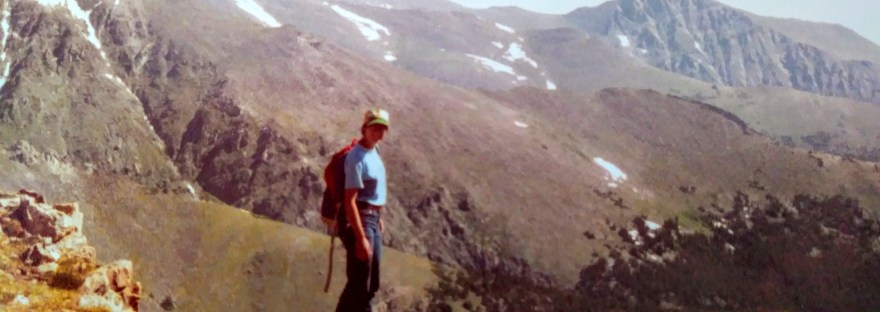
In an icy parking lot earlier this week, the footing was dicey, and, at one point, I blurted out to no one in particular, “Trust your boots girl!”  This adage bubbled up from a deeply-etched memory of a time in high school when a group of gals was climbing Mount Meeker in the front range of Rocky Mountain National Park.  At 13,911 feet, it’s the closest I’ve ever come to peaking a fourteener.  At one point along that climb, there was a steep portion, prompting one member of our group to happily call out,

“Trust your boots girls!”

While at Colorado State University, I reveled in backcountry cross-country skiing. I took a 2-day lesson the first time, and the instructor emphasized the need to trust your skis so that you could flow with them as they glided.  Just before moving back to the Midwest for grad school, I purchased a set of used skis and boots from the ski rental store. The next snow, I waxed them up to go skiing. I could not ski! My left foot kept sliding sideways, and the ski itself seemed to awkwardly tilt my boot so I had no traction or control. My husband-to-be laughed at my claims of being an experienced skier. We soon discovered that the store in Fort Collins had sold me skis with two right-footed bindings. Trust your boots indeed.

When learning to kayak in Wales, we practiced rolling in an indoor pool. Despite heroic attempts, I never did master a tip and roll.  The instructor’s advice to trust your skill in the whitewater rapids didn’t sit well with me. I knew if I capsized, I’d be permanently upside-down knocking my head on submerged rocks.  Having once before been pinned under a turtled boat (see blog post Unbounded Joy, 7-31-18), a healthy respect for the water had evolved into an irrational fear of drowning.

It is just common sense to be fully prepared for a wilderness adventure-to have the right equipment and skill set to see you through to a happy conclusion.

When paddling or hiking, you have to trust your instincts, your experience, your companions, and your preparations. It is folly to be unprepared.

Still, you can never be prepared for everything. Accidents happen with no warning. Wind and weather are fickle. Forests catch fire, and rivers and canyons can swiftly flood. What can you trust when the world turns inside out, when trickles of doubt mushroom into cascades of fear for your safety, even for your life?

Proverbs teaches that trust is an outcome of wisdom, and that wisdom, in turn, is the principal heir of a healthy fear of God.

This is not the kind of fear that makes us dread God’s judgment, but, rather, the kind that sees beauty in creation and is wowed by the God who made it. Not fright but reverence. *

It seems to me we prepare for our trip through the wilderness of this world- on this side of the river- much better than we prepare to face a holy God, misplacing our sense of security by trusting in things, jobs, money, ‘safe’ cars, our own thinking. When my husband was in the ER a few years ago with multiple and deadly pulmonary emboli in both lungs, we did trust that the surgeon would do his best to keep death at bay. Still, our ability to remain calm and hopeful (it was surreal to be honest) came from a stronger, deeper, surer Source. From God himself, whom we love, fear, and deeply trust to make the path through the wilderness straight.

I hope you can spend a little down time this winter working out in what, or whom you place your trust. Life is fragile at best, and downright slippery at its worst.

~J.A.P. Walton

* for more on the wisdom of Proverbs, see God’s Wisdom for Navigating Life by Tim and Kathy Keller. 2017.

adventure, Affirmation, Birds, Creation, Creator, Faithful Living, Forest, God, Hardiness, joy, Lessons from the Wilderness, Life's Storms, Nature, Peace, Perseverence, Praise, Prayer, Sigurd Olson, Silence, Uncategorized, virtue, wilderness, Winter

Bring on the Ice!

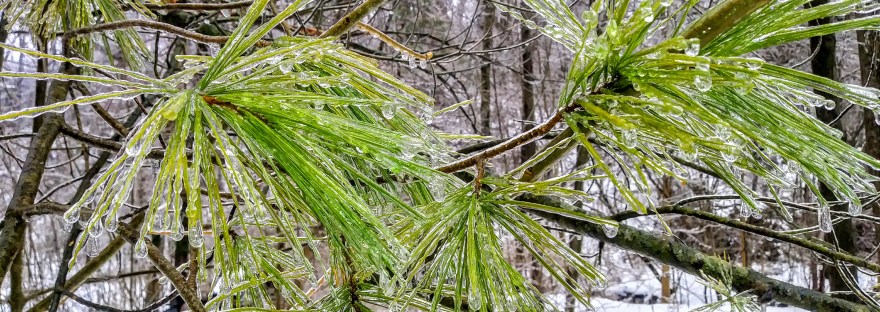
It is icy at Trout Creek this February morning from the overnight sleety rain suspended in millions of icicles off branches and eves. I have the window open a crack to soak in the music of the silence.  The creek riffles on, but the rest of the landscape is a still life, no deer, and no squirrels. Perhaps it is too early yet. Perhaps they ‘ve hit their own version of the snooze alarm, and are rolled over in their roosting cavities for another 10 minutes.

I go make coffee, and sit back down to marvel at the way nature stills itself. The trees have nothing to say, though they are adorned in crystal gowns just waiting for the dance to begin. The tall grasses are bent in prayer. You can feel the hush, as if you are in a great, empty cathedral. The silence is pregnant with expectancy.

Just then the bold, brassy wren who habits the tamarack tree chirrups his, “I’m here, I’m here, I’m heeeerrrre!”

Over and over  he chants his solo, as if inviting the world to join the chorus. Maybe he’s shouting, “Wake up, wake up, wake uuuupppp!”

The wren’s chatter works: the squirrels are carefully heading downtree.  The titmice family swoops in to the feeder for brunch. The deer are out there pawing the snow in the fallen maple’s atrium to belly down for a morning nap.

In his book, The Singing Wilderness,  Sigurd Olson writes about the winter blue jay, with its “brazen call, more of a challenge than a song, a challenge to the storm and cold.

There was a jauntiness and fortitude, announcing to me and to the whole frozen world that where there is wine and sparkle in the air, it is joy to be alive. I liked that jay and what he stood for; no softness there, pure hardiness and disregard of the elements.”

I think that’s how I want to embrace this cold, frozen world we live in. With a cheerful fortitude and strength of character that encourages people to wake up from their numbing technology, their frozen minds, their careless thoughts, their selfish motives. To embrace the joy that life brings, whether it be storm or stillness.  I want to be hardier, and heartier in the face of both challenge and delight. Perhaps, though, a bit less brazen than the wren or jay, with a meekness learned from saints, and a thankfulness wrought by God’s great mercies.

Bring on the ice! (May it give us pause).

~J.A.P. Walton

Adventure Tourism, Birds, Creation, Creator, Faithful Living, God, Nature, Praise, Risk Taking, Uncategorized, wisdom, worry

My Favorite Lesson

I am watching the birds at Trout Creek today, the outdoors swathed in snow mantle, the wind chill temps blisteringly cold.  After our month-long absence, we found the birds waiting in the wings of the Norway spruce for “their” feeder to be refilled, and the water bath topped off.

It was blizzarding out, lacy snow swirling in a blinding, biting wind.

The intrepid titmouse was at the feeder immediately, running laps from there to the gutter to hammer open his seeds, and find a crack to hide them. The red-bellied woodpecker was not far behind, carelessly scattering seed for which the ground-hugging juncos were thankful. All afternoon they came, the hapless chickadees, bold cardinals, upside down nuthatches, purple and house finches, and downy woodpeckers. This morning, a finch parked itself on the feeder as I worked at my desk through a month’s worth of mail. Though birds’ feet can withstand the cold quite well, it was a happy sight to watch the finch balance on one foot with the other tucked up into her fluffed up feathers. Every so often, she switched feet.

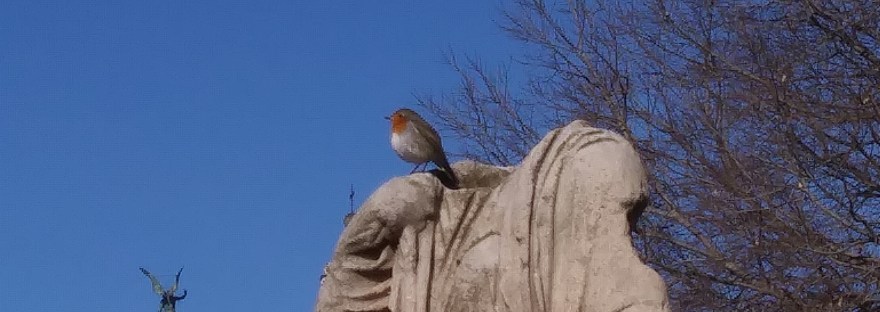
While strolling through the ruins of the Roman Forum earlier this month, I sat for a time to rest and imagine the people who once lived in that grand, impressive place. In the Temple of the Virgins, statues of twelve virtuous ladies line the walk, but only one still has her stone head. On the headless statue in front of me, a small sparrow-sized bird landed, and began to drink out of the water bowled in the lady’s neck.  Next, this bird, a red-breasted flycatcher common to southern Europe, jumped into that pooled water for a bath. I doubt the sculptor could have imagined his beautiful work serving as a bird bath!

Also in Rome, while watching the filthy Tiber River flow by, I observed a pigeon-a fat one at that- limping along on stumped legs; the bird had no feet.  Still, it had adapted quite marvelously, and didn’t even seem to know or care that it was footless.

Jesus taught that

God cares for even the lowliest of sparrows, and that we should never worry about our lives, because He loves us even more.

It is why I like to watch the birds, knowing that while they neither reap nor sow, they are still known by their Creator. While we are busy flitting from thing to thing, worrying the bones of life like a determined dog, God sees us. Knows us. Knows our needs better than we do. Cares for us. Loves us. Provides for us. Hears us.

The birds teach me that. It’s my favorite subject in the school of nature.