Affirmation, Blessings, Creation, Creator, Cycling, Faithful Living, God, Hardiness, Hope, Life's Storms, Mountains, Perseverence, Pilgrimage, Risk Taking, Uncategorized, virtue, wilderness, wisdom

Test Your Mettle

Lately, I have been thinking about the notion of testing one’s mettle.  It’s an old-fashioned way of explaining resiliency, the capacity to soldier on through tough times, and drawn-out challenges. I think the key concept is that we grow in character by stepping out of our comfort zones, and enduring hard experiences. This happens to us as an individual, and to “we” as a community.

We test our own individual mettle to see if we have the courage, tenacity, and inner strength to climb the mountains in our way.

This is jarring, because our world is oriented towards personal comfort, faux strength, and instant gratification. And, because testing oneself is so disorienting, we rarely welcome a chance to see what we’re made of.

First, we don’t want to appear as if we’ve stumbled, splayed out publicly in our weakness, hurt, disbelief, and despair. We often fail to test ourselves because we are too busy acting as if we don’t need to.  Second, such testing is uncomfortable. 

We lay ourselves bare for the blacksmith’s hammering, a tempering that flattens and smashes our beliefs and suppositions on its way to forging strength and stamina.

Third, we are afraid of failing the test, of running the gauntlet only to find ourselves worse off than when we started.  When has your life been at a place of testing?  What was your response?

As a timid kid with little self-confidence, my first tests were all physically-difficult enterprises that pushed my fragile mental and emotional stability to-and beyond- their limits.  Climbing a 13,000 foot mountain while hampered by asthma and anemia was beyond difficult, always served up with a mental side dish of “I can’t do this.” But I did.

Taking a graduate biochemistry course without having the undergraduate requisite of general and organic chem was insanely challenging, my mind constantly gnawed with “I can’t do this.”  But I did.

Biking long distances, when the legs were dead, the seat numb, the fatigue’s lie of “I simply can’t go another mile” an unwelcome inner whine. But I could, and I did.

When we could not have more children, the emotional ache was unbearable. When confronted with “you can’t have kids” I finished my doctorate and taught for 20 years. I had thousands of wonderful kids over time.

Fortitude is an odd virtue. It digs deep, finds strength we didn’t know we had, keeps us moving forward, upward, and outward.  It is gas on the fire when our tank is empty. It is a second wind.  Each time we overcome some unpleasant or challenging circumstance, we carve another notch of confidence in our belt. But, I say fortitude is odd because for people who know and trust God, the real story is not in our own strength and endurance and ability, but in our weakness, our exhaustion, and our inability. All of creation glorifies the Creator.  When we manage to do something we thought impossible, and credit ourselves with fortitude, we take credit for something God did in and through us, trying on God’s glory for size.

We are fallen and always falling. The strength to stand is not our own. Nor is the strength to endure. Those who trust in God know this secret: we don’t have to survive these things alone in our own strength.

God will test your mettle. He will allow some uncomfortable, disorienting, heart-rending chapters to be written in your life. How you respond is up to you. Just know, you don’t have to go it alone.

~J.A.P. Walton

adventure, Affirmation, Cancer, canoeing, Creator, death, God, Hardiness, Hope, Life's Storms, Outdoor Adventures, Peace, Perseverence, Prayer, Religion, Risk Taking, Sea Canoe, Uncategorized, Water, wilderness

All Things ARE Possible with God

At the recent Quiet Water Symposium, QWS  we were thrilled when Hugh was recognized with the Verlen Kruger Award for his years of encouraging others to take up their paddles, and for his ongoing volunteer work on water quality issues in his county. In the nominator’s words, “Hugh believes in the power of water to challenge, teach, and heal.”

At the event, one of Verlen’s original Sea Wind canoes was on display, with the ever present Scripture, “ All things are possible with God,” Verlen’s favorite verse from the Bible.[1]

When you launch out into the current of life with God, anything, even all things are possible right there in the middle of your life, your sickness, your challenges, even your death-God prevails.

Verlen took his faith across 100,000 miles of paddling not just in Michigan, but from the Arctic Circle to Cape Horn, up the Colorado River through the Grand Canyon, from Montreal to the Bering Sea, and many more. He was an inspiration in vision, perseverance, courage and faith. And he was humble enough to admit his mistakes. For more about Verlen, click here

In receiving the award, Hugh spoke about having to move home to Michigan after his leukemia diagnosis, and his desire to fully explore the Great Lakes by canoe. To do so, especially given his illness, he would need a canoe that could take on “big water.” Verlen’s sea-tested design was reputed to be the toughest canoe ever made. In 1999, Hugh visited Verlen and ordered what would become Sea Wind #125.

When the canoe was ready, Mark went with Hugh to pick it up and meet Verlen, who consulted with them about their upcoming trip to the Apostle Islands. When Verlen found out that Mark was taking a family canoe, he insisted that they take one of his old Sea Winds.  When Mark returned the borrowed canoe, he immediately ordered his own Sea Wind. That was the beginning of the Walton brothers’ Kruger Expeditions, and a blossoming friendship with the man behind these boats.

What neither of them knew was that Verlen himself was living with cancer at the time.  Shortly before he died in 2004, he told his biographer, “I’ll fight this thing as long as I’m able, but if God wants me now, I’m ready.”[2]

Hugh had the same philosophy over the ten years of treatments he endured before the curative bone marrow transplant. In those years, he paddled in spite of the fatigue, in spite of the drug-induced flu-like symptoms, and in the face of long odds.  A day didn’t pass that he wasn’t grateful for life, and for the opportunity to paddle with his brother, unwavering in his own belief that all things are possible with God.

~J.A.P. Walton

[1]See accompanying photo of the bow of Sea Wind #3

[2]Phil Peterson. All Things are Possible:  The Verlen Kruger Story. 2006. p.284.

adventure, Affirmation, Birds, Creation, Creator, Faithful Living, Forest, God, Hardiness, joy, Lessons from the Wilderness, Life's Storms, Nature, Peace, Perseverence, Praise, Prayer, Sigurd Olson, Silence, Uncategorized, virtue, wilderness, Winter

Bring on the Ice!

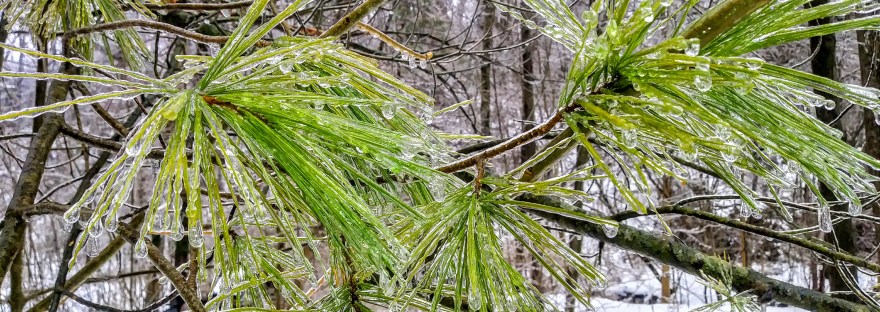
It is icy at Trout Creek this February morning from the overnight sleety rain suspended in millions of icicles off branches and eves. I have the window open a crack to soak in the music of the silence.  The creek riffles on, but the rest of the landscape is a still life, no deer, and no squirrels. Perhaps it is too early yet. Perhaps they ‘ve hit their own version of the snooze alarm, and are rolled over in their roosting cavities for another 10 minutes.

I go make coffee, and sit back down to marvel at the way nature stills itself. The trees have nothing to say, though they are adorned in crystal gowns just waiting for the dance to begin. The tall grasses are bent in prayer. You can feel the hush, as if you are in a great, empty cathedral. The silence is pregnant with expectancy.

Just then the bold, brassy wren who habits the tamarack tree chirrups his, “I’m here, I’m here, I’m heeeerrrre!”

Over and over  he chants his solo, as if inviting the world to join the chorus. Maybe he’s shouting, “Wake up, wake up, wake uuuupppp!”

The wren’s chatter works: the squirrels are carefully heading downtree.  The titmice family swoops in to the feeder for brunch. The deer are out there pawing the snow in the fallen maple’s atrium to belly down for a morning nap.

In his book, The Singing Wilderness,  Sigurd Olson writes about the winter blue jay, with its “brazen call, more of a challenge than a song, a challenge to the storm and cold.

There was a jauntiness and fortitude, announcing to me and to the whole frozen world that where there is wine and sparkle in the air, it is joy to be alive. I liked that jay and what he stood for; no softness there, pure hardiness and disregard of the elements.”

I think that’s how I want to embrace this cold, frozen world we live in. With a cheerful fortitude and strength of character that encourages people to wake up from their numbing technology, their frozen minds, their careless thoughts, their selfish motives. To embrace the joy that life brings, whether it be storm or stillness.  I want to be hardier, and heartier in the face of both challenge and delight. Perhaps, though, a bit less brazen than the wren or jay, with a meekness learned from saints, and a thankfulness wrought by God’s great mercies.

Bring on the ice! (May it give us pause).

~J.A.P. Walton

adventure, Affirmation, Cancer, canoeing, Creation, Creator, Darkness, death, God, Henry David Thoreau, Hope, Lessons from the Wilderness, Life's Storms, Nature, Peace, Perseverence, Praise, Ralph Waldo Emerson, Religion, Silence, Transcendentalism, Uncategorized, wilderness, Wilderness Paddling

The Ecstasy in Being Brave

I have been reading about transcendent philosophy espoused by the likes of Emerson and Thoreau. Its main tenets are that man and (N)ature are inherently good, emphasizing the prime importance of the individual and individual freedom, as well as oneness with the universe. At its most basic, the idea teaches that there is a power deep inside of us that, when we tap it, allows us to become one with what we see, whether it’s a mountain, a constellation, a river, a sunset, a storm, or an animal.  It teaches that we have a light inside us that banishes darkness, leading us to know Truth, wisdom, and goodness. And, when all of this aligns within us, a deep delight, a visceral ecstasy-or transcendence-results.

As a student of the Bible, and the God who wrote it, it is disturbing to me that many of these transcendentalist ideas are woven into the weft and warp of the minds of people who seek out the wilderness. Why?  Because it gets everything horribly backwards.  I will let a simple chart do the talking:

Bible Transcendentalism
Sin is real, both in people and Nature All people and Nature are inherently good
God is light and Truth Each person is his own source of light & Truth
Worship of anything other than God is idolatry Nature and beauty should be worshiped
Knowing God brings delight Delight is a direct result of knowing myself
God is the only and the great, holy I AM I am God, my own deity and salvation

Still, to believe what the Bible says about all of this, you first have to believe in the reality of sin and evil in this world, and, more directly, in your own heart.

People who don’t know the God of the Bible don’t accept that we live in the tension between God’s goodness and the evil he has allowed.

They only want a loving God. They only want the light, the happiness, and the good things of God. But, for humans to have perfect freedom to choose how they live and what they believe, there has to be a choice. Life or death. Light or darkness.  Goodness or evil.  It is no wonder that these people cannot fathom how something so evil as the attack on the World Trade Center could happen in this day and age. People who know God, and understand that most of the world has chosen to reject him think, how could it not?

When Hugh got cancer we were all devastated. Sickness has a way of letting big questions scream at us. Why would God allow this suffering, especially for someone as good as Hugh? But our goodness is irrelevant –and irreverent- in the face of a holy, just, and good God. Sickness is just part of what it means to be human. So is death.  Mark and Hugh had been paddling together long before the leukemia showed up. They kept paddling during ten long years of treatments. Why?  What did the wilderness have to offer in dark and confusing times? It offered the chance to leave the distractions and torments behind: the doctor visits and hospital stays, the long, long road to an outcome that no one could predict, the fear, the hopeless feelings- all of it dropped out of sight the minute the two brothers stepped into their canoes.

We can go to Nature to be wowed. We can go to get away from the world’s brokenness. We can go to seek out the quiet places where God’s voice can be heard, where there are “moments when [we] can sense Him near [us], and [we] can never quite believe it.

He never condemns, He just sustains. He doesn’t judge, He understands. He gives [us] hope again, and says be brave.”[1]

The Walton brothers went out, not to find themselves, not to be their own light, not to become one with Nature, but to bathe in the balm of the unsullied wilderness, perfect in its minute and grand designs, just as God created it.

They went in brotherliness, to be bolstered with strength enough to be brave together in the dark shadow of Hugh’s illness.

They never went to attain ecstasy through oneness with a brilliant sunset. It was to know and treasure that they were one with the very God who made that sunset, knowing that they were loved, held and nurtured in spite of the specter of illness and death. If that’s not ecstasy, what is?

~J.A.P.Walton

[1]Bear Grylls.Facing the Frozen Ocean. Pan Books, UK.2013 (digital edition). p.105.

adventure, Blessings, Creation, Creator, Desert, Faithful Living, God, Henri Nouwen, hiking, Lessons from the Wilderness, Nature, Outdoor Adventures, Perseverence, River, Silence, Uncategorized, wilderness, Zion National Park

Always Worth the Climb

Let me tell you about a day I spent alone in Zion National Park last month.  My husband and brother-in-law set off at 7:30 a.m. to hike the Narrows, the most popular hike in the park.  The Narrows is a train of steep, high canyon walls along the Virgin River, and the only “trail” is upstream through the river itself.  The fellows wanted to hike a minimum of 6 hours upstream, then back in knee-deep water hiding infinite ankle-twisting hazards. Not wanting to go that far, nor get my feet wet (or my ankle broken a 2nd time), I opted for the more moderate 3-mile hike on the Watchman trail, followed by an hour in the museum, an afternoon nap in the shade of a giant oak at the lodge, topped off with a cappuccino from the coffee cart.  Not exactly “wilderness” but delightful nonetheless.

The Watchman is an uphill trail along a dusty, rocky path of switchbacks and ledges on the south and west sides of the east-side canyon wall.  In the early morning, when I hiked, it is gracefully shady and cool, and much less crowded with hikers (Zion N.P. has 5 million visitors per year, so it’s not a place to seek out wilderness per se).  The trail begins at the Virgin River and rises about 600 feet to a football field-sized outcrop with a 270-degree view of the park. I found myself thinking about the men of the Civilian Conservation Corps (CCC) who built this trail in 1934.  CCC  Who were they? Could they conceive of the millions of people who would hike here for the next 100 years?

Toting 64 oz. of water, two granola bars, an apple, a hiking hat, my camera, and hiking poles, I set off alone, thinking of the distinctions Henri Nouwen makes between loneliness and solitude. It can feel lonely hiking alone in such a beautiful, magnificent place because there is no friend or lover to share the experience.  But, Nouwen insists that solitude does not depend on outer circumstance, rather an inner orientation of solitary rest that underpins our spiritual health.[1]   I did feel lonely at times, but it was also an inspiring, uplifting, strangely restful day in the canyon.  Besides, I made a few friends along the way.

I had silly conversations with a chatty canyon wren that was flitting gaily amongst the juniper and prickly pear.

I spent 10 minutes studying a green lizard near a wet patch of seep, and kept busy sweeping the heights with binoculars in search of peregrine falcon and California condor.  I saw mule deer with their laughably large, light-filtering, body-cooling ears.  I kept watch for the western rattlesnake.  (Since I am easily startled, I like animals and people who make noise to announce their presence).

Still, it was already pushing 80 degrees, this was an upwards hike, and because I am prone to acute altitude sickness, I had to rest often, yet keep going, albeit slowly, watching carefully where I put my feet, and leaning -sometimes too heavily- on my trusty hiking poles.  About halfway up, some people approached coming down.  And I thought had started out early!  Then commenced the “dance” that occurs on narrow, gritty trails alongside high, dizzying ridges- no one ever wants the outside position, nor do you want to flatten your back along the canyon wall looking “craven” -as they’d say in Game of Thrones.  Onward and upward, through pinion pine, scrub oak, mosses and ferns doggedly rooted in the sandstone cracks and seeps until I was nearly level with the tree line. Here, the trail turned abruptly southward, still climbing toward a large plateau just made for walking, sitting, snacking, sunning, and thinking.  There were about 30 people already here, and more streaming in behind me, but I had the strange feeling that I had the place to myself.  That is the inner serenity that Nouwen speaks to, and that nature beckons us to immerse ourselves in.

The views are always the reward for hiking up.

True, I didn’t hike a Rocky Mountain 14er, but I was pleased with myself nonetheless.  With the binoculars, I could make out our old RV in the far parking lot, and the throngs of people at the Visitors Center.  To think this was all carved out by the Virgin River over time.

It made me wonder what God is carving out, ever so slowly in my life, and if the result is as beautiful as all this. And that unfolded another secret of solitude: it creates in us a deep, inner, carved-out space for the Spirit of God. Always worth the climb.

~J.A.P. Walton

[1]Henri J.M Nouwen.  Reaching Out: The Three Movements of the Spiritual Life.1966.