adventure, Affirmation, Cancer, canoeing, Creator, death, God, Hardiness, Hope, Life's Storms, Outdoor Adventures, Peace, Perseverence, Prayer, Religion, Risk Taking, Sea Canoe, Uncategorized, Water, wilderness

All Things ARE Possible with God

At the recent Quiet Water Symposium, QWS  we were thrilled when Hugh was recognized with the Verlen Kruger Award for his years of encouraging others to take up their paddles, and for his ongoing volunteer work on water quality issues in his county. In the nominator’s words, “Hugh believes in the power of water to challenge, teach, and heal.”

At the event, one of Verlen’s original Sea Wind canoes was on display, with the ever present Scripture, “ All things are possible with God,” Verlen’s favorite verse from the Bible.[1]

When you launch out into the current of life with God, anything, even all things are possible right there in the middle of your life, your sickness, your challenges, even your death-God prevails.

Verlen took his faith across 100,000 miles of paddling not just in Michigan, but from the Arctic Circle to Cape Horn, up the Colorado River through the Grand Canyon, from Montreal to the Bering Sea, and many more. He was an inspiration in vision, perseverance, courage and faith. And he was humble enough to admit his mistakes. For more about Verlen, click here

In receiving the award, Hugh spoke about having to move home to Michigan after his leukemia diagnosis, and his desire to fully explore the Great Lakes by canoe. To do so, especially given his illness, he would need a canoe that could take on “big water.” Verlen’s sea-tested design was reputed to be the toughest canoe ever made. In 1999, Hugh visited Verlen and ordered what would become Sea Wind #125.

When the canoe was ready, Mark went with Hugh to pick it up and meet Verlen, who consulted with them about their upcoming trip to the Apostle Islands. When Verlen found out that Mark was taking a family canoe, he insisted that they take one of his old Sea Winds.  When Mark returned the borrowed canoe, he immediately ordered his own Sea Wind. That was the beginning of the Walton brothers’ Kruger Expeditions, and a blossoming friendship with the man behind these boats.

What neither of them knew was that Verlen himself was living with cancer at the time.  Shortly before he died in 2004, he told his biographer, “I’ll fight this thing as long as I’m able, but if God wants me now, I’m ready.”[2]

Hugh had the same philosophy over the ten years of treatments he endured before the curative bone marrow transplant. In those years, he paddled in spite of the fatigue, in spite of the drug-induced flu-like symptoms, and in the face of long odds.  A day didn’t pass that he wasn’t grateful for life, and for the opportunity to paddle with his brother, unwavering in his own belief that all things are possible with God.

~J.A.P. Walton

[1]See accompanying photo of the bow of Sea Wind #3

[2]Phil Peterson. All Things are Possible:  The Verlen Kruger Story. 2006. p.284.
adventure, Creation, Creator, death, Faithful Living, God, hiking, Lessons from the Wilderness, Life's Storms, Mountains, Nature, Outdoor Adventures, River, Rocky Mountain National Park, Uncategorized, wilderness, wisdom

Trust Your Boots Girls!

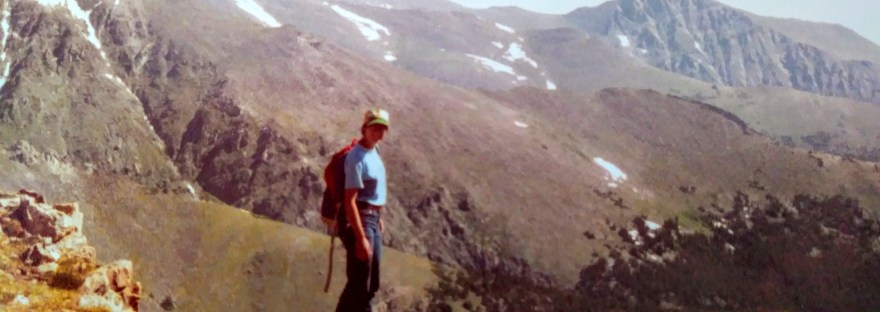
In an icy parking lot earlier this week, the footing was dicey, and, at one point, I blurted out to no one in particular, “Trust your boots girl!”  This adage bubbled up from a deeply-etched memory of a time in high school when a group of gals was climbing Mount Meeker in the front range of Rocky Mountain National Park.  At 13,911 feet, it’s the closest I’ve ever come to peaking a fourteener.  At one point along that climb, there was a steep portion, prompting one member of our group to happily call out,

“Trust your boots girls!”

While at Colorado State University, I reveled in backcountry cross-country skiing. I took a 2-day lesson the first time, and the instructor emphasized the need to trust your skis so that you could flow with them as they glided.  Just before moving back to the Midwest for grad school, I purchased a set of used skis and boots from the ski rental store. The next snow, I waxed them up to go skiing. I could not ski! My left foot kept sliding sideways, and the ski itself seemed to awkwardly tilt my boot so I had no traction or control. My husband-to-be laughed at my claims of being an experienced skier. We soon discovered that the store in Fort Collins had sold me skis with two right-footed bindings. Trust your boots indeed.

When learning to kayak in Wales, we practiced rolling in an indoor pool. Despite heroic attempts, I never did master a tip and roll.  The instructor’s advice to trust your skill in the whitewater rapids didn’t sit well with me. I knew if I capsized, I’d be permanently upside-down knocking my head on submerged rocks.  Having once before been pinned under a turtled boat (see blog post Unbounded Joy, 7-31-18), a healthy respect for the water had evolved into an irrational fear of drowning.

It is just common sense to be fully prepared for a wilderness adventure-to have the right equipment and skill set to see you through to a happy conclusion.

When paddling or hiking, you have to trust your instincts, your experience, your companions, and your preparations. It is folly to be unprepared.

Still, you can never be prepared for everything. Accidents happen with no warning. Wind and weather are fickle. Forests catch fire, and rivers and canyons can swiftly flood. What can you trust when the world turns inside out, when trickles of doubt mushroom into cascades of fear for your safety, even for your life?

Proverbs teaches that trust is an outcome of wisdom, and that wisdom, in turn, is the principal heir of a healthy fear of God.

This is not the kind of fear that makes us dread God’s judgment, but, rather, the kind that sees beauty in creation and is wowed by the God who made it. Not fright but reverence. *

It seems to me we prepare for our trip through the wilderness of this world- on this side of the river- much better than we prepare to face a holy God, misplacing our sense of security by trusting in things, jobs, money, ‘safe’ cars, our own thinking. When my husband was in the ER a few years ago with multiple and deadly pulmonary emboli in both lungs, we did trust that the surgeon would do his best to keep death at bay. Still, our ability to remain calm and hopeful (it was surreal to be honest) came from a stronger, deeper, surer Source. From God himself, whom we love, fear, and deeply trust to make the path through the wilderness straight.

I hope you can spend a little down time this winter working out in what, or whom you place your trust. Life is fragile at best, and downright slippery at its worst.

~J.A.P. Walton

* for more on the wisdom of Proverbs, see God’s Wisdom for Navigating Life by Tim and Kathy Keller. 2017.

adventure, Affirmation, Birds, Creation, Creator, Faithful Living, Forest, God, Hardiness, joy, Lessons from the Wilderness, Life's Storms, Nature, Peace, Perseverence, Praise, Prayer, Sigurd Olson, Silence, Uncategorized, virtue, wilderness, Winter

Bring on the Ice!

It is icy at Trout Creek this February morning from the overnight sleety rain suspended in millions of icicles off branches and eves. I have the window open a crack to soak in the music of the silence.  The creek riffles on, but the rest of the landscape is a still life, no deer, and no squirrels. Perhaps it is too early yet. Perhaps they ‘ve hit their own version of the snooze alarm, and are rolled over in their roosting cavities for another 10 minutes.

I go make coffee, and sit back down to marvel at the way nature stills itself. The trees have nothing to say, though they are adorned in crystal gowns just waiting for the dance to begin. The tall grasses are bent in prayer. You can feel the hush, as if you are in a great, empty cathedral. The silence is pregnant with expectancy.

Just then the bold, brassy wren who habits the tamarack tree chirrups his, “I’m here, I’m here, I’m heeeerrrre!”

Over and over  he chants his solo, as if inviting the world to join the chorus. Maybe he’s shouting, “Wake up, wake up, wake uuuupppp!”

The wren’s chatter works: the squirrels are carefully heading downtree.  The titmice family swoops in to the feeder for brunch. The deer are out there pawing the snow in the fallen maple’s atrium to belly down for a morning nap.

In his book, The Singing Wilderness,  Sigurd Olson writes about the winter blue jay, with its “brazen call, more of a challenge than a song, a challenge to the storm and cold.

There was a jauntiness and fortitude, announcing to me and to the whole frozen world that where there is wine and sparkle in the air, it is joy to be alive. I liked that jay and what he stood for; no softness there, pure hardiness and disregard of the elements.”

I think that’s how I want to embrace this cold, frozen world we live in. With a cheerful fortitude and strength of character that encourages people to wake up from their numbing technology, their frozen minds, their careless thoughts, their selfish motives. To embrace the joy that life brings, whether it be storm or stillness.  I want to be hardier, and heartier in the face of both challenge and delight. Perhaps, though, a bit less brazen than the wren or jay, with a meekness learned from saints, and a thankfulness wrought by God’s great mercies.

Bring on the ice! (May it give us pause).

~J.A.P. Walton

adventure, Affirmation, Cancer, canoeing, Creation, Creator, Darkness, death, God, Henry David Thoreau, Hope, Lessons from the Wilderness, Life's Storms, Nature, Peace, Perseverence, Praise, Ralph Waldo Emerson, Religion, Silence, Transcendentalism, Uncategorized, wilderness, Wilderness Paddling

The Ecstasy in Being Brave

I have been reading about transcendent philosophy espoused by the likes of Emerson and Thoreau. Its main tenets are that man and (N)ature are inherently good, emphasizing the prime importance of the individual and individual freedom, as well as oneness with the universe. At its most basic, the idea teaches that there is a power deep inside of us that, when we tap it, allows us to become one with what we see, whether it’s a mountain, a constellation, a river, a sunset, a storm, or an animal.  It teaches that we have a light inside us that banishes darkness, leading us to know Truth, wisdom, and goodness. And, when all of this aligns within us, a deep delight, a visceral ecstasy-or transcendence-results.

As a student of the Bible, and the God who wrote it, it is disturbing to me that many of these transcendentalist ideas are woven into the weft and warp of the minds of people who seek out the wilderness. Why?  Because it gets everything horribly backwards.  I will let a simple chart do the talking:

Bible Transcendentalism
Sin is real, both in people and Nature All people and Nature are inherently good
God is light and Truth Each person is his own source of light & Truth
Worship of anything other than God is idolatry Nature and beauty should be worshiped
Knowing God brings delight Delight is a direct result of knowing myself
God is the only and the great, holy I AM I am God, my own deity and salvation

Still, to believe what the Bible says about all of this, you first have to believe in the reality of sin and evil in this world, and, more directly, in your own heart.

People who don’t know the God of the Bible don’t accept that we live in the tension between God’s goodness and the evil he has allowed.

They only want a loving God. They only want the light, the happiness, and the good things of God. But, for humans to have perfect freedom to choose how they live and what they believe, there has to be a choice. Life or death. Light or darkness.  Goodness or evil.  It is no wonder that these people cannot fathom how something so evil as the attack on the World Trade Center could happen in this day and age. People who know God, and understand that most of the world has chosen to reject him think, how could it not?

When Hugh got cancer we were all devastated. Sickness has a way of letting big questions scream at us. Why would God allow this suffering, especially for someone as good as Hugh? But our goodness is irrelevant –and irreverent- in the face of a holy, just, and good God. Sickness is just part of what it means to be human. So is death.  Mark and Hugh had been paddling together long before the leukemia showed up. They kept paddling during ten long years of treatments. Why?  What did the wilderness have to offer in dark and confusing times? It offered the chance to leave the distractions and torments behind: the doctor visits and hospital stays, the long, long road to an outcome that no one could predict, the fear, the hopeless feelings- all of it dropped out of sight the minute the two brothers stepped into their canoes.

We can go to Nature to be wowed. We can go to get away from the world’s brokenness. We can go to seek out the quiet places where God’s voice can be heard, where there are “moments when [we] can sense Him near [us], and [we] can never quite believe it.

He never condemns, He just sustains. He doesn’t judge, He understands. He gives [us] hope again, and says be brave.”[1]

The Walton brothers went out, not to find themselves, not to be their own light, not to become one with Nature, but to bathe in the balm of the unsullied wilderness, perfect in its minute and grand designs, just as God created it.

They went in brotherliness, to be bolstered with strength enough to be brave together in the dark shadow of Hugh’s illness.

They never went to attain ecstasy through oneness with a brilliant sunset. It was to know and treasure that they were one with the very God who made that sunset, knowing that they were loved, held and nurtured in spite of the specter of illness and death. If that’s not ecstasy, what is?

~J.A.P.Walton

[1]Bear Grylls.Facing the Frozen Ocean. Pan Books, UK.2013 (digital edition). p.105.

adventure, canoeing, Creation, death, Faithful Living, Lessons from the Wilderness, Life's Storms, Outdoor Adventures, Peace, Perseverence, Ralph Waldo Emerson, River, Sacrifice, Travel, Uncategorized, Water, wilderness, Wilderness Paddling, wisdom

The Cosmic Indifference of the Wilderness

It takes months of planning for a paddling journey into the wilderness.  The Walton brothers toss around ideas, the maps come out, the routes, and access to them are studied, dates are penciled in, then, finally, train and campground reservations are made. In the month preceding any trip, my husband begins an internal transition from here to there as the necessary equipment comes out of storage to join the growing pile in our living room. Sleeping pad and bag. Cook stove. Dry bags. Bear bag. Throw bag. Cooler. Camp chair. Hammock. Swiss army knife. Food list. Boots. Water shoes. Dri-fit clothing. Camera. Tent and fly. Fishing pole. Hat. Rain gear. Maps. You get the idea.  Just now, Mark and Hugh and two more of their brothers are in the early phase of staging their September trip down the Colorado River through the Grand Canyon, a trip three years in the planning.

Why so much planning? The wilderness is, by necessity, wild and weathered, unsympathetic to the needs of a paddler. The wilds don’t care about your life or your death.

I call this the cosmic indifference of the wilderness.

Yes, the wilderness is untamed and unfettered. And all around, usually invisible in the  forest deeps, and the dark swirls of river and lake is the predatory character that drives all creatures to eat, shelter, reproduce and live – as good a description of survival that you can conjure. If you are going to test yourself against the elements of the wilderness – its fire, air, water, rock, flora, and fauna, then you better know what you are doing.

So, when wilderness paddling, you learn to be on the lookout for threats like underwater rocks or deadfall trees, swirling eddies, confused currents, high water, low water, storms, lightning, fires, bears, moose, and poison ivy, to name a few.

Daily life is actually not all that different. It goes merrily along like a calm, placid river, and, unawares, we become lulled into forgetting our creaturely vulnerability to hidden threats to our wellbeing:  sickness, accident, injury, infidelity, terror, poverty, and death. We can go from flourishing to foundering in an instant.  This was true for Hugh when his leukemia diagnosis came out of the blue, followed by the ten-year slog of treatments before a life-saving bone marrow transplant. You simply can’t plan for that.

Even with maps, you don’t always know where you are.

Food can’t satisfy your deepest hungers- for life to have meaning and purpose, to belong, and to be loved.

It’s true: all the planning in the world can’t prevent you from incurring harm in the vicissitudes of this life.  Just ask anyone who’s come within a bear’s breath of dying.

Still. We learn from the wilderness that there is a flip side to almost everything.

Beauty masks pain. Tenacity is a product of frailty. Love necessitates sacrifice. Suffering is never meaningless.   Meekness and tenderness makes for strength. The water can bear you up or take you down.

Time in the wilderness confirms the relationship between the sober realities of life and its loveliness, courage, and peace. The virtues are God-inspired, and there for us to cultivate if we would only abdicate our need to control.  Yes, life is fragile. But, our own can be enlarged, enriched, and emboldened if we embrace it in all its grit and grace. Yes, life is demanding. How will you traverse it? Emerson wrote that the dowry of the wilderness is precious to any who seek it.  When will you start planning to get out and go?

~J.A.P. Walton