Adventure Tourism, Birds, Creation, Creator, Faithful Living, God, Nature, Praise, Risk Taking, Uncategorized, wisdom, worry

My Favorite Lesson

I am watching the birds at Trout Creek today, the outdoors swathed in snow mantle, the wind chill temps blisteringly cold.  After our month-long absence, we found the birds waiting in the wings of the Norway spruce for “their” feeder to be refilled, and the water bath topped off.

It was blizzarding out, lacy snow swirling in a blinding, biting wind.

The intrepid titmouse was at the feeder immediately, running laps from there to the gutter to hammer open his seeds, and find a crack to hide them. The red-bellied woodpecker was not far behind, carelessly scattering seed for which the ground-hugging juncos were thankful. All afternoon they came, the hapless chickadees, bold cardinals, upside down nuthatches, purple and house finches, and downy woodpeckers. This morning, a finch parked itself on the feeder as I worked at my desk through a month’s worth of mail. Though birds’ feet can withstand the cold quite well, it was a happy sight to watch the finch balance on one foot with the other tucked up into her fluffed up feathers. Every so often, she switched feet.

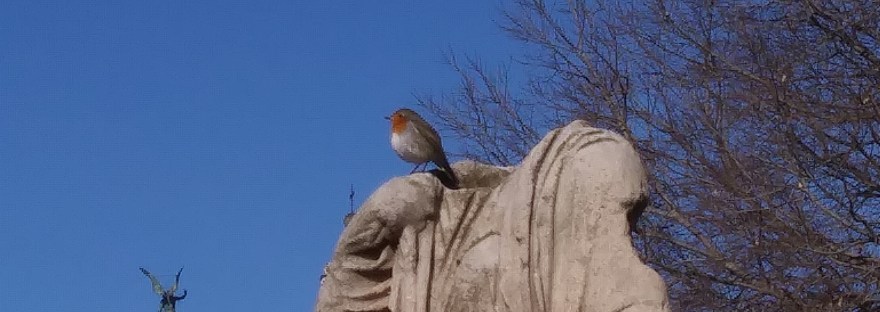
While strolling through the ruins of the Roman Forum earlier this month, I sat for a time to rest and imagine the people who once lived in that grand, impressive place. In the Temple of the Virgins, statues of twelve virtuous ladies line the walk, but only one still has her stone head. On the headless statue in front of me, a small sparrow-sized bird landed, and began to drink out of the water bowled in the lady’s neck.  Next, this bird, a red-breasted flycatcher common to southern Europe, jumped into that pooled water for a bath. I doubt the sculptor could have imagined his beautiful work serving as a bird bath!

Also in Rome, while watching the filthy Tiber River flow by, I observed a pigeon-a fat one at that- limping along on stumped legs; the bird had no feet.  Still, it had adapted quite marvelously, and didn’t even seem to know or care that it was footless.

Jesus taught that

God cares for even the lowliest of sparrows, and that we should never worry about our lives, because He loves us even more.

It is why I like to watch the birds, knowing that while they neither reap nor sow, they are still known by their Creator. While we are busy flitting from thing to thing, worrying the bones of life like a determined dog, God sees us. Knows us. Knows our needs better than we do. Cares for us. Loves us. Provides for us. Hears us.

The birds teach me that. It’s my favorite subject in the school of nature.
Affirmation, Creation, Creator, Darkness, Dying to Self, God, Heaven, Starry Skies, Uncategorized

When Mercy Begot Grace

It’s fair to say that I am a fan of what my writing workshop instructor cautiously termed “strong verbs,” (she didn’t like my writing, but wanted to say something encouraging).

Words can evoke a visceral response in the same way a simple whiff of (fill-in-the-blank) floods the mind with childhood memories… right now I am conjuring up the smell of crayons, peppermint Chiclets gum from the bank, of Fels-Naptha soap, and a cigar box of writhing, doomed earthworms waiting to bait some fat perch.

The words for this time of year are powerful too.  Darkness. Brokenness. Cold. Despair. Hope. Joy. Salvation.   These last three are worth dwelling on.

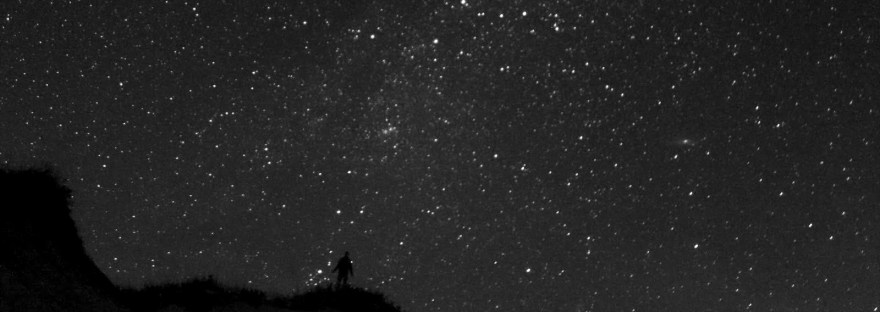
Last night we hunted the comet 46P/Wirtanen slowly cruising way out in the outer black void of space, tucked in a lane between Taurus and the Pleiades. It’s always a wonder to look upon something 7 million miles above and know what you’re seeing- in this case, a fuzzy, Christmas-green ball decorating the twinkling night sky. I love comets for their predictability and promise of return, knowing that people long dead and those not yet born have seen, or will see what I see.  Comets, like sunrises, and tidal ebbs and flows, and spring hounding the heels of winter make us hopeful that the world will go on.

Last night, the darkness could not hide the light of the moon, stars and comet. The cold could not penetrate the happy warmth of stargazing. The despairing news of the week could not harden a seeking heart set on hope and joy. Because, of course, it is the season we celebrate the best news of all. God come down from the heavens, heralded by a star to light the world with Wisdom that bids us seek the Lord while He can be found. It’s the same Light that split the silence and the temple curtain when mercy begot grace, and sacrifice rebirthed an inheritance long rejected. Like the crisp night sky of winter, it can fill you with wonder. Because He is called Wonderful. Everlasting. The Prince of Peace.

Wishing you and yours a Christmas of wonder, light, joy, peace, and the resurrection of the Word in your hearts.

~J.A.P. Walton

Photo credit: S. Zetterberg

adventure, Affirmation, Cancer, canoeing, Creation, Creator, Darkness, death, God, Henry David Thoreau, Hope, Lessons from the Wilderness, Life's Storms, Nature, Peace, Perseverence, Praise, Ralph Waldo Emerson, Religion, Silence, Transcendentalism, Uncategorized, wilderness, Wilderness Paddling

The Ecstasy in Being Brave

I have been reading about transcendent philosophy espoused by the likes of Emerson and Thoreau. Its main tenets are that man and (N)ature are inherently good, emphasizing the prime importance of the individual and individual freedom, as well as oneness with the universe. At its most basic, the idea teaches that there is a power deep inside of us that, when we tap it, allows us to become one with what we see, whether it’s a mountain, a constellation, a river, a sunset, a storm, or an animal.  It teaches that we have a light inside us that banishes darkness, leading us to know Truth, wisdom, and goodness. And, when all of this aligns within us, a deep delight, a visceral ecstasy-or transcendence-results.

As a student of the Bible, and the God who wrote it, it is disturbing to me that many of these transcendentalist ideas are woven into the weft and warp of the minds of people who seek out the wilderness. Why?  Because it gets everything horribly backwards.  I will let a simple chart do the talking:

Bible Transcendentalism
Sin is real, both in people and Nature All people and Nature are inherently good
God is light and Truth Each person is his own source of light & Truth
Worship of anything other than God is idolatry Nature and beauty should be worshiped
Knowing God brings delight Delight is a direct result of knowing myself
God is the only and the great, holy I AM I am God, my own deity and salvation

Still, to believe what the Bible says about all of this, you first have to believe in the reality of sin and evil in this world, and, more directly, in your own heart.

People who don’t know the God of the Bible don’t accept that we live in the tension between God’s goodness and the evil he has allowed.

They only want a loving God. They only want the light, the happiness, and the good things of God. But, for humans to have perfect freedom to choose how they live and what they believe, there has to be a choice. Life or death. Light or darkness.  Goodness or evil.  It is no wonder that these people cannot fathom how something so evil as the attack on the World Trade Center could happen in this day and age. People who know God, and understand that most of the world has chosen to reject him think, how could it not?

When Hugh got cancer we were all devastated. Sickness has a way of letting big questions scream at us. Why would God allow this suffering, especially for someone as good as Hugh? But our goodness is irrelevant –and irreverent- in the face of a holy, just, and good God. Sickness is just part of what it means to be human. So is death.  Mark and Hugh had been paddling together long before the leukemia showed up. They kept paddling during ten long years of treatments. Why?  What did the wilderness have to offer in dark and confusing times? It offered the chance to leave the distractions and torments behind: the doctor visits and hospital stays, the long, long road to an outcome that no one could predict, the fear, the hopeless feelings- all of it dropped out of sight the minute the two brothers stepped into their canoes.

We can go to Nature to be wowed. We can go to get away from the world’s brokenness. We can go to seek out the quiet places where God’s voice can be heard, where there are “moments when [we] can sense Him near [us], and [we] can never quite believe it.

He never condemns, He just sustains. He doesn’t judge, He understands. He gives [us] hope again, and says be brave.”[1]

The Walton brothers went out, not to find themselves, not to be their own light, not to become one with Nature, but to bathe in the balm of the unsullied wilderness, perfect in its minute and grand designs, just as God created it.

They went in brotherliness, to be bolstered with strength enough to be brave together in the dark shadow of Hugh’s illness.

They never went to attain ecstasy through oneness with a brilliant sunset. It was to know and treasure that they were one with the very God who made that sunset, knowing that they were loved, held and nurtured in spite of the specter of illness and death. If that’s not ecstasy, what is?

~J.A.P.Walton

[1]Bear Grylls.Facing the Frozen Ocean. Pan Books, UK.2013 (digital edition). p.105.

adventure, Blessings, Creation, Creator, Desert, Faithful Living, God, Henri Nouwen, hiking, Lessons from the Wilderness, Nature, Outdoor Adventures, Perseverence, River, Silence, Uncategorized, wilderness, Zion National Park

Always Worth the Climb

Let me tell you about a day I spent alone in Zion National Park last month.  My husband and brother-in-law set off at 7:30 a.m. to hike the Narrows, the most popular hike in the park.  The Narrows is a train of steep, high canyon walls along the Virgin River, and the only “trail” is upstream through the river itself.  The fellows wanted to hike a minimum of 6 hours upstream, then back in knee-deep water hiding infinite ankle-twisting hazards. Not wanting to go that far, nor get my feet wet (or my ankle broken a 2nd time), I opted for the more moderate 3-mile hike on the Watchman trail, followed by an hour in the museum, an afternoon nap in the shade of a giant oak at the lodge, topped off with a cappuccino from the coffee cart.  Not exactly “wilderness” but delightful nonetheless.

The Watchman is an uphill trail along a dusty, rocky path of switchbacks and ledges on the south and west sides of the east-side canyon wall.  In the early morning, when I hiked, it is gracefully shady and cool, and much less crowded with hikers (Zion N.P. has 5 million visitors per year, so it’s not a place to seek out wilderness per se).  The trail begins at the Virgin River and rises about 600 feet to a football field-sized outcrop with a 270-degree view of the park. I found myself thinking about the men of the Civilian Conservation Corps (CCC) who built this trail in 1934.  CCC  Who were they? Could they conceive of the millions of people who would hike here for the next 100 years?

Toting 64 oz. of water, two granola bars, an apple, a hiking hat, my camera, and hiking poles, I set off alone, thinking of the distinctions Henri Nouwen makes between loneliness and solitude. It can feel lonely hiking alone in such a beautiful, magnificent place because there is no friend or lover to share the experience.  But, Nouwen insists that solitude does not depend on outer circumstance, rather an inner orientation of solitary rest that underpins our spiritual health.[1]   I did feel lonely at times, but it was also an inspiring, uplifting, strangely restful day in the canyon.  Besides, I made a few friends along the way.

I had silly conversations with a chatty canyon wren that was flitting gaily amongst the juniper and prickly pear.

I spent 10 minutes studying a green lizard near a wet patch of seep, and kept busy sweeping the heights with binoculars in search of peregrine falcon and California condor.  I saw mule deer with their laughably large, light-filtering, body-cooling ears.  I kept watch for the western rattlesnake.  (Since I am easily startled, I like animals and people who make noise to announce their presence).

Still, it was already pushing 80 degrees, this was an upwards hike, and because I am prone to acute altitude sickness, I had to rest often, yet keep going, albeit slowly, watching carefully where I put my feet, and leaning -sometimes too heavily- on my trusty hiking poles.  About halfway up, some people approached coming down.  And I thought had started out early!  Then commenced the “dance” that occurs on narrow, gritty trails alongside high, dizzying ridges- no one ever wants the outside position, nor do you want to flatten your back along the canyon wall looking “craven” -as they’d say in Game of Thrones.  Onward and upward, through pinion pine, scrub oak, mosses and ferns doggedly rooted in the sandstone cracks and seeps until I was nearly level with the tree line. Here, the trail turned abruptly southward, still climbing toward a large plateau just made for walking, sitting, snacking, sunning, and thinking.  There were about 30 people already here, and more streaming in behind me, but I had the strange feeling that I had the place to myself.  That is the inner serenity that Nouwen speaks to, and that nature beckons us to immerse ourselves in.

The views are always the reward for hiking up.

True, I didn’t hike a Rocky Mountain 14er, but I was pleased with myself nonetheless.  With the binoculars, I could make out our old RV in the far parking lot, and the throngs of people at the Visitors Center.  To think this was all carved out by the Virgin River over time.

It made me wonder what God is carving out, ever so slowly in my life, and if the result is as beautiful as all this. And that unfolded another secret of solitude: it creates in us a deep, inner, carved-out space for the Spirit of God. Always worth the climb.

~J.A.P. Walton

[1]Henri J.M Nouwen.  Reaching Out: The Three Movements of the Spiritual Life.1966.

adventure, Adventure Tourism, Bryce Canyon National Park, Camping, Creation, Creator, Desert, God, hiking, Hope, Lessons from the Wilderness, Mountains, Nature, Outdoor Adventures, Praise, River, Starry Skies, Uncategorized, Water, wisdom, Zion National Park

Thin Air, Thick Dust, Beauty All Around

It is good to be home in Michigan after a 3-week spell in Arizona and Utah. Here, I can drink deep draughts of the autumnal palette of green, vermillion, orange and gold, reveling in this bounty of colors so much rarer in the western landscape.

Phoenix was particularly hot and dry where the greenish-yellow of the prickly pear and saguaro cacti stands in base-relief against the purple of distant mountains. Here, the only deep greens are on the golf course, watered with precious and dwindling flows from the Colorado River, and on the cell phone towers painted green to look like giant saguaros.

Climbing out of the desert into the high mesas to the north, the landscape changes in an instant. The cactus and sand give way to rock and bristlecone pine at the higher elevations. In appearance it seems an unforgiving landscape, but

the Hopi and Navajo have lived here for a thousand years, “thriving long in adverse conditions: poor soil, drought, temperature extremes, high winds.”*

Past the Grand Canyon and on into southern Utah, aspen join the autumn chorus, waving golden, glittering arms in gladness. Here, the weathered rock cathedrals tower, where sandstone is king, and sagebrush his queen as they reign over free-ranging cattle on a thousand hills. Here is the confluence of the Green and Colorado Rivers, those life-giving ribbons of water, home to the pronghorn antelope, nattering prairie dog, and swift peregrine falcon. Here, too, is Zion, a river-carved fortress of sheer honeyed walls, and Bryce, with its colorful hoodoo armies blown by winds like fine glass.( Zion National Park   and Bryce Canyon National Park )

It is an entirely different kind of wilderness than what we experience in northern Michigan and southern Ontario.  Here, damp, verdant, fertile. Out west, thin air thick with dust, where the only immediately visible abundance for hundreds of miles is rock. To be sure, both are beautiful in their own ways. Both point to an imaginative Creator, who paints with a bold and vibrant palette.  Both give us the same gifts that wilderness always gives: delight in its bigness, contentedness with our own smallness, hope that life and beauty abound wherever we find ourselves, and that

nothing on this earth is godforsaken at all.

~ J.A.P. Walton

* William Least Heat Moon. Blue Highways. Chapter 2.