beauty, Being resilient, Blessings, Campfire's glow, Campfires, Creation, Darkness, Faithful Living, Having hope about the future, how nature heals, joy, Lessons from the Wilderness, Light, Losing yourself in nature, Outervention, Sitting around the campfire, sunrise, the vicissitudes of life, Watching the campfire, When the sunrise lights the clouds

The Light from Under

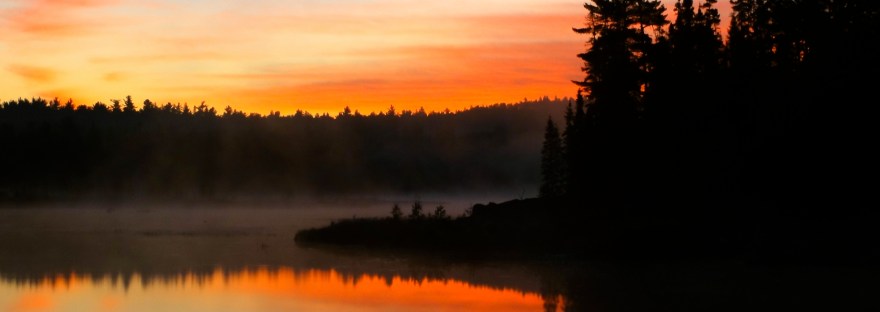
The sun rose above a cold and hushed forest this morning, making the high clouds blush with anticipation. To the east, the trees’ backdrop was all crimson and fire, while to the west the underbelly of the sky was lit in rosy pastels. A gull floated high above the bluff shaded as pink as a flamingo. The browsing doe’s brown winter coat was tinged a dusky magenta.

I have always enjoyed the effects of things being lit up from below. This is nowhere more observable than around a campfire on a very dark night. As people lean forward to warm their hands, their faces take on a softened shimmer, mesmerized by the flick and spark of the burning wood. We are used to turning our faces toward the sun to momentarily appreciate its balm and warmth, but a campfire’s burning coals smooth out wrinkles of anxiety, bathing the heart in calming thought like

a reflection within a reflection. 

Light from above leaves sharp shadows. Light from below melds with shadow to soften the outlines. Life is like that sometimes. An unanticipated threat looms suddenly, glaringly lit by a fearful realization: an unexpected bill we cannot pay, a pink slip at work, an unwelcome, gut-wrenching diagnosis. The light is coldly enlightening-there is trouble afoot, and the shadows are long and dark. 

Making a nighttime fire in the fireplace or the backyard fire pit brings a different perspective. The light softly cracks the darkness, the flames invite us to quell our panic, to murmur with the nattering coals into the warm light’s crevices – not to forget our troubles, but to see them in a light less stark. Illumined, yes. But without the anxious shadows, warming our souls in the fire’s rhythms of flare and ember. I’ve never seen a more beautiful face than one watching a campfire, meditatively strengthening with faith and resolve to face the shadows and overcome them.

________

Thanks for the time you take to read my wandering mind. After seeing today’s magnificent sunrise, I decided to try a writing exercise on why I adore the softening effects of under-lighting. It isn’t easy to describe!

J.A.P.Walton, Ph.D.

Feel free to comment here or send an email: jpraywalton.writing@gmail.com

adventure, Blessings, Campfires, Creation, Darkness, death, Faithful Living, Forest, Henry David Thoreau, hiking, Hope, Lessons from the Wilderness, Nature, Ralph Waldo Emerson, River, Trees, Uncategorized, Water, wilderness

Ashes to Ashes, Dust to Dust

We spent the past week at Tahquamenon Falls State Park in Michigan’s Upper Peninsula. This park is an emerald gem set between Lake Superior’s Whitefish Bay and the wide and placid Tahquamenon River. One day we hiked from the river’s lower falls about 5 miles up to the upper falls along a well-loved trail that follows the river, traversing low wet bogs, and high dry forested ridges of cedar, hemlock, and oak. Each step along the river’s edge had me looking into dark, calm pools that surely were teeming with brook trout-oh for my fishing pole! The late summer flowers were lush despite the season’s lack of rain, mostly yellow and orange as the late bloomers tend to be- black-eyed Susan, butter-and-eggs (a sore throat treatment in the old days), tall, spiky mullein, and the delicate jewelweed. We saw little wildlife, though the pileated woodpeckers laughed at us all along the trail.

Near the upper falls we came across a large hemlock about 10” in diameter with a sign that said a hemlock with a circumference the size of a soda can would be about 100 years old. Things grow slowly where the arctic winds and snows of Lake Superior have hammered at the terrain for thousands upon thousands of years.

Nature is not in a hurry it seems, and we have much to learn about the virtues of taking life more slowly.

All in all, this was a hopeful walk, the kind of hike Thoreau or Emerson would approve. In his treatise on nature, Emerson noted that a walk in the woods helps us become young again, where the “air is a cordial” and we find ourselves wrapped in an “uncontained and immortal beauty.” [1]  On this day, the trail, labeled by the park service as strenuous and challenging because it is crisscrossed by fingerlike tree roots, muddy and slick in places, was, for us, a delight, a hushed forest canvas caressed by the river, filled with beauty, harmony, grace, and peace.

Day’s end brought a leisurely campfire enjoyed in good company with mugfuls of hot tea. As always, there isn’t much to say as the fire pulls us in and rearranges our thoughts.

I thought about the wood, not unlike my own life, so many long, patient years in the making.

The wood roars to life in a last, bursting fling, sparks rising up in joyous mutiny as if they could escape a foregone conclusion: ashes to ashes, dust to dust.

We repeated these words recently as we committed my husband’s mom to her earthly grave. I can only hope that, at the end of my days, I might rise up and light the night in one last delighted burst of joy, willowy arms reaching for heaven just like flames that lick away the darkness-a supplication of praise and thanksgiving for my life and my rebirth.

~J.A.P. Walton

[1]Ralph Waldo Emerson. Nature.1836.

adventure, Campfires, Camping, Cancer, canoeing, Creation, Darkness, death, Faithful Living, God, Henry David Thoreau, Hope, Lessons from the Wilderness, Outdoor Adventures, Starry Skies, Uncategorized, wilderness, Wilderness Paddling, wisdom

The Brothers Gemini

The two Walton brothers have spent over thirty years paddling the rivers and lakes of the far north each autumn because of their shared love of wilderness, canoeing, and one another. They paddled as young men in the vibrant prime of their lives, and still do today as seasoned and much older men. Not even Hugh’s cancer could stop these adventuring brothers, who know more than most that both the wilderness and brotherly affection have healing hands. Hugh stayed positive throughout the ten long years of treatments, too busy living to entertain thoughts of dying. And in his deliberate living and adventuring, he taught his brother Mark about peace and hope.

It often happens that the sicker man is the nurse to the sounder.”[1]

A favorite time of day in the northern latitudes is the autumnal twilight when the sun has gone down early and it’s too cool for bugs. An earlier sunset means the brothers can sit around the campfire for a few hours before turning in. The washing up is done, the canoes are put to bed, and the bear bag has been secured high in a tree. Such evenings are steeped in the reflections of the lowering sun as it briefly teases the landscape and water into a blush, while the spruces’ silhouettes go from stark outline to murky drab until darkness cradles them into its bosom entirely. Eventually, the young fire that started up with spits and mutters matures into a sedate, radiating murmur of glowing and hypnotizing embers. The waters warble a sultry lullaby. A loon mournfully trills across the water. The night in the wilderness is never completely silent, rather orchestrated with a subtle harmony, and it becomes clear, with careful listening, that the small voice of God is out here in this deep indigo twilight. Slow evenings are a necessary part of the adventure, for it is at night that the body is restored. The same can be said for one’s soul.

It is easy, when far away from the nonstop noises and lights of our lifestyles, to look intently at every natural thing out in the wilds and feel thankful that the planet still has these unadulterated oases of space, timelessness, stillness, color, and open skies. This is flair. Art. It is creation, imagination, beauty and adornment. This is how God made the world, speaking it out word by word, adding extravagant flashes of color, texture, and music in the everyday life of the wilds. We miss seeing it and hearing it, and we misunderstand its importance in our daily lives. Fire, water, and the waking creatures of the night all make for a mesmerizing symphony, a bewitching tonic for what ails us.

The brothers aren’t big talkers at night; still they enjoy each other’s company in a curiously uncommunicative way, on a shared adventure among best friends at the end of a physically challenging day. And though the fire and melody draw them in, they stay up late-on clear nights at least-because of the stars. This is especially true when camped beside a remote lake, where trees and rocky ledges can’t obscure the sky. The starry lights emerge one by one as the darkness encroaches. And, aside from the fire, the darkness in the wilderness is complete, no rival light pollution out here. Venus, Jupiter, and the Big Dipper materialize. And though Orion won’t show up until November, they know he’s on his way, the able guardian of the night and comforting friend to those who pray through the night watches in winter. The dancers of the Pleiades begin their warm up. Somewhere out there in the low autumnal sky the sleepy moon pokes its head out from under the covers. Like Orion, felt but not yet visible in the northern hemisphere, the brothers Gemini stand tall, side by side, arms raised in triumph and praise. I like to imagine that the Walton fellows are the Gemini twins, arms around each other’s waists, holding their paddles aloft in victorious self-congratulation and a joy that cancer could not squelch.

~J.A.P. Walton

[1] Henry David Thoreau. A Week on the Concord and Merrimack Rivers, Viking Press, 1985. p. 31 (The author originally published this book in 1849, detailing an 1839 river trip with his beloved brother John, who died in 1842.) Read it here: A Week…Thoreau