adventure, Affirmation, beauty, canoeing, childhood, Creation, Faithful Living, God, John Muir, Kindred Spirits, Lessons from the Wilderness, Marriage, Nature, River, Silence, Uncategorized, Water, White Water Paddling, Wilderness Paddling, wisdom

Where Words are Unnecessary

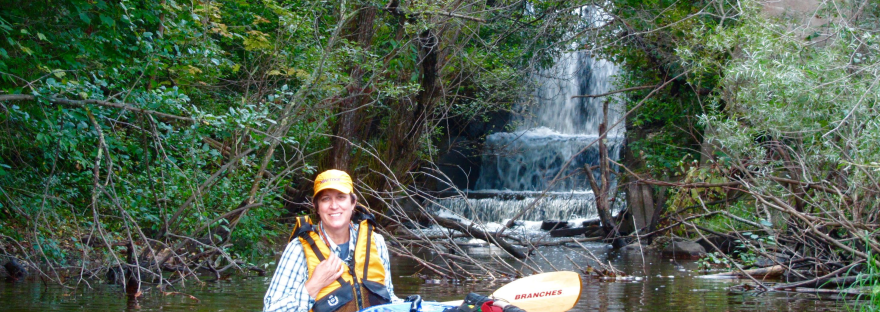
I must confess that I covet the times my husband and I paddle a river alone together. Being surrounded by boats, family, friends, and visitors, we are more often than not on the water in big groups.

He is a much stronger, abler paddler than I. He can read the currents and the wind in ways that let him slither downriver like a water snake-completely at home and at one with the boat. It is a marvel to watch him, when the edges of man, boat, and river blur into lovely moments of being in nature, rather than standing over it.

We met 57 years ago as children.  Now, the canoe and the wild river are symbols of our relationship. Stable and still in deep quiet water, swift and determined in the face of life’s challenges and submerged snags. We seek out the wilderness for our own restoration as individuals and as man and wife. We travel the rivers and lakes because this is how man has traveled the deep, dark forests for centuries, taking us where no road can go, no cell phone can reach. We go quietly. Reverently. Following the world’s first paddlers past rocks and pines, scrub oaks and scarred outcroppings, shallow sandbars and towering eagles’ roosts.

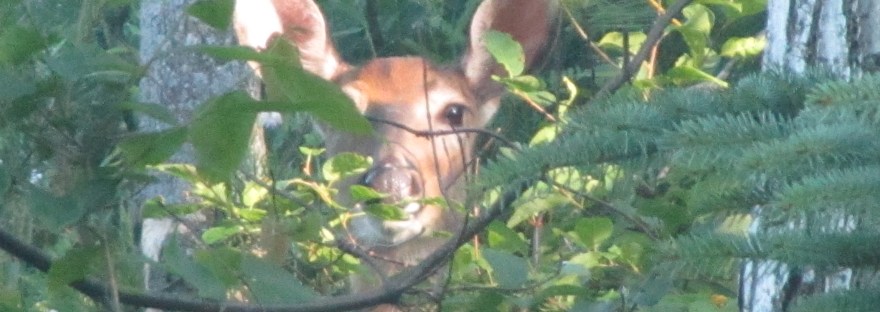
Out here, life hangs on; a tree’s roots cling with enduring hope, it’s branches reaching for God. Every breeze lifts a melody. The deer snuffs and stamps. The kingfisher scolds. The milkweed suckles the Monarch.

And all the while, the waters flow down, the land bowing to its power and majesty. John Muir said, “The rivers flow not past, but through us, thrilling, tingling, vibrating every fiber and cell of the substance of our bodies, making them glide and sing.”

My husband and I need to be where words are unnecessary that we too might glide, and where creation does all the talking and singing for us. Where there is healing at every bend.

Where the earth’s broad sighs, and the sun’s nightly farewell give the soul hue and heft, and space and weft. Like candy at a parade, the wilderness tosses us joy with remarkable abandon, and we unwrap each treat with childish wonder that our hearts, together, could know such timelessness and beauty.

It is breath. It is gift. It is life. It is marriage. And it is ours.

~J.A.P.Walton

Thanks for reading!
 

Accomodation, Affirmation, Creation, death, Dying to Self, Faithful Living, Forest, hiking, Lessons from the Wilderness, Nature, Parasites, Pilgrimage, Religion, Sacrifice, Serving Others, Trees, Uncategorized, wisdom

The Plover and the Crocodile

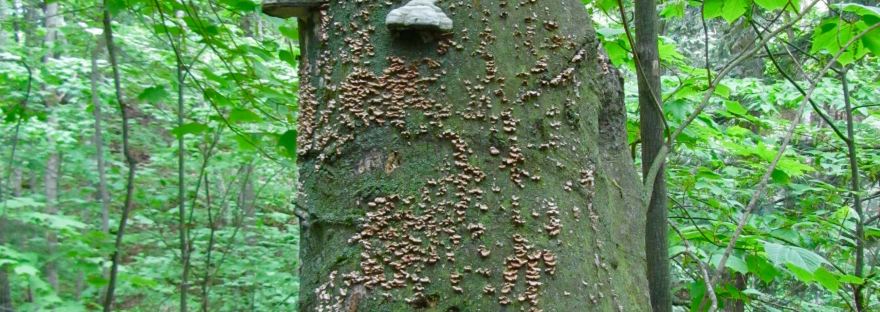
Last month, we hiked through a mixed forest of beech, oak, pine, and hemlock. It is evident all through the north that these hundred+ year-old forests are stressed; the ash still standing are all dead from the ash borer, the beech are ringed with deadly fungus, and the hemlock is next, expected to succumb to the wooly adelgid in Michigan as the tiny insects migrate from the east.

When we came across this tree (pictured), I began to think about the nature of parasitism, that form of symbiosis between species in which a squatter takes advantage of a host. The deer tick is a good example; it sucks the host’s blood, and transmits Lyme disease. Obviously, there is nothing good in the relationship for the host. The photo is of a hoof fungus on a decaying tree. It is a true parasite, attaching to a vulnerable place on the tree and causing stem rot, which eventually kills the tree.

Other symbiotic relationships can be mutually beneficial, in which both host and parasite benefit one another. In Egypt, the plover and the crocodile have made peace for millennia. The crocodile opens wide, the bird flits in and eats the rotting food stuck in the croc’s teeth, and, in apparent gratitude, the croc doesn’t eat the plover. Voila!  The bird eats and the reptile gets a free dental cleaning.

I think the most interesting of these relationships is that of commensalism, in which a parasite attaches to a host for a free ride. One benefits, while the other is not harmed; think barnacles on a whale. Or a person who has asked for prayer.

This has had me thinking mostly about human relationships.  I am people-shy by nature,

in a lifelong struggle to reconcile scriptural demands to love my neighbor with the fact that I prefer solitude. Instead of open arms that welcome “the inconveniences and suffering that love requires,” [1] I tend to flee into myself, wrapped, not in apathy, but in a dread-frosted cake of isolationism.

I do not want to be needed. I do not want my energy to be sucked dry like a tick sucks blood. I do not want to be used. And, to be sure, there are people who are parasitic on one’s time, emotions, money, and good intentions. Thus, most of my freely-given time goes to things like making the coffee, offering to pray for people, serving a meal, helping people move across town, even recover from a hurricane. I can do these things without much chance of exposing my inner self to the deep, sometimes twisted, often long-term (even endless) neediness (especially emotional neediness) of others. It is as much as I can do to avoid parasites while agreeing to a time-constrained spell of commensalism.

I guess, if I am honest, I dislike sacrifice.

And that’s too bad. Here, Nature is such a good teacher. I know that, like the plover and the crocodile, the Church is full of people who both need and love God.

I know that people will come alongside me to model what it means to love without dread, to give without constraint, and to be the hands and heart of God to someone who is hurting-even when that someone, someday, is me.

We always want our relationships to be mutual, in which both parties benefit. I see this naiveté all the time when young people head out on a mission trip; it’s less about sacrificial service than they like to think.

Truth is, the foundation of faith is sacrifice. And bloody.

Freely given that we might be greedy takers of forgiveness and salvation.

But, once freed from our wayward living, the expectation is that we follow. All the way to our own death if necessary. I believe this, but I have to continually pray that God helps me in my unbelief.

~J.A.P. Walton

[1]www.desiringgod.orgaccessed July 13, 2019. John Piper. Future Grace: The Purifying Power of the Promises of God.  pp. 283-284. 2012.

adventure, Affirmation, beauty, canoeing, Creation, Creator, Faithful Living, God, joy, Kindred Spirits, Lessons from the Wilderness, Nature, Outdoor Adventures, Peace, Rain, River, Spring, Uncategorized, Water, Wilderness Paddling, wisdom

The Kindred Spirits of Water and Life

The brothers went canoeing last weekend, a spring paddle to quench a long-wintered thirst. Boats and paddles silently slip into waters roiling with snowmelt. Spring rivers are generally unpeopled, effortlessly pulsing on with energy and focus, down, ever down. How odd that their endpoint is called a mouth, opening wide in confluence with some other body of water.

As the brothers shove off, the water embraces each canoe like long-gone and dearly-missed friends, kindred spirits which understand and accept each other with the delight of contented belonging. It is a holy reunion. The brothers wave and paddle off in an unconscious identical rhythm, letting the water carry them downstream. They, too, are kindred spirits-they have been since the day of the younger one’s birth, perfectly matched in mutual respect and a shared understanding of the world and one another. It is a rare and beautiful friendship. They are silent, letting the water and the birds do the talking. What a happy picture of harmony and rightness!  And just like that, they are gone, carried by the water around a bend and on to the day’s adventure.

Water is so dynamic, ever on the move from lake to cloud to rain, from headwaters to the sea, where ocean currents bathe continental shelves. Eventually, their energies amass in swirling foment of wave and hurricane and flood.

I often wonder at the mystery and miracle of water’s global expeditionary nature. Where has it been? Where is it going? Can it be that this very water dripping from the paddle once kissed Jesus at his baptism?

Did this very water float baby Moses in a basket? Did it balk into walls so the Israelites could walk through the Red Sea? Was it one of billions of raindrops that floated the ark? Was it in the spit with which Jesus made mud to heal a blind man’s eyes? Was it in the roiling, storming waves so quickly calmed by Jesus’ rebuke?

Water, so critical to life, lives on long after we die. It passes through us like we pass through it. We are kindred spirits with it, even though we fail to care for it properly. Next time you’re out, dip your hand in the water- be it creek, pond, or lake. Feel the life in it. This too is holy reunion. Listen to its stories. Marvel at its travels. And be resolved to care for it like a dearly-loved brother.

~J.A.P. Walton


Affirmation, Birds, Blessings, Creation, Creator, Faithful Living, Forest, God, Lessons from the Wilderness, Nature, Peace, Pilgrimage, Prayer, Religion, Silence, Spring, Uncategorized, wilderness

Manifold Witness

We are briefly back north at the bluff to open the house and plant the garden. It is always a “hard work” kind of week-clearing sand out of gutters, raking leaves, sweeping and dusting every horizontal surface, washing windows (a never-ending list really…when was spring cleaning ever easy?).  At the same time, it is curiously restful because we are surrounded by beauty in every direction.  The distractions are natural ones, instead of manmade. No highway or airport noise, no sirens, no teens driving by with thumping base, no door-to-door salesmen. Not even cell phone robo-calls, since the cell signal in the north woods is so weak. The Internet here is iffy too, and our monthly plan severely so limited datawise that we must, by necessity, trim the sails of online time.

Away from town, it’s easier to pay less attention to the news and its tendency to dampen the spirit. There is just something about finding yourself isolated from the noise of the world that is settling. Calming. Affirming. It layers on a balm of hours to get to work with grateful hands, despite the creaky knees and shoulders.  Here, the distractions are different- the screech owl and red-bellied woodpecker. The drumming of an amorous ruffed grouse, a deer prancing by, and the fog rolling in over the lake. Just like in town, we aren’t alone.

The manifold witness of all of nature* reminds us minute by minute of the love, creativity, faithfulness, and constancy of God, maker of heaven and earth.

The bird chorus at dawn, the pregnant bobcat, the mist heavy over the bog, and the waves pounding the foot of the bluff- these are God’s way of assuring us that he is here, ever-watchful, always waiting.

The good news is that you don’t have to go to the north woods to hear and see God’s goodness.

It is my prayer that you can find a space this week to let the beauty of creation enfold you right where you are.

There is glory in the daffodil, marvel in the work of the ant and wren, and a delight in the unfolding of tender new leaves. See if you can silence the distractions wrought by this worrying world long enough to go outside and enjoy what God gives to all so freely.

~J.A.P. Walton

* from the hymn, Great is Thy Faithfulness

Adventure Tourism, Birds, Creation, Creator, Faithful Living, God, Nature, Praise, Risk Taking, Uncategorized, wisdom, worry

My Favorite Lesson

I am watching the birds at Trout Creek today, the outdoors swathed in snow mantle, the wind chill temps blisteringly cold.  After our month-long absence, we found the birds waiting in the wings of the Norway spruce for “their” feeder to be refilled, and the water bath topped off.

It was blizzarding out, lacy snow swirling in a blinding, biting wind.

The intrepid titmouse was at the feeder immediately, running laps from there to the gutter to hammer open his seeds, and find a crack to hide them. The red-bellied woodpecker was not far behind, carelessly scattering seed for which the ground-hugging juncos were thankful. All afternoon they came, the hapless chickadees, bold cardinals, upside down nuthatches, purple and house finches, and downy woodpeckers. This morning, a finch parked itself on the feeder as I worked at my desk through a month’s worth of mail. Though birds’ feet can withstand the cold quite well, it was a happy sight to watch the finch balance on one foot with the other tucked up into her fluffed up feathers. Every so often, she switched feet.

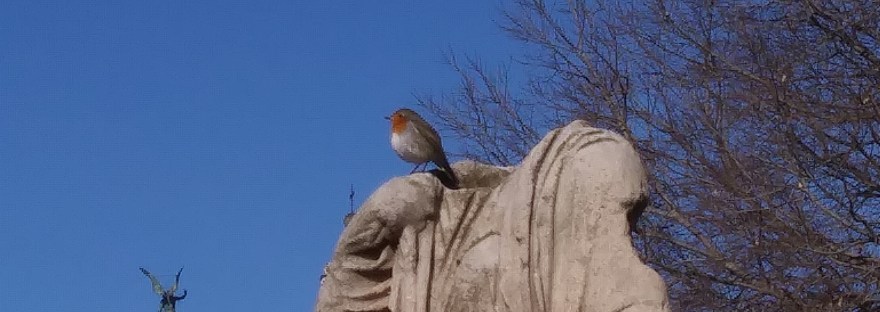
While strolling through the ruins of the Roman Forum earlier this month, I sat for a time to rest and imagine the people who once lived in that grand, impressive place. In the Temple of the Virgins, statues of twelve virtuous ladies line the walk, but only one still has her stone head. On the headless statue in front of me, a small sparrow-sized bird landed, and began to drink out of the water bowled in the lady’s neck.  Next, this bird, a red-breasted flycatcher common to southern Europe, jumped into that pooled water for a bath. I doubt the sculptor could have imagined his beautiful work serving as a bird bath!

Also in Rome, while watching the filthy Tiber River flow by, I observed a pigeon-a fat one at that- limping along on stumped legs; the bird had no feet.  Still, it had adapted quite marvelously, and didn’t even seem to know or care that it was footless.

Jesus taught that

God cares for even the lowliest of sparrows, and that we should never worry about our lives, because He loves us even more.

It is why I like to watch the birds, knowing that while they neither reap nor sow, they are still known by their Creator. While we are busy flitting from thing to thing, worrying the bones of life like a determined dog, God sees us. Knows us. Knows our needs better than we do. Cares for us. Loves us. Provides for us. Hears us.

The birds teach me that. It’s my favorite subject in the school of nature.