

We live atop a terminal moraine along the eastern shore of Lake Michigan where northern forests abruptly meet perched dunes left by retreating ice. The dunes themselves have particular personalities formed over eons by wind, water, and erosion. Some are filled with bowls of fine, gentle sand, others are, especially on the lee side of a foredune, more stable, with an increasingly diverse plant life that will transition slowly over centuries into forest. Because the dunes themselves are in constant flux, caving and calving in giant blowouts down into the lake and blowing in a never ending effort to build more dune, it appears as if the forests behind the dune scarps are in constant peril of falling into Lake Michigan. In reality, the dunes are just as likely to give way to forest over the centuries.
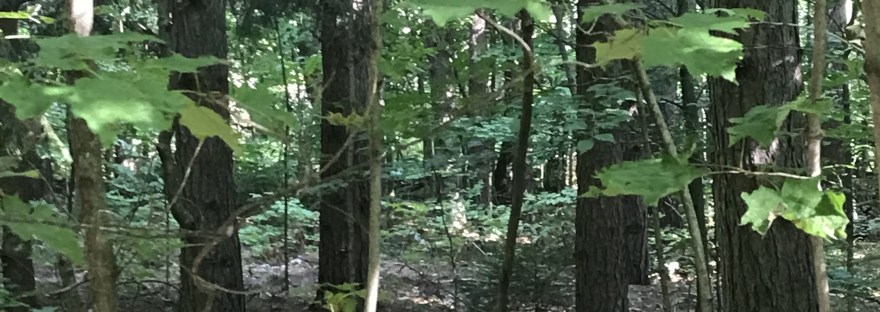
The forest here is itself transitional, a mix of mature hardwoods of beech, ash, sugar maple, birch, basswood and oak, trees that took shameless advantage of copious sunlight when the loggers of the 19th and early 20th centuries voraciously harvested every white pine in the area. The towns here are all old logging towns, built quickly to handle the loads of lumber needed to build (and rebuild) Chicago, and to fire smelting operations up and down the coast.
What is interesting about the forest that sprang up behind the white pine decimation is its inclination toward increased diversity. This is especially evident in the understory, which is that sub-canopy of life that resides in the scarce light beneath the skirts of the overstory canopy created by the largest trees-here, the beech and ash particular.
The understory is what is a fascinating study. A first look in summer reveals a tangled mess of saplings, seedlings, mosses, lichen, ferns, and bracken all competing mightily for even a taste of the sun, and just a smidge of the soil’s nutrients and rain hogged so mercilessly by the overstory. They don’t just survive, they thrive. It’s an important adaptation since the canopy itself is aging-out. A grand beech may live 150 years. Here they are already about 120, and severely tested by beech bark disease. Most will be gone within the decade. The stately ash ARE already gone, succumbed to the emerald ash borer like so many foot soldiers hopelessly advancing into waves of cannon fire and bullets.
So, the oak and maple and basswood have had to accept the mantle of keepers of the canopy, along with scattered hemlock, cedar, and balsam fir. And, happily, the understory pulses with life: deer, trillium, wild leek and blackberry, porcupine, pileated woodpecker, screech owl, wolf spider, wild turkey, coyote, bobcat and cougar. I love the victorious understory, patiently waiting its turn, secure in the relative protection of the older, more mature trees, then stepping into the light when its turn arrives.
It is the same, I think, for my own family. Our grandparents came to the area 90 years ago, when the ash and beech were young, the town languishing in a post-logging and post-war hangover. They began a legacy that we now carefully steward and nurture because they, like the forest, went from young to old, from healthy to ailing, and from upright to fallen. So it is our turn to take up the mantle until we too age-out and leave the canopy to younger lives. What is glorious to me is that life will go on here without us in all its beauty.
Thanks for reading,
J.A.P. Walton
jpraywalton.writing@gmail.com
 This Side of the River