Costa Rica, Creation, death, Dying to Self, Faithful Living, God, Lessons from the Wilderness, Prayer, Sacrifice, Serving Others, Uncategorized, wilderness, wisdom

Snatched

Do you have questions that can’t be answered?

Does it bother you that mercy is so difficult to understand?” *

I sat staring at the creek through the snowflakes yesterday, thinking about the nearness of Easter. Just then, Trout Creek’s resident red tail hawk dove to the wooded floor, wings awkwardly fanning the brown leaves, hopping and clawing, before launching to a sturdy branch for a fresh snack of field mouse. It only took a minute to rip and tear and gulp that mouse down. It reminded me of a day several years back when I was admiring a male cardinal at the feeder. Without a sound, a sharp shinned hawk dropped out of the Norway spruce, snatching that cardinal with swift surprise. The only evidence was a tiny cloud of red and pink wing fluff floating down onto the deck.

On our Costa Rica Outward Bound adventure, we were required to catch a chicken, kill it, and eat it. The catching was comical, but using a machete to behead it was gruesome, blood spurting in all directions while firmly holding the still nerve-wracked body in its violent and nauseating death shake. All so we could have some protein.  

Our sanitized grocery store wrappings of chicken and ground beef have made us naïve. Time out in the wilderness quickly teaches not of the gentleness of nature, but of its brutishness. Is life so cruel? Out in the wilds, we can’t whitewash the truth that all this teeming life around us will, and must be stilled. The heron will gulp the minnow. The salmon feeds the bear. The vole grows the fledging owlet. The cougar will bring down the freckled fawn, and the speckled trout will become our dinner. For one to live, another must die. That’s the immutable law of nature and nourishment, that one’s weakness becomes another’s lifeblood. And, that is the sum of it; life depends on death by design.

The same can be said for Good Friday and the Easter resurrection and what the mercy of God in Jesus did for each of us. Jesus died our own death and bore the just punishment we deserve, his flesh torn, his blood spilled out. If you think about it, it isn’t really about cruelty, but the mercy of sacrifice. For our own life to go on, we must kill and eat. (before you vegetarians get too high-minded, even the plants must die to feed us).

So I think it is good to ponder, “what or who would I die for?” at this time of year. Perhaps we’d die for our loved ones, or a brother or sister in the faith. Some might answer country, or liberty. I know people who give up things for Lent, like chocolate or screen time.  But that misses the entire point. Christ calls us to die to self first, to willingly give up our rights and our comforts by gladly and sacrificially taking up the hard work of our faith.

It is so clearly laid out for us in the Beatitudes. You are blessed when you recognize and mourn your selfishness and sin. And on up the ladder it climbs: life-giving blessing flows out of a meekness that denies self, hungers after God and a rightly pure heart, and shows mercy to others. Friends, isn’t it time to let Christ snatch you out of this world?

~J.A.P. Walton

Please share with your friends!

* Mary Oliver. Devotions. Penguin Press, NY. 2017. p. 239.


Cancer, Creation, Darkness, death, Faithful Living, God, Hope, John Muir, Lessons from the Wilderness, Life's Storms, Prayer, River, Sierra Nevada, Spring, Trees, Uncategorized, wilderness, wisdom

The Geese, the Floods, and John Muir

Geese flew over the house this morning, with a honking so hauntingly welcome that it stopped me breathless with the happy assurance that winter is losing its grip. This has truly been a winter of discontent, to borrow from John Steinbeck (my favorite author of fiction). We lost a loved one. Another continues to decline. We are sending up prayers for too much cancer, too many bullets, the sword-rattling of our enemies, and the deaths of two great men of prayer and faith, R.C. Sproul and Billy Graham. This week we had days and days of rain atop melting snow, sending our creeks and rivers out of their banks.

To dwell on all this too long leaves us as drab and lifeless as the snow-matted flood-stained grass. We defend ourselves with intentional numbness. Yet the geese remind us that goodness abounds, that life is not snuffed out entirely, and that there is work to be done. This week, as Trout Creek rose higher and faster, swelling and bullying itself downstream, I thought about the nature of things-water most especially. How it gathers to itself, seeks out the lowest places, dwells and swells with an abandoned playfulness that lurks with deadly innocence too. Water has a voice and a rhythm. It sings and swings down its course, sweeping everything unrooted away with raw power. What other than our faith can anchor us amid the flood of evil tides?  But water is also life-giving.

I have spent this winter reading the selected works of John Muir because his writing is extraordinarily uplifting (winter is long in the north, so I strategically choose reading that will edify and encourage me). Muir’s prose is divinely poetic, and his love for God and Creation oozes from every page. He often wrote about the waters that fall from the peaks of the Sierra Nevada in California, carving out passes and canyons-

“The happy stream sets forth again, warbling and trilling like an ouzel, ever delightfully confiding, no matter how dark the way; leaping, gliding, hither, thither, clear or foaming: manifesting the beauty of its wildness in every sound and gesture.” 1

Muir shows us that part of the water’s power is in the way it glories to be on its way, hailing any who would heed. Spring is coming friends. Won’t it be glorious to be on our way, doing the work God has given us to do, righting wrongs with energy, and pointing others to the same hope we have in God? May you “set forth again” and rise up out of your banks with a renewed vigor, confiding in one another no matter how dark the way. Look up. The geese will show you the way.

~J.A.P. Walton

We have almost reached 500 readers. Help me get to 500! Please SHARE with your friends if you like what you read.  (just click the SHARE button!). And if you haven’t, sign up to FOLLOW!

  1.  John Muir Selected Writings, A.Knopf, New York. 2017,p.178.  This excerpt is from Muir’s first book, The Mountains of California published in 1894. (an ouzel is a bird)
Cancer, Cancer treatments, Darkness, death, Faithful Living, God, Hope, Lessons from the Wilderness, Life's Storms, Prayer, Uncategorized, wilderness, wisdom

Bad News Comes Calling

We were just getting ready for bed when my brother-in-law Hugh called. He was in graduate school at the time, and I assumed he was calling Mark with an idea for their next wilderness canoeing adventure. Mark gasped and motioned to me to pick up the other phone. Hugh was shaky and emotional as he related to us that his visit to student health services that afternoon for flu-like symptoms ended up instead with the diagnosis of leukemia. Out of nowhere.

Life is a wilderness of unexpected challenges, of things that burrow in and deposit a twisting terror deep in our marrow. None of us could know all that lay ahead for Hugh…dropping out of school and moving home, not one but two body-slamming bone marrow transplants, the agonizingly unfruitful search for a donor, the enrollment in clinical trials for new drugs, the knowledge that nothing again would ever be the same. And it all hit him, and us, out of nowhere.

Death is often referred to as passing. We liken it not to an ending but a transition from here to somewhere else. Not many people like to talk about the process of dying, but the notion that it is like a water crossing is a biblical one. Israel crossed the Red Sea into freedom, and again the Jordan River into the Promised Land. Jesus and his disciples crossed the Sea of Galilee in a killer storm. * All relate to the idea of passage from an old life into a new one, from chaos into calm, and from death of the old self into a new, better one.

When you stand along any river, whether the water is sluggish or swift, your mind automatically looks both across and downstream. What’s over there? What delights are just around the bend? What threats are hidden under the surface? The waterman learns to read the currents and the shoreline, but the only real way to find out what’s across the water is to go there. For Hugh, the far shore of the river was closing in, and it felt like he was being swept away. For us it became a 10-year exercise in the power of prayer. Hugh’s positivity was amazing, and he never did cross that water and leave us. Instead, he turned into the downriver swifts, and ran the rapids of experimental cancer treatments for 9 long years until he reached the calm waters of a cure. He has been in remission for 14 years.

Hanging on for dear life is not easy. Your physical self is decimated, your finances often ruined, and the loss of all control intensely frustrating. The drugs make you crazy, and the loneliness cuts deep. But God is in that despair with us. Jesus crossed the water before us, for us. Even if the cancer grows unabated, Jesus stays with us, and promises no more tears, no more suffering. And if the treatments are successful, we are reborn into a changed life. Because you cannot be unchanged by cancer.

Bad news will come calling out of nowhere. That’s just how life works; suffering is as much a part of life as is joy. We must be brave and prayer-full, and accept a lot of help. What’s more, God is always here in the boat with us no matter the destination. He does not come out of nowhere. So when bad news calls, get ready to ride.

* I highly recommend Leslie Leyland Fields’ book, Crossing the Waters, Philip Yancey’s book, Where is God When it Hurts?, and Kara Tippets’ & Jill Buteyn’s book Just Show Up: the Dance of Walking Through Suffering Together.

~J.A.P.Walton

Follow this blog by entering your email for weekly updates. Thanks for reading!

canoeing, Creation, death, Faithful Living, God, Lessons from the Wilderness, Outdoor Adventures, Uncategorized, wilderness, Wilderness Paddling, wisdom

The Tired Barn

“When God established the force of the wind
and measured out the waters,
when he made a decree for the rain
and a path for the thunderstorm,
then he looked at wisdom and appraised it;
he confirmed it and tested it.
And he said to the human race,
“The fear of the Lord—that is wisdom,
and to shun evil is understanding.” Job 28: 25-28

Wilderness paddlers never underestimate how much time and effort it takes to get afloat on a wild river untouched by man. That is because everywhere people go, there is ample evidence of repeated assaults on the natural environment. It is part of our conquering DNA I suppose, of a deep, inner impulse to remake, refashion, and call it “mine”. Although this drive to create is God-given, we often do so with egotistical abandon, unwisely usurping the title and glory of the Creator. Just visit ruins though-the great pyramids, the Acropolis, Petra, Stonehenge-all manmade things built in a race to command and control, intimidate and dominate. Even these are only temporary. The re-engineered rivers, the cement kingdoms we call home, and the miles of coastline we’ve tamed will, all too soon, crack, decay and return to the earth as surely as we do, victims of fire, flood, neglect, and time.

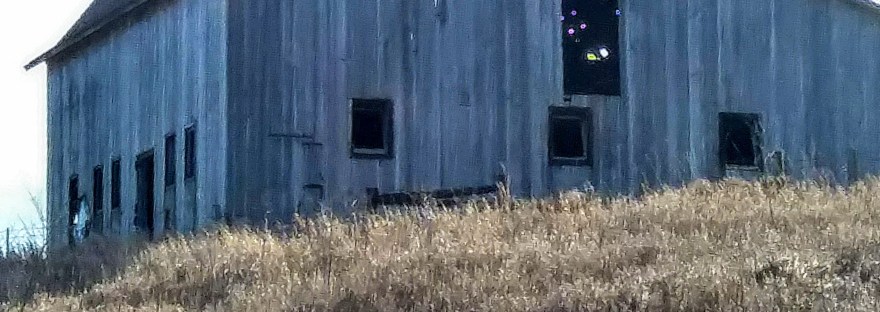
Not far from the Mississippi River there is a barn on a hill in western Illinois that has, at least in our lifetime, stood proud, defiant in the face of stinging northwest winds, its bones leached by decades of relentless summer sun. Sixty years ago it was a robust symbol of the agricultural subjugation of the vast prairies. We drove by it last week, and found instead a tired, sagging structure with sun streaming through multiple holes in the roof-only one generation left until it returns to dust.

Take a good, long look across the River of this life. We too are simply time-warped dust while God stands outside of time, unchanging, and all wise. We paddlers are apt to seek out the remotest rivers to escape into unsullied nature, and the beauty of what we encounter always hushes our hearts and makes our spirits soar. But, we are mistaken if we worship nature instead of the Creator who made it all. Everything but God is a tired, old barn. Wisdom alone knows what counts.

~J.A.P. Walton

Please leave your comments and suggestions.  I am happy to dialogue and debate with you!  Thank you for reading.


canoeing, death, Faithful Living, Hope, Lessons from the Wilderness, Trees, Wilderness Paddling, Winter

Tamarack

The graceful tamarack is my favorite tree. Now, in the iron fist of winter, it soldiers on, bared of its fronds like a naked pine. Also called a larch, the tamarack is a unique tree in that it is considered both coniferous (evergreen, conical shape) and deciduous (loses its leaves/needles). The indigenous Algonquian and Abenaki peoples used it to make snowshoes because of its pliant nature.

Why do I love it so? Mostly I think it is because it is shaped by grace, and colored a rich, soft emerald that turns a royal gold in the autumn, and because the birds love the tamarack’s cover and branching. Here at Trout Creek our resident wrens sing lustily from the largest tamarack next to the garden. Tamaracks grow in swampy areas, greedily drinking up the excess water like a camel in the desert. And, heaven knows, in this family, we love the mired bogs and fens that subdue sound and teem with life. The tamarack tenderly graces the rivers we paddle, swaddled into the forest edge with cedar, birch, and pine.

What I love most, though, is that this tree, so dead-like now, will soon sprout soft, feathery green pinions as the wrens return to nest in its bosom. It reminds me of my dad and brother-in-law who lost their hair to chemotherapy- bald and bare in the cold. But, what seems utterly dead and ready for the woodpile is actually a living thing at rest, hibernating like the bear. What seems lifeless is full of life, of living beauty and grace, where birds and animals shelter with confidence and hope. I love, too, that the tamarack is pliant, like a life bent to the Presence and will of God.

Here, in the strong grip of winter, the tamarack’s barren look mirrors my own mood; the cold, dark days strip and whip me mentally and physically, and my vitality dips, and I feel exactly the same way stumbling through this drowsy hibernation. And yet, I remain secure in the knowledge that I am protected, warmed, and given a great hope in the life that is in me and is also to come. Thank you God for the tamarack trees, and the way they remind us of your grace and love.

These short essays are my way of noodling about life in the wilderness, on foot, in a canoe, on a bike.  If you want to read more, sign up to follow the blog and you will receive an email each time a new essay is posted!  Your comments help

~J.A.P. Walton

If you are passionate about quiet adventuring: paddling, camping, hiking, cycling etc. try this link to find out about the Quiet Water Society!  Quiet Water Society