adventure, Campfires, Camping, Cancer, canoeing, Creation, Darkness, death, Faithful Living, God, Henry David Thoreau, Hope, Lessons from the Wilderness, Outdoor Adventures, Starry Skies, Uncategorized, wilderness, Wilderness Paddling, wisdom

The Brothers Gemini

The two Walton brothers have spent over thirty years paddling the rivers and lakes of the far north each autumn because of their shared love of wilderness, canoeing, and one another. They paddled as young men in the vibrant prime of their lives, and still do today as seasoned and much older men. Not even Hugh’s cancer could stop these adventuring brothers, who know more than most that both the wilderness and brotherly affection have healing hands. Hugh stayed positive throughout the ten long years of treatments, too busy living to entertain thoughts of dying. And in his deliberate living and adventuring, he taught his brother Mark about peace and hope.

It often happens that the sicker man is the nurse to the sounder.”[1]

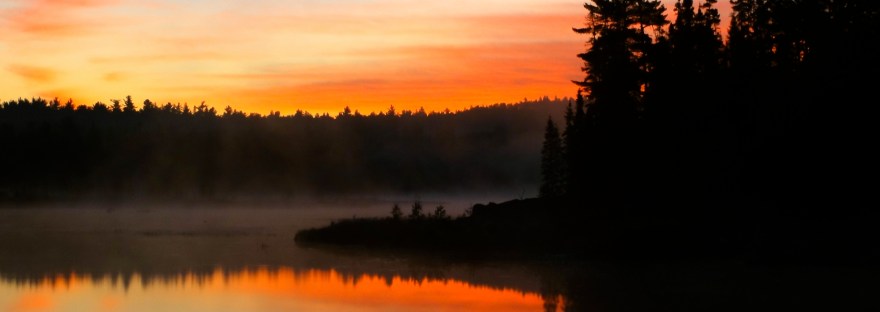
A favorite time of day in the northern latitudes is the autumnal twilight when the sun has gone down early and it’s too cool for bugs. An earlier sunset means the brothers can sit around the campfire for a few hours before turning in. The washing up is done, the canoes are put to bed, and the bear bag has been secured high in a tree. Such evenings are steeped in the reflections of the lowering sun as it briefly teases the landscape and water into a blush, while the spruces’ silhouettes go from stark outline to murky drab until darkness cradles them into its bosom entirely. Eventually, the young fire that started up with spits and mutters matures into a sedate, radiating murmur of glowing and hypnotizing embers. The waters warble a sultry lullaby. A loon mournfully trills across the water. The night in the wilderness is never completely silent, rather orchestrated with a subtle harmony, and it becomes clear, with careful listening, that the small voice of God is out here in this deep indigo twilight. Slow evenings are a necessary part of the adventure, for it is at night that the body is restored. The same can be said for one’s soul.

It is easy, when far away from the nonstop noises and lights of our lifestyles, to look intently at every natural thing out in the wilds and feel thankful that the planet still has these unadulterated oases of space, timelessness, stillness, color, and open skies. This is flair. Art. It is creation, imagination, beauty and adornment. This is how God made the world, speaking it out word by word, adding extravagant flashes of color, texture, and music in the everyday life of the wilds. We miss seeing it and hearing it, and we misunderstand its importance in our daily lives. Fire, water, and the waking creatures of the night all make for a mesmerizing symphony, a bewitching tonic for what ails us.

The brothers aren’t big talkers at night; still they enjoy each other’s company in a curiously uncommunicative way, on a shared adventure among best friends at the end of a physically challenging day. And though the fire and melody draw them in, they stay up late-on clear nights at least-because of the stars. This is especially true when camped beside a remote lake, where trees and rocky ledges can’t obscure the sky. The starry lights emerge one by one as the darkness encroaches. And, aside from the fire, the darkness in the wilderness is complete, no rival light pollution out here. Venus, Jupiter, and the Big Dipper materialize. And though Orion won’t show up until November, they know he’s on his way, the able guardian of the night and comforting friend to those who pray through the night watches in winter. The dancers of the Pleiades begin their warm up. Somewhere out there in the low autumnal sky the sleepy moon pokes its head out from under the covers. Like Orion, felt but not yet visible in the northern hemisphere, the brothers Gemini stand tall, side by side, arms raised in triumph and praise. I like to imagine that the Walton fellows are the Gemini twins, arms around each other’s waists, holding their paddles aloft in victorious self-congratulation and a joy that cancer could not squelch.

~J.A.P. Walton

[1] Henry David Thoreau. A Week on the Concord and Merrimack Rivers, Viking Press, 1985. p. 31 (The author originally published this book in 1849, detailing an 1839 river trip with his beloved brother John, who died in 1842.) Read it here: A Week…Thoreau

adventure, Camping, canoeing, Faithful Living, God, Lessons from the Wilderness, Outdoor Adventures, Uncategorized, wilderness, Wilderness Paddling, wisdom

I Wish I May, I Wish I Might…

At the canoe shows, I like to watch people who stop to admire my husband’s and his brother Hugh’s Sea Wind canoes. These hardy vessels were both built by the famous Michigan paddling pioneer Verlen Kruger. The boats have handsome lines and a certain robust utility about them, and have rightly earned their reputation as having “cavernous storage and bombproof construction.”[1] They can even be joined with a cross arm for catamaran sailing on windy days. Some of the folks-usually men- are seasoned and avid paddlers, and the conversation wags excitedly back and forth around paddle characteristics, dry bags, portage-ability, steering, and stowage. But, by far, most of the people who stop by simply stare at the canoes with their bright yellow sail with what always transmits as a deep longing.

I resonate with that feeling of “I wish I may, I wish I might…” For one, the Sea Wind is a one-man canoe, so I cannot trip along with the men unless I get my own boat. For another, the boats weight 70 pounds, and the gear upwards of 200-300 pounds. I cannot physically carry that much on portage, and the first rule of wilderness adventure is that the group is as weak as its weakest member. More importantly though, the brothers’ yearly adventure trips are wilderness getaways that they’ve shared for 30 years or more, a time so sacred to their deep relationship that I really have no right to intrude. It’s okay, though. We all still paddle together plenty of other times each year.

No, the longing I observe is of the person who wants to be more than a casual weekend paddler who haunts the canoe shows. Who yearns to seek out true wilderness and pit him/herself against the fickle elements of nature, to share the nighttime stars with the moose and the bear. This person wants to do exactly what the brothers do, but can never get past the dreaming.

In all my years as a college professor and academic advisor, I had certain students with the same problem-they thought they wanted something quite badly, but simply could not summon the wherewithal to do what it took to make it happen. The biggest impediment was almost always their lack of confidence that they could, in fact, do this thing. As a result, they took few risks, settled too early, failed to do the hard work required, and missed out on a lot of life’s adventures. Of course, this same lack of confidence holds any of us back in myriad situations. We won’t risk the adventure of a job change, a move out of state, or going back to school to finally study the one thing we always loved. We long for a change we haven’t the grit to embrace and see through to its rewarding end.

I have to say that I think God himself is a risk taker.

He risked becoming a man in order to put the world back to rights. He certainly takes risks on us every day. The Bible is FULL of fragile people God bet on when they thought they couldn’t; just take a look at the weak-kneed lives of Moses, Jonah, and Peter. But, God equips us in every endeavor to which he calls us. And this is the secret: the strength is never our own, but God’s! What have you always wanted to do, felt called to do, but were afraid to try? Maybe it’s time to get in the boat, stop wishing and start paddling!

I wish I may, I wish I might, have the strength to start tonight.

~J.A.P. Walton

Join 485 other weekly readers by adding your email . You will be sent each new post directly!

Verlen Kruger

Quiet Water Symposium

[1] Phil Peterson. All Things are Possible: the Verlin Kruger Story: 100,000 miles by Paddle. Adventure Pulbications. Cambridge, MN. 2006. p.257.

adventure, Life's Storms, Orienteering, Outdoor Adventures, Saint David, Serving Others, Technical Climbing, Uncategorized, Wales, White Water Paddling, wisdom

Saint David, the Wilds of Wales, & Doing the Little Things

March 1st is Saint David’s Day. My family has always celebrated it with pride, and not a little relief that the winter months are behind us. My great-grandmother was an immigrant from Wales in the 1880’s. Her father left the poverty-stricken slate mines of north Wales to settle in eastern Iowa as a farmer. Nearly one hundred years later, I found myself a student at Trinity College in south Wales where I could study Welsh (a difficult, guttural language to be sure). My other classes were Russian History, Outdoor Pursuits, and Chorale, because when you are in Wales, you must sing!

It was the OP class that captured my heart. Over 12 weeks, we learned technical climbing on the steep western cliffs facing the Irish Sea, whitewater kayaking in the wild, foaming rivers of Wales, hiking up the brooding mountains of the north, and the sport of orienteering. It challenged me physically, and I learned quickly to trust ~ my peers, the ropes, the kayak, and the compass. When we live with our petty suspicions about the motives and nature of others, it is wonderfully freeing to learn, experientially, that trust is a virtue to be cultivated.

My brother is named after Saint David, who was a teacher and a monk in the 6th century. Native Welsh, Saint David established Christian enclaves throughout the country. He was no stranger to challenges, and it was his faith that led him on as he shared the gospel with Atlantic pirates and poor Welsh villagers alike.

His trust in God never wavered. On his deathbed, he admonished people to be joyful, to keep their faith, and do the little things in life.

In future posts, I will describe the thrill of running rapids, racing through deep snow to find the orange control flags at an orienteering competition, and rappelling down the steep sea cliffs in a wildly beautiful, breathtaking country. But today is Saint David’s Day, March 1, and I am thinking about “doing the little things” that, when added up, make for a life of meaning and service…things like sharing a meal, sitting with the sick, imprisoned, or widowed, taking on extra at work so a co-worker can get a break, driving your car without ranting at other drivers, keeping your space neat so people don’t have to live with your mess. Joining folks in their sorrow. Saying thank you.

It’s rarely about the thrill, is it? Life is about trusting God that he made you to lighten the burden of other people. It takes trust to step backwards off a high cliff. To paddle over a waterfall, or to run in deep snow after hidden clues. But to trust in God is so much grander. It means that all will be well, even as waters pour over our heads, even as we slip and fall, even as we persist in the mundane. The secret is in staying focused on the little things of life! Happy Saint David’s Day!   Dydd Gŵyl Dewi Hapus!

~ J.A.P. Walton

Photo Credit: Google images (because mine are all slides!) My chorale class sang a Christmas Concert here on a cold, snowy evening in December 1978.  For more information about Wales, see here: Wales | History, Geography, Facts, & Points of Interest | Britannica.com      Wales travel guide

Backpacking, Costa Rica, Creation, Faithful Living, God, Hope, Lessons from the Wilderness, Outdoor Adventures, Outward Bound, Rainforest, Trees, Uncategorized, wilderness, wisdom

Lessons from the Rain Forest

I turned 46 the month I led a group of college students on an Outward Bound trip through the Costa Rica rainforest. Twenty year olds can go all day on enthusiasm alone, but my middle-aged middling fitness brought multiple challenges, the least of which was just keeping pace with my students.

The rainforest is as unforgiving as it is beautiful. On the first day, we hiked UP for 4 straight hours in a relentless rain that made the 90 degree heat unbearable. (Most people don’t even know that Costa Rica has high mountains with rugged wilderness terrain, and that you can easily get altitude sick and lost in the same day). Everything inside of me was, as the Brits say, upsot. Lungs desperate for air, sweat joined to raindrops with nowhere to evaporate, leg and back muscles screaming for relief from the 50 pound pack. Hot spots on both heels you pray are not becoming blisters. All while the young ones traipsed with joyful abandon happily shouting out lines from the Princess Bride movie.

It was hard for me to get outside of my own physical misery long enough to appreciate the stillness, the deep emerald greenness in a fine mist that nearly assaults the senses, the cheerfulness of my companions to finally be underway, and the teeming, fecund, inconceivable LIFE at every turn. Sapphire-tinged moths as big as your hand. Armies of leaf-cutting ants-whole platoons of them winding their way through the jungle, carrying, like me, a heavy load with unwavering duty. Cockroaches as fat as mice. Birds singing. Birds winging. Birds, birds, birds!

In matters of faith, it takes a willful choosing to be outwardly focused. To look at this hurting world with compassion and care even when we ourselves are hurting is, I think, the most difficult, and stridently unnatural thing that God calls us to do. The secret is in the abandon. The giving over in order to give out. To give out and not give up.

 Much of what Outward Bound teaches is how to keep going in the face of physical challenge, and how to embrace a physical challenge that you know will bring pain, tears, doubts, and, always, the bedeviling whisper that you can’t go another step. What God teaches is that there is a strength from unwavering belief that no man, certainly no devil can match. And it is true for all of our difficulties. In the midst of life’s wilderness of hurt, fear, doubt and misery, God is there to be our strength, our immovable rock. But, only if we let Him. Climb on, and BELIEVE that you need never climb alone. It is INCONCEIVABLE!

~J.A.P. Walton

Sign up to receive email notices of new posts. I welcome your feedback.

(more posts about the Costa Rica experience are in the offing, stay tuned. Oh, and lest you think me wimpy, on Day 2 of this trip a student asked if he could take something from my pack to lighten my load.  I was so grateful!  Only later, on the plane home, would I read his reaction in his trip journal:  “I took Dr. Walton’s food sack on the 2nd day to help her out.  HOLY CRAP!! It was heavy!”


death, Faithful Living, Hope, iceboating, Lessons from the Wilderness, Outdoor Adventures, Uncategorized, Winter, Winter Water Sports

At the Mercy of…

It is finally iceboating season in Michigan! Lake Michigan acts as a huge heat sink, and when its waters are warmer than the air, the significant evaporation results in lake effect snow showers for days on end. But, once the lake begins to cool off, the snow lets up so that the inland lakes can freeze slick and relatively snow-free. Our whole family gets impatient for the good ice to form!

My brother got his boat out last weekend. It takes some work, sharpening the runners (as you do your ice skates), checking the sail for holes (the mice can eat like horses), making sure the stays and halyard and sheet ropes are sound, and, of course, gauging the depth of the ice and the force of the wind.

As in all outdoor adventure, you put yourself at the mercy of prevailing elements when iceboating. That means you must withstand marrow-freezing cold, fickle winds, imperfections in the ice, and other ice boaters. Of course, you do your best to fend off the threats with the right equipment and sound judgment. A pot of chili on day-long simmer doesn’t hurt either.

I have been thinking a lot this year about “being at the mercy of…”. We typically think of mercy as something we extend to others-actions like charity, compassion, and nonjudgmental service. I wonder, though, if mercy isn’t so much bigger, and why we often fail to see ourselves in need of it; we are needy recipients, yet prefer to believe we are grandly altruistic in our smug self-sufficiency. God knows better. There is nothing we can do or buy to protect ourselves. In the end, we are incapable of saving ourselves because we can’t be enough-not good enough, or smart enough, or rich enough, nor can we work hard enough to avoid the ice cold truth that we will die.

Think about a God who would still love you despite all your imperfections and sins. One who would make a way for you to be fully prepared in life to accept and even welcome death, and to live forever with Him. That is mercy as deep and solid as good ice. All you have to do is believe it.

Happy sailing…into the arms of a savior!

~J.A.P. Walton

Please LIKE and SHARE as you are able. These short pieces are to become part of a bigger book, and I welcome your feedback in the COMMENT section.