adventure, Creation, Creator, death, Faithful Living, God, hiking, Lessons from the Wilderness, Life's Storms, Mountains, Nature, Outdoor Adventures, River, Rocky Mountain National Park, Uncategorized, wilderness, wisdom

Trust Your Boots Girls!

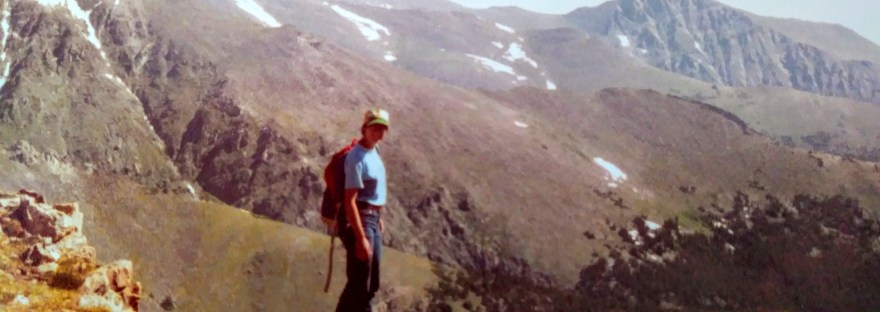
In an icy parking lot earlier this week, the footing was dicey, and, at one point, I blurted out to no one in particular, “Trust your boots girl!”  This adage bubbled up from a deeply-etched memory of a time in high school when a group of gals was climbing Mount Meeker in the front range of Rocky Mountain National Park.  At 13,911 feet, it’s the closest I’ve ever come to peaking a fourteener.  At one point along that climb, there was a steep portion, prompting one member of our group to happily call out,

“Trust your boots girls!”

While at Colorado State University, I reveled in backcountry cross-country skiing. I took a 2-day lesson the first time, and the instructor emphasized the need to trust your skis so that you could flow with them as they glided.  Just before moving back to the Midwest for grad school, I purchased a set of used skis and boots from the ski rental store. The next snow, I waxed them up to go skiing. I could not ski! My left foot kept sliding sideways, and the ski itself seemed to awkwardly tilt my boot so I had no traction or control. My husband-to-be laughed at my claims of being an experienced skier. We soon discovered that the store in Fort Collins had sold me skis with two right-footed bindings. Trust your boots indeed.

When learning to kayak in Wales, we practiced rolling in an indoor pool. Despite heroic attempts, I never did master a tip and roll.  The instructor’s advice to trust your skill in the whitewater rapids didn’t sit well with me. I knew if I capsized, I’d be permanently upside-down knocking my head on submerged rocks.  Having once before been pinned under a turtled boat (see blog post Unbounded Joy, 7-31-18), a healthy respect for the water had evolved into an irrational fear of drowning.

It is just common sense to be fully prepared for a wilderness adventure-to have the right equipment and skill set to see you through to a happy conclusion.

When paddling or hiking, you have to trust your instincts, your experience, your companions, and your preparations. It is folly to be unprepared.

Still, you can never be prepared for everything. Accidents happen with no warning. Wind and weather are fickle. Forests catch fire, and rivers and canyons can swiftly flood. What can you trust when the world turns inside out, when trickles of doubt mushroom into cascades of fear for your safety, even for your life?

Proverbs teaches that trust is an outcome of wisdom, and that wisdom, in turn, is the principal heir of a healthy fear of God.

This is not the kind of fear that makes us dread God’s judgment, but, rather, the kind that sees beauty in creation and is wowed by the God who made it. Not fright but reverence. *

It seems to me we prepare for our trip through the wilderness of this world- on this side of the river- much better than we prepare to face a holy God, misplacing our sense of security by trusting in things, jobs, money, ‘safe’ cars, our own thinking. When my husband was in the ER a few years ago with multiple and deadly pulmonary emboli in both lungs, we did trust that the surgeon would do his best to keep death at bay. Still, our ability to remain calm and hopeful (it was surreal to be honest) came from a stronger, deeper, surer Source. From God himself, whom we love, fear, and deeply trust to make the path through the wilderness straight.

I hope you can spend a little down time this winter working out in what, or whom you place your trust. Life is fragile at best, and downright slippery at its worst.

~J.A.P. Walton

* for more on the wisdom of Proverbs, see God’s Wisdom for Navigating Life by Tim and Kathy Keller. 2017.
Adventure Tourism, Birds, Creation, Creator, Faithful Living, God, Nature, Praise, Risk Taking, Uncategorized, wisdom, worry

My Favorite Lesson

I am watching the birds at Trout Creek today, the outdoors swathed in snow mantle, the wind chill temps blisteringly cold.  After our month-long absence, we found the birds waiting in the wings of the Norway spruce for “their” feeder to be refilled, and the water bath topped off.

It was blizzarding out, lacy snow swirling in a blinding, biting wind.

The intrepid titmouse was at the feeder immediately, running laps from there to the gutter to hammer open his seeds, and find a crack to hide them. The red-bellied woodpecker was not far behind, carelessly scattering seed for which the ground-hugging juncos were thankful. All afternoon they came, the hapless chickadees, bold cardinals, upside down nuthatches, purple and house finches, and downy woodpeckers. This morning, a finch parked itself on the feeder as I worked at my desk through a month’s worth of mail. Though birds’ feet can withstand the cold quite well, it was a happy sight to watch the finch balance on one foot with the other tucked up into her fluffed up feathers. Every so often, she switched feet.

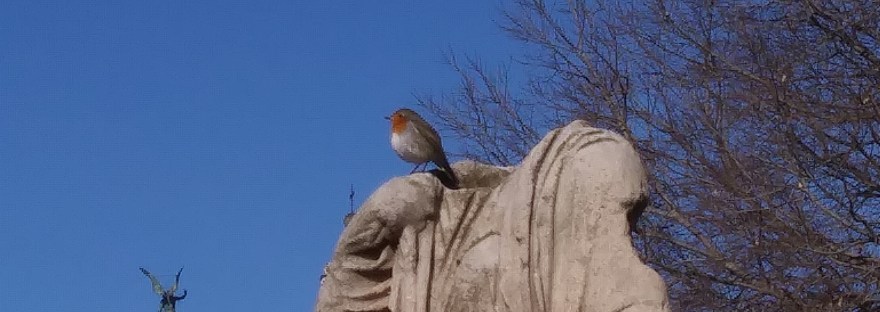
While strolling through the ruins of the Roman Forum earlier this month, I sat for a time to rest and imagine the people who once lived in that grand, impressive place. In the Temple of the Virgins, statues of twelve virtuous ladies line the walk, but only one still has her stone head. On the headless statue in front of me, a small sparrow-sized bird landed, and began to drink out of the water bowled in the lady’s neck.  Next, this bird, a red-breasted flycatcher common to southern Europe, jumped into that pooled water for a bath. I doubt the sculptor could have imagined his beautiful work serving as a bird bath!

Also in Rome, while watching the filthy Tiber River flow by, I observed a pigeon-a fat one at that- limping along on stumped legs; the bird had no feet.  Still, it had adapted quite marvelously, and didn’t even seem to know or care that it was footless.

Jesus taught that

God cares for even the lowliest of sparrows, and that we should never worry about our lives, because He loves us even more.

It is why I like to watch the birds, knowing that while they neither reap nor sow, they are still known by their Creator. While we are busy flitting from thing to thing, worrying the bones of life like a determined dog, God sees us. Knows us. Knows our needs better than we do. Cares for us. Loves us. Provides for us. Hears us.

The birds teach me that. It’s my favorite subject in the school of nature.

Blessings, Creation, Darkness, Forest, hiking, Lessons from the Wilderness, Light, Nature, Outdoor Adventures, Peace, Silence, Trees, Uncategorized, wilderness, Winter, wisdom

The Days Grow Short

The snow is drifting down at Trout Creek, but the squirrels and juncos pay it no heed. They stay busy burrowing and flitting, feeding.  Even so, it is quiet.  Too quiet. The pair of great horned owls we’ve had in the tall cedars for several years have not returned. Perhaps it’s too early, or they’ve wandered further north in search of denser forest. Their absence is palpable, even though we rarely saw them.

The color palette is hushed this time of year too. Brown is the primary hue, only brightened by the snow. Most signs of life are dampened too; no green leaves to dance in the breeze, no delectable tender shoots for the deer to eat. A six-pointed buck roamed by last week in a futile search for greens.  He was hard to spot in his winter camouflage of bristle brown.

We took a walk last week, up north on the Old Indian Trail, part of the Sleeping Bear Dunes National Lakeshore. Sleeping Bear info  It too was silent, the only sign of wildlife in the form of prints and scat. One lone, blustering blue jay pierced the calm, but even it preferred to remain hidden. No other sounds but the wind sighing up high in the firs, and our footsteps crunching on snow-crusted, ice-rimmed leaves.

Silence and beauty are soul sisters, each one weaving purpose and meaning into the other, that we can wrap ourselves in them.  It is one of the gifts of the wilderness to be able to experience both together.  The pulsing of the mute northern lights. Silently spreading ripples on still water. The shadow of an overhead harrier flitting across your path. The flick of the white patch of a deer’s tail.  The sun on its daily trip across the sky.  How nice that the tick of the clock, that slave driver of modern life, cannot contaminate the wilds.

The days grow short. May you find some silence in them, in the falling snow, the lighted tree, and the smile of a loved one. God once broke the winter’s silence with a baby’s cry and an angel’s song. It was cold and dark then too. May you embrace the quiet spells with wonder and delight.

~J.A.P. Walton

Thank you for reading along, and sharing with your friends.

Accomodation, adventure, Adventure Tourism, Creation, Edward Abbey, Henry David Thoreau, hiking, John Muir, Lessons from the Wilderness, National Parks, Nature, Outdoor Adventures, Outfitting, River, Silence, Uncategorized, White Water Paddling, wilderness, Wilderness Paddling, wisdom

The ‘Unhurried Grace’ of the Wilderness

The Walton brothers are back and rested from their rafting trip down the Colorado River, full of stories, memories, and the gratification one gets from completing a once-in-a-lifetime wilderness adventure.  Over eleven days, they rafted 192 miles, bucking through 66 rapids, 28 of which were level IV or V (i.e., significantly formidable).  Since the Colorado is open to paddlers only by permit, almost everyone on the river is with a professional outfitting group. This is good because the rapids and cold water (around 50 degrees) are dangerous even when you know what you are doing.

So the brothers joined 12 other trippers at the South Rim of the Grand Canyon, as well as 4 guides and 4 support staff from O.A.R.S. outfitters. They spent time at the start in orientation: man-overboard drills, helmet rules, and “groover” instructions (a groover is a backcountry toilet for solid waste, because we all know that everything we eat must come out, and that on the Colorado, everything solid that comes out must be packed out).  At 4:00 a.m. the next day, they set off down the Bright Angel trail from the rim of the Grand Canyon hiking down (with a capital D), nearly 10 miles to Phantom Ranch and the Colorado River. They began in a frosty, pitch dark with headlamps, and 3 water bottles apiece. By the time they reached the bottom it was 95 degrees and they were footsore, more than ready to on the river. The rafts were awaiting them in the cool brown Colorado, 4 for the 16 trippers and 4 guides, and support staff with other rafts with supplies like food, drink, gear, and groover. The group all agreed that this was the most physically-challenging day of the trip, and that hiking 10 miles downhill makes everything hurt: back, hips, knees, and, most especially, toes.

When you trip with an outfitter, you have to learn that you are the patron, and the staff is there to serve you.

This is so unlike any trip you would plan and execute on your own; on this trip, carrying the gear, brewing the coffee at 5:30 a.m., cooking the food, cleaning up the camp kitchen, and steering the raft through dangerous rapids was all done for the trippers.  This is fun for most people, and allows them a chance to enjoy being in the wilderness without any of the obligations of planning and paddling.  But, for the two paddling Walton brothers, this was hard. They enjoy the process, and welcome hard physical challenges, where testing themselves against the beauty, danger, and mystery of the wilderness is the main thrust of why they go in the first place. This is not to say they didn’t have a terrific time on the Colorado, only that they would have enjoyed a more hands-on experience.

It begs several questions that have plagued the national parks for decades. How do we get more people in touch with what the wilderness has to teach, and accommodate the novice explorer’s lack of expertise and physical fitness, while preserving the true notion of “wilderness”?  How do we make the wilderness accessible and relatable for people with disabilities?  We know that hands-on experience is a master teacher. So, if we want people to advocate for wilderness preservation, how do we help them be active participants instead of passive passengers?

The world is shrinking. The national parks are experiencing record numbers of visitors, and the wildness of the lands the government preserves is in peril when accessibility/development is at loggerheads with preservation of the virgin wilderness.

Edward Abbey, John Muir, and Henry Thoreau would decry the bulldozers ripping and gnawing at the wilderness so that the auto, RV, motor boat, and trail bike can reach far corners, in faster time, than would happen if we could only get there on foot, or with mute paddle.

What’s lost is the silent stretch of time and physical challenge that births reverence and awe in the undiminished wilds, something that industrial tourism* can never authentically afford.  For now, there’s the shallow surface beauty that national park visitors can enjoy in a quick stop-for-a-day.

The deeper, more mysterious, yet difficult to access  “unhurried grace”* of the wilderness, is won

only by those able and willing to do the hard work to get out and away from the crowds, and it is diminishing by the year.

~J.A.P. Walton

* Edward Abbey. Desert Solitaire. Chapter 4. 1968.

You can receive an email with each new post by clicking on the “follow” tab and entering your email address.  Thanks for reading!

adventure, Adventure Tourism, Bryce Canyon National Park, Camping, Creation, Creator, Desert, God, hiking, Hope, Lessons from the Wilderness, Mountains, Nature, Outdoor Adventures, Praise, River, Starry Skies, Uncategorized, Water, wisdom, Zion National Park

Thin Air, Thick Dust, Beauty All Around

It is good to be home in Michigan after a 3-week spell in Arizona and Utah. Here, I can drink deep draughts of the autumnal palette of green, vermillion, orange and gold, reveling in this bounty of colors so much rarer in the western landscape.

Phoenix was particularly hot and dry where the greenish-yellow of the prickly pear and saguaro cacti stands in base-relief against the purple of distant mountains. Here, the only deep greens are on the golf course, watered with precious and dwindling flows from the Colorado River, and on the cell phone towers painted green to look like giant saguaros.

Climbing out of the desert into the high mesas to the north, the landscape changes in an instant. The cactus and sand give way to rock and bristlecone pine at the higher elevations. In appearance it seems an unforgiving landscape, but

the Hopi and Navajo have lived here for a thousand years, “thriving long in adverse conditions: poor soil, drought, temperature extremes, high winds.”*

Past the Grand Canyon and on into southern Utah, aspen join the autumn chorus, waving golden, glittering arms in gladness. Here, the weathered rock cathedrals tower, where sandstone is king, and sagebrush his queen as they reign over free-ranging cattle on a thousand hills. Here is the confluence of the Green and Colorado Rivers, those life-giving ribbons of water, home to the pronghorn antelope, nattering prairie dog, and swift peregrine falcon. Here, too, is Zion, a river-carved fortress of sheer honeyed walls, and Bryce, with its colorful hoodoo armies blown by winds like fine glass.( Zion National Park   and Bryce Canyon National Park )

It is an entirely different kind of wilderness than what we experience in northern Michigan and southern Ontario.  Here, damp, verdant, fertile. Out west, thin air thick with dust, where the only immediately visible abundance for hundreds of miles is rock. To be sure, both are beautiful in their own ways. Both point to an imaginative Creator, who paints with a bold and vibrant palette.  Both give us the same gifts that wilderness always gives: delight in its bigness, contentedness with our own smallness, hope that life and beauty abound wherever we find ourselves, and that

nothing on this earth is godforsaken at all.

~ J.A.P. Walton

* William Least Heat Moon. Blue Highways. Chapter 2.