adventure, Camping, canoeing, Faithful Living, God, Lessons from the Wilderness, Outdoor Adventures, Uncategorized, wilderness, Wilderness Paddling, wisdom

I Wish I May, I Wish I Might…

At the canoe shows, I like to watch people who stop to admire my husband’s and his brother Hugh’s Sea Wind canoes. These hardy vessels were both built by the famous Michigan paddling pioneer Verlen Kruger. The boats have handsome lines and a certain robust utility about them, and have rightly earned their reputation as having “cavernous storage and bombproof construction.”[1] They can even be joined with a cross arm for catamaran sailing on windy days. Some of the folks-usually men- are seasoned and avid paddlers, and the conversation wags excitedly back and forth around paddle characteristics, dry bags, portage-ability, steering, and stowage. But, by far, most of the people who stop by simply stare at the canoes with their bright yellow sail with what always transmits as a deep longing.

I resonate with that feeling of “I wish I may, I wish I might…” For one, the Sea Wind is a one-man canoe, so I cannot trip along with the men unless I get my own boat. For another, the boats weight 70 pounds, and the gear upwards of 200-300 pounds. I cannot physically carry that much on portage, and the first rule of wilderness adventure is that the group is as weak as its weakest member. More importantly though, the brothers’ yearly adventure trips are wilderness getaways that they’ve shared for 30 years or more, a time so sacred to their deep relationship that I really have no right to intrude. It’s okay, though. We all still paddle together plenty of other times each year.

No, the longing I observe is of the person who wants to be more than a casual weekend paddler who haunts the canoe shows. Who yearns to seek out true wilderness and pit him/herself against the fickle elements of nature, to share the nighttime stars with the moose and the bear. This person wants to do exactly what the brothers do, but can never get past the dreaming.

In all my years as a college professor and academic advisor, I had certain students with the same problem-they thought they wanted something quite badly, but simply could not summon the wherewithal to do what it took to make it happen. The biggest impediment was almost always their lack of confidence that they could, in fact, do this thing. As a result, they took few risks, settled too early, failed to do the hard work required, and missed out on a lot of life’s adventures. Of course, this same lack of confidence holds any of us back in myriad situations. We won’t risk the adventure of a job change, a move out of state, or going back to school to finally study the one thing we always loved. We long for a change we haven’t the grit to embrace and see through to its rewarding end.

I have to say that I think God himself is a risk taker.

He risked becoming a man in order to put the world back to rights. He certainly takes risks on us every day. The Bible is FULL of fragile people God bet on when they thought they couldn’t; just take a look at the weak-kneed lives of Moses, Jonah, and Peter. But, God equips us in every endeavor to which he calls us. And this is the secret: the strength is never our own, but God’s! What have you always wanted to do, felt called to do, but were afraid to try? Maybe it’s time to get in the boat, stop wishing and start paddling!

I wish I may, I wish I might, have the strength to start tonight.

~J.A.P. Walton

Join 485 other weekly readers by adding your email . You will be sent each new post directly!

Verlen Kruger

Quiet Water Symposium

[1] Phil Peterson. All Things are Possible: the Verlin Kruger Story: 100,000 miles by Paddle. Adventure Pulbications. Cambridge, MN. 2006. p.257.
canoeing, Creation, death, Faithful Living, God, Lessons from the Wilderness, Outdoor Adventures, Uncategorized, wilderness, Wilderness Paddling, wisdom

The Tired Barn

“When God established the force of the wind
and measured out the waters,
when he made a decree for the rain
and a path for the thunderstorm,
then he looked at wisdom and appraised it;
he confirmed it and tested it.
And he said to the human race,
“The fear of the Lord—that is wisdom,
and to shun evil is understanding.” Job 28: 25-28

Wilderness paddlers never underestimate how much time and effort it takes to get afloat on a wild river untouched by man. That is because everywhere people go, there is ample evidence of repeated assaults on the natural environment. It is part of our conquering DNA I suppose, of a deep, inner impulse to remake, refashion, and call it “mine”. Although this drive to create is God-given, we often do so with egotistical abandon, unwisely usurping the title and glory of the Creator. Just visit ruins though-the great pyramids, the Acropolis, Petra, Stonehenge-all manmade things built in a race to command and control, intimidate and dominate. Even these are only temporary. The re-engineered rivers, the cement kingdoms we call home, and the miles of coastline we’ve tamed will, all too soon, crack, decay and return to the earth as surely as we do, victims of fire, flood, neglect, and time.

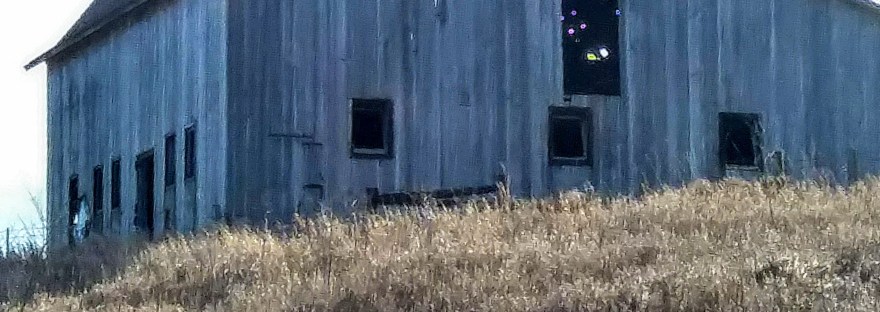
Not far from the Mississippi River there is a barn on a hill in western Illinois that has, at least in our lifetime, stood proud, defiant in the face of stinging northwest winds, its bones leached by decades of relentless summer sun. Sixty years ago it was a robust symbol of the agricultural subjugation of the vast prairies. We drove by it last week, and found instead a tired, sagging structure with sun streaming through multiple holes in the roof-only one generation left until it returns to dust.

Take a good, long look across the River of this life. We too are simply time-warped dust while God stands outside of time, unchanging, and all wise. We paddlers are apt to seek out the remotest rivers to escape into unsullied nature, and the beauty of what we encounter always hushes our hearts and makes our spirits soar. But, we are mistaken if we worship nature instead of the Creator who made it all. Everything but God is a tired, old barn. Wisdom alone knows what counts.

~J.A.P. Walton

Please leave your comments and suggestions.  I am happy to dialogue and debate with you!  Thank you for reading.


canoeing, death, Faithful Living, Hope, Lessons from the Wilderness, Trees, Wilderness Paddling, Winter

Tamarack

The graceful tamarack is my favorite tree. Now, in the iron fist of winter, it soldiers on, bared of its fronds like a naked pine. Also called a larch, the tamarack is a unique tree in that it is considered both coniferous (evergreen, conical shape) and deciduous (loses its leaves/needles). The indigenous Algonquian and Abenaki peoples used it to make snowshoes because of its pliant nature.

Why do I love it so? Mostly I think it is because it is shaped by grace, and colored a rich, soft emerald that turns a royal gold in the autumn, and because the birds love the tamarack’s cover and branching. Here at Trout Creek our resident wrens sing lustily from the largest tamarack next to the garden. Tamaracks grow in swampy areas, greedily drinking up the excess water like a camel in the desert. And, heaven knows, in this family, we love the mired bogs and fens that subdue sound and teem with life. The tamarack tenderly graces the rivers we paddle, swaddled into the forest edge with cedar, birch, and pine.

What I love most, though, is that this tree, so dead-like now, will soon sprout soft, feathery green pinions as the wrens return to nest in its bosom. It reminds me of my dad and brother-in-law who lost their hair to chemotherapy- bald and bare in the cold. But, what seems utterly dead and ready for the woodpile is actually a living thing at rest, hibernating like the bear. What seems lifeless is full of life, of living beauty and grace, where birds and animals shelter with confidence and hope. I love, too, that the tamarack is pliant, like a life bent to the Presence and will of God.

Here, in the strong grip of winter, the tamarack’s barren look mirrors my own mood; the cold, dark days strip and whip me mentally and physically, and my vitality dips, and I feel exactly the same way stumbling through this drowsy hibernation. And yet, I remain secure in the knowledge that I am protected, warmed, and given a great hope in the life that is in me and is also to come. Thank you God for the tamarack trees, and the way they remind us of your grace and love.

These short essays are my way of noodling about life in the wilderness, on foot, in a canoe, on a bike.  If you want to read more, sign up to follow the blog and you will receive an email each time a new essay is posted!  Your comments help

~J.A.P. Walton

If you are passionate about quiet adventuring: paddling, camping, hiking, cycling etc. try this link to find out about the Quiet Water Society!  Quiet Water Society

canoeing, Lessons from the Wilderness, Outdoor Adventures, Wilderness Paddling, Winter, Winter Paddling, Winter Water Sports

The Ice Shelf

The question always at the back of my mind: is the reward worth the risk?

I really like to canoe. My husband Mark and his brother Hugh rabidly LOVE it, so much so that a winter paddle is never far from their minds. I guess it isn’t fair to expect a real waterman to stay grounded for long. One year, the three of us decided to paddle the lower end of a local river that winds lazily out to Lake Michigan through the Sleeping Bear National Lakeshore. In the summer, the canoes and tubes are five across as tipsy tourists float or flail their paddles with an astounding lack of expertise. No matter if they tip over, the water is warm, shallow, and not too swift.

Winter is another matter altogether. Winter paddling takes planning, the right clothes, and a spare set of dry clothes in a dry bag (a hefty water proof sack made for water sports). The winter we went down this particular river had been exceptionally cold, and the ice mantle butted ten feet out to create a narrow middle channel where the water was corralled into a swift current. We walked up and down the bank looking for a good place to “put in,” a canoeman’s “ism” for getting an awkward, land-lubbed craft gracefully (and dryly) afloat. But, with so much unstable ice, there were no good choices.

The fellows determined that if we started on a high point, we could “sled” the canoes down the hill, over the ice, and into the downstream swifts. I wasn’t so sure-it seemed risky to me. What’s more, with Hugh’s cancer always in the back of my mind, I didn’t think an icy dunking would be good for his already vulnerable health. In the end, Hugh went downstream with the lifesaving throw bag to toss us if we capsized, and my husband and I geared up our “sled.” I am always in the bow, so I got in on my knees to stay low, while my husband grabbed the gunnels and did two practice push-pulls like a bobsledder. On the third push he ran alongside the canoe, then jumped in for the ride, and we were launched. No turning back now!

We hit that ice, slid straight across it, and nosed broadside into the current with an exhilarated whoop. Before I could worry about being perpendicular to the current with the opposite ice shelf looming ahead, Mark had expertly turned the canoe downstream.   Hugh soon followed.

The landscape along a river is as robustly alive in winter as other seasons, but it takes a vigilant and patient eye to parse out the subtle differences in the tinted palette of grays, blacks, and browns. The trees stand dormant, a stark relief against their snowy backdrop. The mountain ash berries pixilate the landscape with wild red abandon, and the snow is clumped in the wild river grasses like so many wads of cotton.

It is exceptionally rare to encounter other people. But the deer, mice, squirrels, snowy owl, muskrats, minks, bald eagles, hawks, titmice, and the drably draped goldfinches are all out paying no mind to the cold. Energy along the singing river lifts life up and out in a muted chorus of vigorous yet hushed harmony. People miss it entirely when they hibernate inside all winter. Being outdoors in the winter helps us become so alive, so attuned to the natural environment, so energized by spending all our energy, that the answer is, always yes, the reward is worth the risk.

Get up! Get moving! Don’t duck the winter, dive into it!

Please click on the FOLLOW button to be sent future posts.  And SHARE liberally with friends!

~J.A.P. Walton