adventure, Affirmation, beauty, Blue Skies, Cancer, canoeing, Creation, Creator, Darkness, Faithful Living, God, Hope, Lake Michigan, Lessons from the Wilderness, Life's Storms, Nature, Peace, Perseverence, Rain, River, Storms, Uncategorized, Water, wilderness, Wilderness Paddling, worry

It’s Going to be All Right

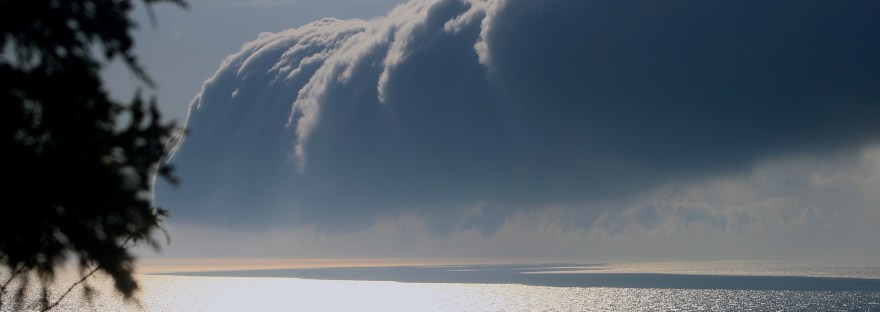
The weather along Lake Michigan has been noticeably unsettled this summer, like a nervous groom before his wedding.  We are missing the long stretch of sunny days under high barometric pressure that bring such deep blue skies and the warm assurance that winter is still far away.

What we need is a really good storm.

Of course, the weather takes special watchfulness in paddling situations. You don’t want to be caught out on the water in wind and lightning when a big blow rises up. It’s one of the rules of paddling: to pay attention to the signs and barometer when heading out.

Once on a paddle on the Au Train River in Michigan’s Upper Peninsula, we got caught in a late afternoon storm. The lightning was too intense to safely shelter under the big trees that leaned over the water. Paddling furiously back upstream, we returned to hunker down under a bridge we had passed earlier. The fury of the storm flashed and crashed all around us as the wind was funneled under the bridge. Trees came down, and grasses were flattened while the sedate river of just minutes ago became a roiling, angry maelstrom in pure, unleashed cacophony.

Life is filled with unexpected blows.

Things are sunny and pleasant, and we loll happily in our unwary hours. Then out of the blue, the skies darken, the storm threatens, and we are caught unawares. Examples abound: the day of 9-11; a cancer diagnosis; an accident; a death.  There seems nowhere to take shelter. Nowhere to turn. Nowhere to hide, or huddle.  Life’s storms can be terrifying, and sometimes they pile up and train down on us one after another.

All I can say is that with perfect predictability, all storms pass. In our canoe, after 30 long minutes of hanging on by our fingertips to the overhead girders, the tempest grudgingly moved on, leaving the river to calm its nerves, the trees dripping with diamonds, and a permeating whiff of fresh-bathed forest in every direction- abrupt silence, achingly beautiful crystal lighting, and a newly-birthed loveliness.

God himself set up the physical laws that create storms. He also has his reasons for allowing them to roil our lives.

But, no matter what assails us, God works only good for those who love him.  He is always for us, so that the storms of trouble and hardship cannot separate us from his love.

Not storms. Not evil. Not hate. Nothing high, nothing low, nothing in all of creation can separate us from how much God loves us.*  The most oft-written phrase in the Bible is,
“Do not be afraid.”

In a storm?  Let God be your bridge. Your shelter. Your hope. It’s going to be all right.  Don’t be afraid. Just hang on and let it blow.

~J.A.P. Walton

* loose paraphrase of Romans chapter 8 in the Bible
adventure, Affirmation, beauty, canoeing, childhood, Creation, Faithful Living, God, John Muir, Kindred Spirits, Lessons from the Wilderness, Marriage, Nature, River, Silence, Uncategorized, Water, White Water Paddling, Wilderness Paddling, wisdom

Where Words are Unnecessary

I must confess that I covet the times my husband and I paddle a river alone together. Being surrounded by boats, family, friends, and visitors, we are more often than not on the water in big groups.

He is a much stronger, abler paddler than I. He can read the currents and the wind in ways that let him slither downriver like a water snake-completely at home and at one with the boat. It is a marvel to watch him, when the edges of man, boat, and river blur into lovely moments of being in nature, rather than standing over it.

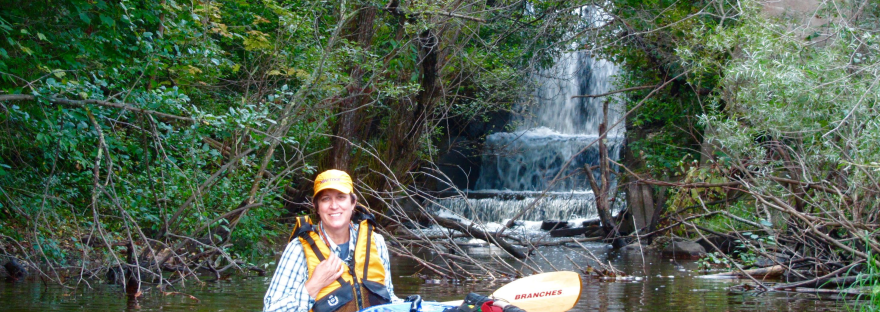
We met 57 years ago as children.  Now, the canoe and the wild river are symbols of our relationship. Stable and still in deep quiet water, swift and determined in the face of life’s challenges and submerged snags. We seek out the wilderness for our own restoration as individuals and as man and wife. We travel the rivers and lakes because this is how man has traveled the deep, dark forests for centuries, taking us where no road can go, no cell phone can reach. We go quietly. Reverently. Following the world’s first paddlers past rocks and pines, scrub oaks and scarred outcroppings, shallow sandbars and towering eagles’ roosts.

Out here, life hangs on; a tree’s roots cling with enduring hope, it’s branches reaching for God. Every breeze lifts a melody. The deer snuffs and stamps. The kingfisher scolds. The milkweed suckles the Monarch.

And all the while, the waters flow down, the land bowing to its power and majesty. John Muir said, “The rivers flow not past, but through us, thrilling, tingling, vibrating every fiber and cell of the substance of our bodies, making them glide and sing.”

My husband and I need to be where words are unnecessary that we too might glide, and where creation does all the talking and singing for us. Where there is healing at every bend.

Where the earth’s broad sighs, and the sun’s nightly farewell give the soul hue and heft, and space and weft. Like candy at a parade, the wilderness tosses us joy with remarkable abandon, and we unwrap each treat with childish wonder that our hearts, together, could know such timelessness and beauty.

It is breath. It is gift. It is life. It is marriage. And it is ours.

~J.A.P.Walton

Thanks for reading!


Accomodation, Affirmation, Creation, death, Dying to Self, Faithful Living, Forest, hiking, Lessons from the Wilderness, Nature, Parasites, Pilgrimage, Religion, Sacrifice, Serving Others, Trees, Uncategorized, wisdom

The Plover and the Crocodile

Last month, we hiked through a mixed forest of beech, oak, pine, and hemlock. It is evident all through the north that these hundred+ year-old forests are stressed; the ash still standing are all dead from the ash borer, the beech are ringed with deadly fungus, and the hemlock is next, expected to succumb to the wooly adelgid in Michigan as the tiny insects migrate from the east.

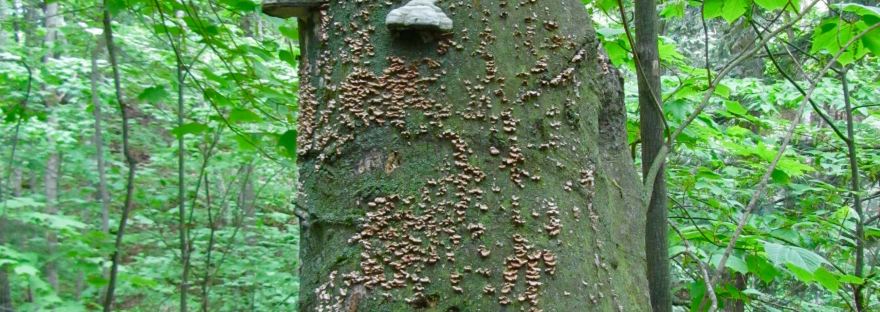
When we came across this tree (pictured), I began to think about the nature of parasitism, that form of symbiosis between species in which a squatter takes advantage of a host. The deer tick is a good example; it sucks the host’s blood, and transmits Lyme disease. Obviously, there is nothing good in the relationship for the host. The photo is of a hoof fungus on a decaying tree. It is a true parasite, attaching to a vulnerable place on the tree and causing stem rot, which eventually kills the tree.

Other symbiotic relationships can be mutually beneficial, in which both host and parasite benefit one another. In Egypt, the plover and the crocodile have made peace for millennia. The crocodile opens wide, the bird flits in and eats the rotting food stuck in the croc’s teeth, and, in apparent gratitude, the croc doesn’t eat the plover. Voila!  The bird eats and the reptile gets a free dental cleaning.

I think the most interesting of these relationships is that of commensalism, in which a parasite attaches to a host for a free ride. One benefits, while the other is not harmed; think barnacles on a whale. Or a person who has asked for prayer.

This has had me thinking mostly about human relationships.  I am people-shy by nature,

in a lifelong struggle to reconcile scriptural demands to love my neighbor with the fact that I prefer solitude. Instead of open arms that welcome “the inconveniences and suffering that love requires,” [1] I tend to flee into myself, wrapped, not in apathy, but in a dread-frosted cake of isolationism.

I do not want to be needed. I do not want my energy to be sucked dry like a tick sucks blood. I do not want to be used. And, to be sure, there are people who are parasitic on one’s time, emotions, money, and good intentions. Thus, most of my freely-given time goes to things like making the coffee, offering to pray for people, serving a meal, helping people move across town, even recover from a hurricane. I can do these things without much chance of exposing my inner self to the deep, sometimes twisted, often long-term (even endless) neediness (especially emotional neediness) of others. It is as much as I can do to avoid parasites while agreeing to a time-constrained spell of commensalism.

I guess, if I am honest, I dislike sacrifice.

And that’s too bad. Here, Nature is such a good teacher. I know that, like the plover and the crocodile, the Church is full of people who both need and love God.

I know that people will come alongside me to model what it means to love without dread, to give without constraint, and to be the hands and heart of God to someone who is hurting-even when that someone, someday, is me.

We always want our relationships to be mutual, in which both parties benefit. I see this naiveté all the time when young people head out on a mission trip; it’s less about sacrificial service than they like to think.

Truth is, the foundation of faith is sacrifice. And bloody.

Freely given that we might be greedy takers of forgiveness and salvation.

But, once freed from our wayward living, the expectation is that we follow. All the way to our own death if necessary. I believe this, but I have to continually pray that God helps me in my unbelief.

~J.A.P. Walton

[1]www.desiringgod.orgaccessed July 13, 2019. John Piper. Future Grace: The Purifying Power of the Promises of God.  pp. 283-284. 2012.

adventure, Affirmation, beauty, Blue Skies, Creation, Fog, God, Growing Up, Home, Lake Michigan, Lessons from the Wilderness, Life's Storms, Nature, Outdoor Adventures, Risk Taking, sailing, Uncategorized

Safely Into Port

A peculiar delight of my childhood summers in northern Michigan involved the dueling foghorns of the Coast Guard stations in Frankfort and at Point Betsie. The old fog signals were automatically activated when sensors detected fog.

All through a foggy night, the two lighthouses would sing their duet, the throaty bass booooommm from Frankfort followed 30 seconds later by a nasal middle F note from the Point.

Big ships, obscured in the mist, would echo back with their own howls accompanied by their thrumming propellers. Whenever the horns were bleating at dawn, my brother and I could lazily roll over, cozy in the cottage blankets, sleepily glad because there would be no 9:30 a.m. swimming lessons today.

Just such a day occurred last week, when I had a dozen things on my to-do list, but awoke to the musical thrill of the foghorns.  I rolled onto one side to enjoy the concert, secretly glad that I would not waste a “good beach” day on so many errands. As I rolled, however, I could feel the sun on my face. What in the world? Why would the fog signals be singing out if the sun was out?  Sure enough, it was a clear morning with just a hint of mist on the far horizon.

The foghorns lied.

It turns out that, over the last decade, the US Coast Guard turned its automatic coastal warning system into one that is, instead, an on demand system for mariners.  It means that any sailor, or fisherman, or tugboat captain can activate the coastal foghorns from the cockpit of their boat.

Now, I find it disorienting to know that it can be densely foggy and the signals won’t sing. Or bright and clear yet the horns are bleating. It robs one of the assurance that things are as they should be. We can no longer rely on the signals to tell us the weather. Talk about getting your signals crossed!

It brings to mind a scary crossing in thick, disorienting fog that we undertook on a sailboat across Lake Ontario when we were newly married. The captain had paid us to help him crew his new boat from the Toronto shipyards, across Lake Ontario, and through the locks of the Welland Canal. He needed to get his boat into Lake Erie, and we needed the money. But, we should not have been out in that fog. It was my job to stand at the bow with a tight grip on the fore-stay (I am unsure, had I fallen over, if they would have been able to find me in that fog), and blow the air horn- one prolonged blast at two-minute intervals to indicate we were underway by engine.  Perhaps it would have been less nerve-wracking had we had the ability to summon the coastal signals at will.

Today’s onboard navigation systems make being fogbound a less daunting circumstance. Even so, I take great comfort in hearing a foghorn trill on a truly foggy day.

It is a lot like life; we can rarely see what’s ahead, and we often feel we are just barely muddling through, but we can have confidence that God will see us safely into port. He may even be calling to us on a sunny day.

~J.A.P. Walton


Loon, Marriage, Petoskey Stone, Uncategorized

Hunting Petoskey Stones with the Loons

We are camping at Petoskey State Park in northern lower Michigan this week, on a shakedown cruise of our new (to us) RV. Located on Lake Michigan along a sandy strip that was once a tannery, the park is tucked into dunes that quickly transition into hemlock and beech forest. It also abuts a wonderful bike path called the Little Traverse Wheelway, which we rode north into Harbor Springs under a cloudless sky yesterday.

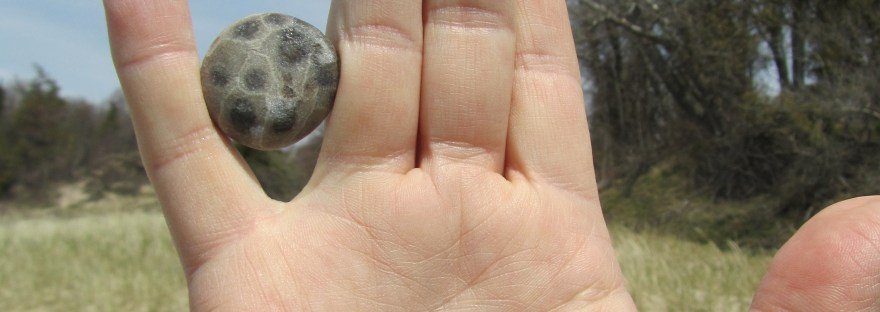
Today is as gray and rainy as yesterday was bright and clear. We hunted petoskey stones between downpours this morning, wading in 43 degree water (great therapy for pesky plantar fasciitis). Our bucket filled fast with over 100 stones. A loon swam along with us about 50 yards out, letting out one lone wail to let its mate know where it was.

I looked down the shoreline to watch my husband hunt stones. He was standing like a human question mark *, head bent, shoulders hunched, knee-deep in the mirror-calm melted ice. No need for him to yodel like the loon, he knew I was nearby. We have haunted these waters together for 45 years. We know each other so well, and share a simple but never stale delight when one of us finds a particularly beautiful petoskey stone.

Back at the picnic table, we sorted through stones and slugged down hot tea. Just one morning of many. Deeply satisfying. The rain resumed, a sky unburdened; a revelation of the simplicity of time spent side by side in unusually quiet waters at the edge of the whispering forest, like a loon pair with an oft-stamped passport of a long-married life together.

~J.A.P. Walton

* this analogy may be attributable to Jane Austen (cannot find the exact source)