adventure, Adventure Tourism, Cancer, Cancer treatments, canoeing, Dying to Self, Faithful Living, God, Lessons from the Wilderness, Life's Storms, Nature, Outdoor Adventures, Perseverence, Prayer, Religion, River, Serving Others, Uncategorized, wilderness, Wilderness Paddling

When God Floats Your Boat

Two years ago, the Walton brothers paddled in Ontario’s Spanish River Provincial Park. SRPP info   They chose a route that threaded through multiple lakes connected by short, shallow outlets. In low water, these outlets turn into tricky portages that leave the canoeist knee deep in boggy, rocky muck. It can quickly become a slog hauling canoes and supplies over challenging barriers that were supposed to be paddled but instead have to be portaged without any trails to follow. The brothers were dismayed to find when they arrived in September that the water levels were at their lowest in a long time, clogging their planned paddling route with clots of muck and rock where lakes should have been.

After Hugh underwent his second round of chemotherapy and subsequent bone marrow transplant, he developed blood clots called DVT, or deep vein thrombosis in one leg.  It is actually quite common for leukemia patients to acquire DVT.  DVT info  These clots are life-threatening because they can move through the blood and lodge in the lungs. Once in the lungs, the clots become barriers to oxygen exchange, and the patient can quickly die of suffocation. As a result, Hugh is now on blood thinners. While this is a terrific remedy for blood clots, it does raise the risk of a dangerous bleed-out from cuts or accidents. As a matter of fact, on one trip, Hugh was pulling a canoe up onto a sandy beach in his bare feet when he stepped on a buried and severed tree root that stabbed deep into his instep. It took some time for the bleeding to stop, and the brothers were too far into the wilderness for immediate help. They now have a rule that you can’t ever be barefoot on trips unless in your sleeping bag.

There are barriers in life that quickly and easily clot our thinking. I often find that they are spiritual in nature, and usually begin innocuously when we let our focus become too heavily inward. Our inner dialogue evolves into a diatribe. We’ve been wronged, treated unfairly or with disrespect, and the “I” language in our head bubbles over in frustration and anger. These are times to take great care, because the lifeblood of the Holy Spirit is clogged, and our sour thinking then deprives us of the spiritual oxygen to act and live rightly toward God and others. Days become a slog of carrying heavy burdens that weigh us down in the muck of our darkened thoughts.

There is a spiritual blood thinner though, and it is incongruously connected with the blood of Christ.

If you can intentionally move your thoughts from yourself to God, if you are willing to unyoke yourself from life’s burdens, to think of and serve others first, God will float you up out of the muck. It’s a wonderful experience to feel the waters of the Spirit float you up, out, and on your way. Next time your language is laced with “I’s”, get in the boat with God and get moving again.

~J.A.P. Walton


adventure, Adventure Tourism, Camping, Creator, Faithful Living, God, Heaven, Home, Outdoor Adventures, River, Travel, Uncategorized

Home is a Comfy Old Robe

It feels so good to be home after a month of adventuring. Stepping across the threshold is like slipping into a comfy old robe. Sleeping in our own bed. Salivating over the stack of waiting books that were too heavy to take along. Standing under a cascade of endless hot water. Driving a car! I think being far away from home for long stretches of time is good for us. We learn to appreciate what we have, and to be grateful for the hospitality of others. It teaches us to be better hosts, offering others sanctuary, nourishment, and rest.

To have a home is a great privilege, whether it is a dorm room, a tent in the wilderness, a small loft apartment in the city, a 3-bedroom ranch, or an old drafty farmhouse. What pleasure there is in making our own “nest” for rest and comfort and for hosting others, with a roof over our head, a place to sleep in relative safety, and an inviting place at the table!

Adventuring often means taking your entire home with you in packs- tent, camp kitchen, food, sleeping bag, first aid kit, knife, matches, lantern, clothing, water filter, camp stove, bucket, bear bag, hatchet, and trowel (for your outdoor “bathroom”). It is amusing to discover how much stuff you can live without when you travel like this, when the weight of everything is a factor for consideration.

It’s true: our stuff truly does weigh us down, and makes our homes cramped and confining. I think we try to fill a hole of deep longing with more stuff because of an undeniably lingering sense that we are never truly at home on the earth.

Jesus, to become a human, left an indescribably magnificent home in heaven. During his 3-year ministry he was an itinerant with no home and, short of the kindness of strangers, had nowhere to lay his head.

Imagine the Son of God having no home!

But he wasn’t homeless either, because he knew where he had come from and that he was going back. More than that, he told us before he left that he was leaving in order to prepare a home for us in heaven. Our unease on earth- really our dis-ease, is this whispering sense of longing, and of knowing that there is something better. It’s a God-given sensation, that we might pine for heaven and God himself while living right here.

These feelings are often most acute when we are away from home, sleeping under the stars, wondering what they look like from God’s vantage, carrying our necessities on our back, needing a map to get around, and relentlessly relying on the kindness of strangers. We miss our own bed, and the comfort of the rooms we know so well. It is a whiff of what heaven will be like-somewhere on the other side of the river of life, a place to be home, known, safe, and loved. That’s a trip I want to take, a threshold I will be glad to cross, and a robe I can’t wait to don!

~J.A.P. Walton

adventure, Adventure Tourism, Affirmation, Camping, canoeing, Faithful Living, God, Lessons from Mom, Lessons from the Wilderness, Outdoor Adventures, Rainforest, Religion, Travel, Uncategorized, wilderness

Thanks Mom

It is the last week of a month in France for us, and I find I have been thinking much about my mother, who first took me to France when I was eighteen.  She is no longer the robust, tireless woman of my youth, now frail in mind and body, though not in spirit. I have been missing her!

My mom taught me much of what I know about outdoor adventure. The first lesson in camping was how to squat to “go” in the woods: heels apart, elbows inside knees flanged wide, facing up a slight incline so the stream trickles downhill without pooling at your feet. My first attempt at the age of 5 exasperated her, as I haplessly filled my sneakers to the brim.

We camped a good deal back then, so I learned about tent setting and sweeping out, about food handling, about packing, site selection and more. We had a wonderful old tin breadbox that was the “kitchen” filled with cutlery, salt & pepper in Tupperware shakers, metal plates and coffee cups, tightly rolled dish towels, and, of course, matches. I still have it, and memories flood in whenever I open it.

My mom taught me how to ride a horse. And canoe. And row. And sail. And hike. And travel. I have climbed to high mountain tarns in the Colorado Rockies with her (she herself summited the 14-er Longs Peak). Together we climbed Mount Snowden in Wales. We paddled rivers swift and lethargic, and sailed and sailed and sailed. I owe my love of nature and the outdoors to her. Mom took me to Europe for a month before I started college, finding ourselves in Paris in the middle of the hottest weather in recorded history. We traipsed the city from end to end: Eiffel Tower, Tuileries, Montmartre, Notre Dame. This was when I learned that the French don’t like COLD drinks, and that asking for ice-MORE ICE S’IL VOUS PLAIT-only brings looks of disdain from the server.  My mother taught me to seek out the adventure, to get out into a new place and explore by foot. We had escargot in Nice because it was important to try a culture’s exotic foods. Today I recognize the privilege of such an upbringing, with a mother who worked fulltime to pay for the adventuring.

The world is a kind of wilderness in its beauty and unpredictability.

Still, I am a more cautious traveler now. Just the other day, two women surrounded me with clipboards asking if I spoke English. This is a typical scam in France-for gangs to send out emissaries to distract a tourist with a petition for a charitable cause and lift her valuables while she is signing. I said “no.” When they pushed further into my personal space, I shouted, “NO!” They jumped back as if I had a communicable disease.

My vehemence surprised even me, giving me pause. I must thank you mom for everything you taught me, but most especially for taking me to church week after week where I would encounter the adventure of a life with God.  I am learning that the world is filled with people wandering in a different kind of wilderness, where God is remote and survival is everything.

So, I have spent this week contemplating the wide gulf between awe and pain. Between beauty and baseness. Between the fist that holds tight, and the open palm that gives away. Between pushing away with a shout and beckoning the lost by gently saying, “Jesus loves you.”

It’s an uphill climb, and I have miles to go, but my mother taught me well.

~J.A.P. Walton

Thanks for reading!

adventure, Backpacking, Camping, canoeing, Creation, Creator, Faithful Living, God, Henry David Thoreau, Lessons from the Wilderness, Nature, Outdoor Adventures, Prayer, Uncategorized, wilderness, wisdom

A Song of Praise

Why do people yearn to go to the wilderness? Is it as simple as wanting to get away for a break? Is it an escape? For some, these adventures take the form of a quest to seek out beauty and peace and quiet, to discover new worlds. For others, getting away- in a canoe, or a tent, backpacking or biking- is a form of worship. Thoreau once saw a man fishing, and described it as “a sort of solemn sacrament and withdrawal from the world.”[1] Even Jesus was known to draw away for time alone. But he was not really alone, because we are also told that he drew away to pray to his Father.

We should think about the reasons we draw away from our busy world. I have heard people laughingly say that they don’t go to church on Sunday morning because they prefer to enjoy God’s world out on the golf course. Nature is beautiful, and no doubt golf is fun. Time spent in nature is restorative. Instructive. But to worship the creation instead of the Creator, to create our own god out of nature, is a mistake because nature is not God.

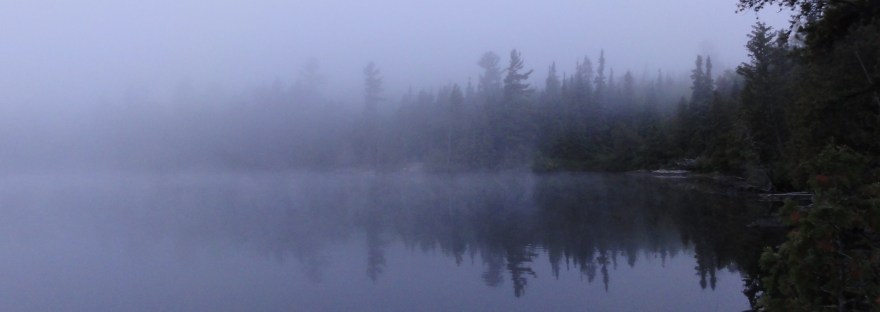
Nature teems with life. We rise from our tent, look out across a fog-shrouded wilderness lake, hear the birds, and breathe deep sighs of contentment. We feel so alive! But where does all this life come from? Your life does not rise out of the deep waters, the sighing pines, the quick-footed hare or the soaring hawk. God made all this beauty. Heart-wrenching, breath-stopping, glorious beauty. Why? To point our hearts to Him. It turns out that all of creation is a road map to God, and the delight He took in making everything is the same delight we are to take in Him.

Job knew it was all too wonderful to understand. But he did appreciate that “earth will never be your savior…that God alone is able to give you life.”[2]

There’s more to living this life than we can see, just like there’s more to a river than what we see on its surface. We don’t go out in nature to worship what we see but what we can’t.”

The next time you pick up a paddle or a pack, and find yourself surrounded by the glories of the wilderness, take a moment to let the awe sink in that a Creator would make all this life, including your life, and that He takes great delight in you. A song of praise can’t help but well up out of your heart.

~J.A.P. Walton

I appreciate it when you SHARE a blog post!

[1] Henry David Thoreau. A Week on the Concord and Merrimack Rivers, Viking Press, 1985. p. 22.

[2] Paul David Tripp. New Morning Mercies. Crossway. Wheaton IL. 2014. Devotion for March 24.

adventure, Campfires, Camping, Cancer, canoeing, Creation, Darkness, death, Faithful Living, God, Henry David Thoreau, Hope, Lessons from the Wilderness, Outdoor Adventures, Starry Skies, Uncategorized, wilderness, Wilderness Paddling, wisdom

The Brothers Gemini

The two Walton brothers have spent over thirty years paddling the rivers and lakes of the far north each autumn because of their shared love of wilderness, canoeing, and one another. They paddled as young men in the vibrant prime of their lives, and still do today as seasoned and much older men. Not even Hugh’s cancer could stop these adventuring brothers, who know more than most that both the wilderness and brotherly affection have healing hands. Hugh stayed positive throughout the ten long years of treatments, too busy living to entertain thoughts of dying. And in his deliberate living and adventuring, he taught his brother Mark about peace and hope.

It often happens that the sicker man is the nurse to the sounder.”[1]

A favorite time of day in the northern latitudes is the autumnal twilight when the sun has gone down early and it’s too cool for bugs. An earlier sunset means the brothers can sit around the campfire for a few hours before turning in. The washing up is done, the canoes are put to bed, and the bear bag has been secured high in a tree. Such evenings are steeped in the reflections of the lowering sun as it briefly teases the landscape and water into a blush, while the spruces’ silhouettes go from stark outline to murky drab until darkness cradles them into its bosom entirely. Eventually, the young fire that started up with spits and mutters matures into a sedate, radiating murmur of glowing and hypnotizing embers. The waters warble a sultry lullaby. A loon mournfully trills across the water. The night in the wilderness is never completely silent, rather orchestrated with a subtle harmony, and it becomes clear, with careful listening, that the small voice of God is out here in this deep indigo twilight. Slow evenings are a necessary part of the adventure, for it is at night that the body is restored. The same can be said for one’s soul.

It is easy, when far away from the nonstop noises and lights of our lifestyles, to look intently at every natural thing out in the wilds and feel thankful that the planet still has these unadulterated oases of space, timelessness, stillness, color, and open skies. This is flair. Art. It is creation, imagination, beauty and adornment. This is how God made the world, speaking it out word by word, adding extravagant flashes of color, texture, and music in the everyday life of the wilds. We miss seeing it and hearing it, and we misunderstand its importance in our daily lives. Fire, water, and the waking creatures of the night all make for a mesmerizing symphony, a bewitching tonic for what ails us.

The brothers aren’t big talkers at night; still they enjoy each other’s company in a curiously uncommunicative way, on a shared adventure among best friends at the end of a physically challenging day. And though the fire and melody draw them in, they stay up late-on clear nights at least-because of the stars. This is especially true when camped beside a remote lake, where trees and rocky ledges can’t obscure the sky. The starry lights emerge one by one as the darkness encroaches. And, aside from the fire, the darkness in the wilderness is complete, no rival light pollution out here. Venus, Jupiter, and the Big Dipper materialize. And though Orion won’t show up until November, they know he’s on his way, the able guardian of the night and comforting friend to those who pray through the night watches in winter. The dancers of the Pleiades begin their warm up. Somewhere out there in the low autumnal sky the sleepy moon pokes its head out from under the covers. Like Orion, felt but not yet visible in the northern hemisphere, the brothers Gemini stand tall, side by side, arms raised in triumph and praise. I like to imagine that the Walton fellows are the Gemini twins, arms around each other’s waists, holding their paddles aloft in victorious self-congratulation and a joy that cancer could not squelch.

~J.A.P. Walton

[1] Henry David Thoreau. A Week on the Concord and Merrimack Rivers, Viking Press, 1985. p. 31 (The author originally published this book in 1849, detailing an 1839 river trip with his beloved brother John, who died in 1842.) Read it here: A Week…Thoreau