adventure, Campfires, Camping, Cancer, canoeing, Creation, Darkness, death, Faithful Living, God, Henry David Thoreau, Hope, Lessons from the Wilderness, Outdoor Adventures, Starry Skies, Uncategorized, wilderness, Wilderness Paddling, wisdom

The Brothers Gemini

The two Walton brothers have spent over thirty years paddling the rivers and lakes of the far north each autumn because of their shared love of wilderness, canoeing, and one another. They paddled as young men in the vibrant prime of their lives, and still do today as seasoned and much older men. Not even Hugh’s cancer could stop these adventuring brothers, who know more than most that both the wilderness and brotherly affection have healing hands. Hugh stayed positive throughout the ten long years of treatments, too busy living to entertain thoughts of dying. And in his deliberate living and adventuring, he taught his brother Mark about peace and hope.

It often happens that the sicker man is the nurse to the sounder.”[1]

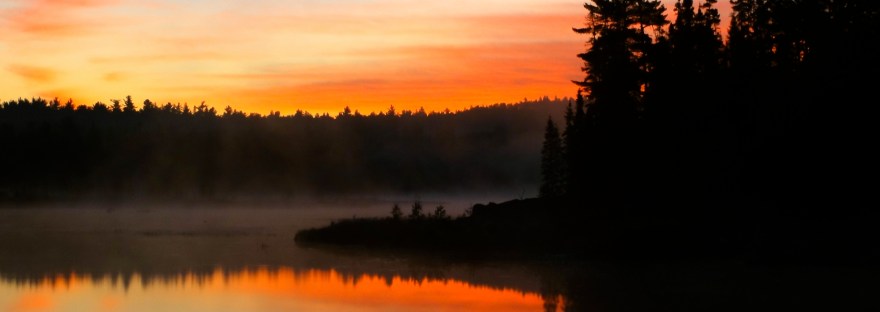
A favorite time of day in the northern latitudes is the autumnal twilight when the sun has gone down early and it’s too cool for bugs. An earlier sunset means the brothers can sit around the campfire for a few hours before turning in. The washing up is done, the canoes are put to bed, and the bear bag has been secured high in a tree. Such evenings are steeped in the reflections of the lowering sun as it briefly teases the landscape and water into a blush, while the spruces’ silhouettes go from stark outline to murky drab until darkness cradles them into its bosom entirely. Eventually, the young fire that started up with spits and mutters matures into a sedate, radiating murmur of glowing and hypnotizing embers. The waters warble a sultry lullaby. A loon mournfully trills across the water. The night in the wilderness is never completely silent, rather orchestrated with a subtle harmony, and it becomes clear, with careful listening, that the small voice of God is out here in this deep indigo twilight. Slow evenings are a necessary part of the adventure, for it is at night that the body is restored. The same can be said for one’s soul.

It is easy, when far away from the nonstop noises and lights of our lifestyles, to look intently at every natural thing out in the wilds and feel thankful that the planet still has these unadulterated oases of space, timelessness, stillness, color, and open skies. This is flair. Art. It is creation, imagination, beauty and adornment. This is how God made the world, speaking it out word by word, adding extravagant flashes of color, texture, and music in the everyday life of the wilds. We miss seeing it and hearing it, and we misunderstand its importance in our daily lives. Fire, water, and the waking creatures of the night all make for a mesmerizing symphony, a bewitching tonic for what ails us.

The brothers aren’t big talkers at night; still they enjoy each other’s company in a curiously uncommunicative way, on a shared adventure among best friends at the end of a physically challenging day. And though the fire and melody draw them in, they stay up late-on clear nights at least-because of the stars. This is especially true when camped beside a remote lake, where trees and rocky ledges can’t obscure the sky. The starry lights emerge one by one as the darkness encroaches. And, aside from the fire, the darkness in the wilderness is complete, no rival light pollution out here. Venus, Jupiter, and the Big Dipper materialize. And though Orion won’t show up until November, they know he’s on his way, the able guardian of the night and comforting friend to those who pray through the night watches in winter. The dancers of the Pleiades begin their warm up. Somewhere out there in the low autumnal sky the sleepy moon pokes its head out from under the covers. Like Orion, felt but not yet visible in the northern hemisphere, the brothers Gemini stand tall, side by side, arms raised in triumph and praise. I like to imagine that the Walton fellows are the Gemini twins, arms around each other’s waists, holding their paddles aloft in victorious self-congratulation and a joy that cancer could not squelch.

~J.A.P. Walton

[1] Henry David Thoreau. A Week on the Concord and Merrimack Rivers, Viking Press, 1985. p. 31 (The author originally published this book in 1849, detailing an 1839 river trip with his beloved brother John, who died in 1842.) Read it here: A Week…Thoreau

Costa Rica, Creation, death, Dying to Self, Faithful Living, God, Lessons from the Wilderness, Prayer, Sacrifice, Serving Others, Uncategorized, wilderness, wisdom

Snatched

Do you have questions that can’t be answered?

Does it bother you that mercy is so difficult to understand?” *

I sat staring at the creek through the snowflakes yesterday, thinking about the nearness of Easter. Just then, Trout Creek’s resident red tail hawk dove to the wooded floor, wings awkwardly fanning the brown leaves, hopping and clawing, before launching to a sturdy branch for a fresh snack of field mouse. It only took a minute to rip and tear and gulp that mouse down. It reminded me of a day several years back when I was admiring a male cardinal at the feeder. Without a sound, a sharp shinned hawk dropped out of the Norway spruce, snatching that cardinal with swift surprise. The only evidence was a tiny cloud of red and pink wing fluff floating down onto the deck.

On our Costa Rica Outward Bound adventure, we were required to catch a chicken, kill it, and eat it. The catching was comical, but using a machete to behead it was gruesome, blood spurting in all directions while firmly holding the still nerve-wracked body in its violent and nauseating death shake. All so we could have some protein.  

Our sanitized grocery store wrappings of chicken and ground beef have made us naïve. Time out in the wilderness quickly teaches not of the gentleness of nature, but of its brutishness. Is life so cruel? Out in the wilds, we can’t whitewash the truth that all this teeming life around us will, and must be stilled. The heron will gulp the minnow. The salmon feeds the bear. The vole grows the fledging owlet. The cougar will bring down the freckled fawn, and the speckled trout will become our dinner. For one to live, another must die. That’s the immutable law of nature and nourishment, that one’s weakness becomes another’s lifeblood. And, that is the sum of it; life depends on death by design.

The same can be said for Good Friday and the Easter resurrection and what the mercy of God in Jesus did for each of us. Jesus died our own death and bore the just punishment we deserve, his flesh torn, his blood spilled out. If you think about it, it isn’t really about cruelty, but the mercy of sacrifice. For our own life to go on, we must kill and eat. (before you vegetarians get too high-minded, even the plants must die to feed us).

So I think it is good to ponder, “what or who would I die for?” at this time of year. Perhaps we’d die for our loved ones, or a brother or sister in the faith. Some might answer country, or liberty. I know people who give up things for Lent, like chocolate or screen time.  But that misses the entire point. Christ calls us to die to self first, to willingly give up our rights and our comforts by gladly and sacrificially taking up the hard work of our faith.

It is so clearly laid out for us in the Beatitudes. You are blessed when you recognize and mourn your selfishness and sin. And on up the ladder it climbs: life-giving blessing flows out of a meekness that denies self, hungers after God and a rightly pure heart, and shows mercy to others. Friends, isn’t it time to let Christ snatch you out of this world?

~J.A.P. Walton

Please share with your friends!

* Mary Oliver. Devotions. Penguin Press, NY. 2017. p. 239.


Cancer, Creation, Darkness, death, Faithful Living, God, Hope, John Muir, Lessons from the Wilderness, Life's Storms, Prayer, River, Sierra Nevada, Spring, Trees, Uncategorized, wilderness, wisdom

The Geese, the Floods, and John Muir

Geese flew over the house this morning, with a honking so hauntingly welcome that it stopped me breathless with the happy assurance that winter is losing its grip. This has truly been a winter of discontent, to borrow from John Steinbeck (my favorite author of fiction). We lost a loved one. Another continues to decline. We are sending up prayers for too much cancer, too many bullets, the sword-rattling of our enemies, and the deaths of two great men of prayer and faith, R.C. Sproul and Billy Graham. This week we had days and days of rain atop melting snow, sending our creeks and rivers out of their banks.

To dwell on all this too long leaves us as drab and lifeless as the snow-matted flood-stained grass. We defend ourselves with intentional numbness. Yet the geese remind us that goodness abounds, that life is not snuffed out entirely, and that there is work to be done. This week, as Trout Creek rose higher and faster, swelling and bullying itself downstream, I thought about the nature of things-water most especially. How it gathers to itself, seeks out the lowest places, dwells and swells with an abandoned playfulness that lurks with deadly innocence too. Water has a voice and a rhythm. It sings and swings down its course, sweeping everything unrooted away with raw power. What other than our faith can anchor us amid the flood of evil tides?  But water is also life-giving.

I have spent this winter reading the selected works of John Muir because his writing is extraordinarily uplifting (winter is long in the north, so I strategically choose reading that will edify and encourage me). Muir’s prose is divinely poetic, and his love for God and Creation oozes from every page. He often wrote about the waters that fall from the peaks of the Sierra Nevada in California, carving out passes and canyons-

“The happy stream sets forth again, warbling and trilling like an ouzel, ever delightfully confiding, no matter how dark the way; leaping, gliding, hither, thither, clear or foaming: manifesting the beauty of its wildness in every sound and gesture.” 1

Muir shows us that part of the water’s power is in the way it glories to be on its way, hailing any who would heed. Spring is coming friends. Won’t it be glorious to be on our way, doing the work God has given us to do, righting wrongs with energy, and pointing others to the same hope we have in God? May you “set forth again” and rise up out of your banks with a renewed vigor, confiding in one another no matter how dark the way. Look up. The geese will show you the way.

~J.A.P. Walton

We have almost reached 500 readers. Help me get to 500! Please SHARE with your friends if you like what you read.  (just click the SHARE button!). And if you haven’t, sign up to FOLLOW!

  1.  John Muir Selected Writings, A.Knopf, New York. 2017,p.178.  This excerpt is from Muir’s first book, The Mountains of California published in 1894. (an ouzel is a bird)
Backpacking, Costa Rica, Creation, Faithful Living, God, Hope, Lessons from the Wilderness, Outdoor Adventures, Outward Bound, Rainforest, Trees, Uncategorized, wilderness, wisdom

Lessons from the Rain Forest

I turned 46 the month I led a group of college students on an Outward Bound trip through the Costa Rica rainforest. Twenty year olds can go all day on enthusiasm alone, but my middle-aged middling fitness brought multiple challenges, the least of which was just keeping pace with my students.

The rainforest is as unforgiving as it is beautiful. On the first day, we hiked UP for 4 straight hours in a relentless rain that made the 90 degree heat unbearable. (Most people don’t even know that Costa Rica has high mountains with rugged wilderness terrain, and that you can easily get altitude sick and lost in the same day). Everything inside of me was, as the Brits say, upsot. Lungs desperate for air, sweat joined to raindrops with nowhere to evaporate, leg and back muscles screaming for relief from the 50 pound pack. Hot spots on both heels you pray are not becoming blisters. All while the young ones traipsed with joyful abandon happily shouting out lines from the Princess Bride movie.

It was hard for me to get outside of my own physical misery long enough to appreciate the stillness, the deep emerald greenness in a fine mist that nearly assaults the senses, the cheerfulness of my companions to finally be underway, and the teeming, fecund, inconceivable LIFE at every turn. Sapphire-tinged moths as big as your hand. Armies of leaf-cutting ants-whole platoons of them winding their way through the jungle, carrying, like me, a heavy load with unwavering duty. Cockroaches as fat as mice. Birds singing. Birds winging. Birds, birds, birds!

In matters of faith, it takes a willful choosing to be outwardly focused. To look at this hurting world with compassion and care even when we ourselves are hurting is, I think, the most difficult, and stridently unnatural thing that God calls us to do. The secret is in the abandon. The giving over in order to give out. To give out and not give up.

 Much of what Outward Bound teaches is how to keep going in the face of physical challenge, and how to embrace a physical challenge that you know will bring pain, tears, doubts, and, always, the bedeviling whisper that you can’t go another step. What God teaches is that there is a strength from unwavering belief that no man, certainly no devil can match. And it is true for all of our difficulties. In the midst of life’s wilderness of hurt, fear, doubt and misery, God is there to be our strength, our immovable rock. But, only if we let Him. Climb on, and BELIEVE that you need never climb alone. It is INCONCEIVABLE!

~J.A.P. Walton

Sign up to receive email notices of new posts. I welcome your feedback.

(more posts about the Costa Rica experience are in the offing, stay tuned. Oh, and lest you think me wimpy, on Day 2 of this trip a student asked if he could take something from my pack to lighten my load.  I was so grateful!  Only later, on the plane home, would I read his reaction in his trip journal:  “I took Dr. Walton’s food sack on the 2nd day to help her out.  HOLY CRAP!! It was heavy!”


canoeing, Creation, death, Faithful Living, God, Lessons from the Wilderness, Outdoor Adventures, Uncategorized, wilderness, Wilderness Paddling, wisdom

The Tired Barn

“When God established the force of the wind
and measured out the waters,
when he made a decree for the rain
and a path for the thunderstorm,
then he looked at wisdom and appraised it;
he confirmed it and tested it.
And he said to the human race,
“The fear of the Lord—that is wisdom,
and to shun evil is understanding.” Job 28: 25-28

Wilderness paddlers never underestimate how much time and effort it takes to get afloat on a wild river untouched by man. That is because everywhere people go, there is ample evidence of repeated assaults on the natural environment. It is part of our conquering DNA I suppose, of a deep, inner impulse to remake, refashion, and call it “mine”. Although this drive to create is God-given, we often do so with egotistical abandon, unwisely usurping the title and glory of the Creator. Just visit ruins though-the great pyramids, the Acropolis, Petra, Stonehenge-all manmade things built in a race to command and control, intimidate and dominate. Even these are only temporary. The re-engineered rivers, the cement kingdoms we call home, and the miles of coastline we’ve tamed will, all too soon, crack, decay and return to the earth as surely as we do, victims of fire, flood, neglect, and time.

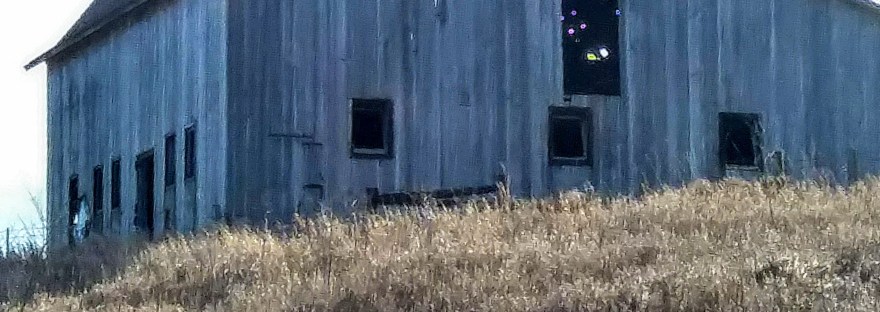
Not far from the Mississippi River there is a barn on a hill in western Illinois that has, at least in our lifetime, stood proud, defiant in the face of stinging northwest winds, its bones leached by decades of relentless summer sun. Sixty years ago it was a robust symbol of the agricultural subjugation of the vast prairies. We drove by it last week, and found instead a tired, sagging structure with sun streaming through multiple holes in the roof-only one generation left until it returns to dust.

Take a good, long look across the River of this life. We too are simply time-warped dust while God stands outside of time, unchanging, and all wise. We paddlers are apt to seek out the remotest rivers to escape into unsullied nature, and the beauty of what we encounter always hushes our hearts and makes our spirits soar. But, we are mistaken if we worship nature instead of the Creator who made it all. Everything but God is a tired, old barn. Wisdom alone knows what counts.

~J.A.P. Walton

Please leave your comments and suggestions.  I am happy to dialogue and debate with you!  Thank you for reading.