
Birds, black bear in Michigan, Dying to Self, Faithful Living, feeding the birds, food assistance, Learn how to cook, Nature, Prayer, Spring, wild turkeys

Bird Feeders & Food Pantries

Essay #80

This Side of the River

05-17-2023

Last night I brought in the feeders (as is our habit because of bear activity). With hands full of suet and seed, I set the hummingbird and oriole feeders outside the sliding door with the intention of bringing those in next. Of course, I forgot. And of course, some hungry opportunist found the grape jelly very much to her liking. When I finally remembered the feeders long after dark, I thrust open the slider only to hear the panicked scramble of feet tearing lickety-split down the deck. I was only too glad the animal (raccoon?) didn’t race in the open door!

We can debate later whether it is wise to feed wild animals. One time I was buying sunflower seed in the garden center when a colleague from my university leaned over my cart and tsk-tsked me with the adage, “You know the birds are perfectly capable of finding their own food, right?”  I was taken aback by his passive-aggressive judgement and could only mumble that it was so my elderly mother could enjoy the birds up close (which was true).  Yes, we must be concerned about over-concentration of birds in an avian flu environment. Yes, we must not lure them so close to the windows that bird strikes threaten great harm. Yes, they can find food in the wild.  But, for these few weeks in the Spring and Summer they are also hungry and have other mouths to feed.

On my shift at the food pantry yesterday, the trend of less food available from the area-wide food rescue organization continued. The math is simple: more people flocking in for food assistance, more pantries are being opened, less food available per pantry and per person. So, in our pantry, there are limits to how much of any one item a person may take. Yesterday, a woman came to the checkout with eight bags of salad greens and became irate when I told her the limit was two. 

We do funny things when we are vulnerable. We may become humbly grateful or angrily entitled. Happily, most of our clientele at the pantry are exceedingly thankful.”

I simply had to absorb this lady’s anger, but all of my being wanted to quietly reply that she is not the only person we serve, that taking 6 extra bags of greens means that three other families will go without.

So that is what I have been observing lately-

there is hunger everywhere if we are willing to see it.”

Here at the bluff, the jays, orioles, grosbeaks, cardinals, robins, hummingbirds, thrushes, indigo buntings, goldfinches, and woodpeckers are eating-gobbling really-like they haven’t had a meal in a long time. Today the wild turkeys showed up at the banquet table of grass seed sowed two days ago. Even the deer are licking up the spillage from under the feeders. I have to believe that the rabbit, raccoon, and opossum are out there at night.

And here in the county, the food pantry is busy, and how I wish we could provide more. How I wish people knew more about cooking. Yesterday we had sleeves of Ritz crackers available, and one gal was particularly excited because her family loves crackers. When I shared that crackers are quite easy to make at home for pennies on the dollar, she was astounded. When the local farm donated a crate of rutabagas no one took any because they had no idea what to do with a rutabaga. I mentioned to a client she could use them to make pasties. She was surprised to think you can make your own pasties from scratch.

Of course, thinking of hunger reminds me that some folks are simply hungry for love, for a listening ear, a whispered prayer, a word of encouragement.  So today, if you will, take a good look around for the hunger that surrounds you. It’s there. It’s there. And growing every day.

beauty, Being resilient, Blessings, Creation, Creator, Faithful Living, Forest, God, Hardiness, Having hope about the future, Lessons from the Wilderness, Life's Storms, Living Faithfully, Nature, Outervention, Perseverence, Praise, rabbits, Religion, Storms, The forest and the dune, The sounds of nature, The squirrel and the rabbit, The still small voice of God, Things that are true, Threats from above, virtue, What nature can teach us, When God speaks, wilderness, wisdom

When the Rabbit Runs

I have been working on a list of things I know to be true no matter what my feelings might otherwise dictate. It is an interesting list I think, and one that will continue to grow. For example, the first item on the list is that all storms pass, and rough waters eventually become calm. I know in my heart that is true even though being in the middle of one of life’s storms often feels interminable and frightening.  Another is that a pleasant demeanor is always worth more than you feel it costs you.  And yet another: most unkindness is rooted in and motivated by fear.

But the one that captures my imagination today is the truth that you should look up when the rabbit runs.

Here at the bluff, the rabbits inhabit the margins between dune grass and forest edge. They are a sniffly little band, out in the dark devouring my carefully cultivated vegetation when there’s an entire forest of food at their disposal. But the forest hides the bobcat, and the bobcat has babies to feed. 

Out in the openness of the dune, the rabbit is most vulnerable to overhead threats. The red-tailed and red-shouldered hawks silently prowl the perimeter, then brashly dive right over the open space. Any living thing small enough to claw and suffocate-chipmunk, mouse, squirrel, bird, rabbit- is in their sights. Just the other day, a rabbit was hunkered under the bird feeder nosing around for spare seed when one of the resident bald eagles soared past. Though the eagle was not hunting, the sight and shadow of the large wings sent the rabbit panicking into cover of spruce.

Look up when the rabbit runs.”

The same holds true in our own lives, when surrounding threats make the heart skip a beat, when the instinct to run and hide overrules any other thought. Yet most of our threats don’t require flight, but head-on confrontation; they need a deep, thoughtful look, because they are rarely overt, but rather insidious, unobserved, often ignored. What do I mean? I mean we should think about the things that soar unnoticed overhead, things that threaten our well-being, things like too much time spent on frivolities like scrolling numbly through social media. Or too much raunchy music or humor or television that infiltrates our spirit with ideas that are not noble, or worthy of our brain power. Or the surprising anger that blackly rises up out of our hearts when another driver annoys us. Or the vitriol we spew when someone with an opposing viewpoint speaks out.

These are threats to our life precisely because we never recognize them until they have their claws around us, squeezing and suffocating the life right out of us. They cause us to sow discord, to angrily participate in cynical or enraged dispute rather than welcoming a civil discussion.  We mock others instead of honoring the very humanity we cherish in ourselves. Why can’t we instead concentrate on things that are noble and of good repute? What is so hard about keeping the ugly and sinister at bay while embracing whatever is lovely, and upright, admirable, and praiseworthy? I wish I knew. 

What I do know for certain is that God’s creation in nature is balm to the suffocating soul. This is where wisdom teaches patient and quiet observation, and where we will learn and observe all kinds of things that are worthy of praise. The opossum may not be comely, may even remind us of a rat, but it voraciously eats the ticks that make us and our pets sick. That scary little spider dines on roaches and mosquitos-the best pest control money can’t buy. The blue jay may mock and scold, but it also blares out a danger warning like a tornado siren. 

 Yes, the truth is that wisdom and insight are treasures worth seeking, and that the ant and bee are good mentors.”

Stop listening to the culture’s banalities. God’s nature is almost always more beautiful than human nature. Maybe a walk in the rain is a good idea. Maybe getting down to observe what’s going on in the grass will yield a bit of wisdom. Maybe setting aside your phone for a few hours is a worthwhile rebellion. Maybe you can learn the ways of the rabbit, to look up when it runs. You might just glimpse a magnificent eagle.

Thanks for reading along. Photo credit: Pixaby 051123

J.A.P. Walton, Ph.D.

jpraywalton.writing@gmail.com

beauty, Being resilient, Birds, Blessings, Creation, Creator, Faithful Living, Forest, God, Great horned owl, Hardiness, Having hope about the future, Heartwarming, Hope, joy, Kindred Spirits, Lessons from the Wilderness, Living Faithfully, Losing yourself in nature, Meeting at the Post Office, Nature, Peace, Perseverence, Praise, Prayer, Silence, Sounds, Spring, Springtime in your sweatshirt, sweatshirt, The sounds of nature, weeds

On the Lookout in My Sweatshirt

Here in the north, we await spring alongside our longsuffering tree companions. Yesterday we had a typical spring bluster curving the stoic trees into the posture of an elderly man bent stiffly forward at the hip. Branches swayed in frank petition for their leaves to come soon. Soon Lord!

It seems we need a greening of the soul.”

The daffodils and forsythia are drunkenly painting the town yellow in defiance of lingering snowflakes. At the post office, there’s a fellow in shorts, a woman in winter boots and scarf, two suntanned folks joyfully reuniting after a long winter in the south, and a tuneful whistling coming from the sorting room. All this color and joy under the dark and foreboding old mural of a sinking Ann Arbor car ferry. And yet, the post office is family of sorts, with a seeping warmth in the face of the chilled grayness outside-this is spring in our little town up north.

Yes, spring in the north is for reunions, and color explosions, leaves and grass and blooming bulbs. But mostly, for me, spring is for birds and sweatshirts. Oh, how I love sweatshirt weather in the north. I can sit in my SOTD (sweatshirt of the day) on the deck and watch the birds for hours.

The wood thrush has returned, shyly showing off his speckled vest, singing like a busker at eventide. I would toss you a dollar if you could use it Mr. Thrush. May you be blessed with a lovely brood to add to the forest choir.

It will only be days before the grosbeak, ovenbird, and vireo are here to join you, while the ruffed grouse beats his drum to lure in a mate. Yes, it is a blissfully happy time here in my sweatshirt, here at the place where dune and forest meet.

Just don’t blink; things quickly change this time of year. Yesterday’s drab unremarkable goldfinch is shockingly yellow this morning. The grass greened up within hours of rain, and the weeds are already out there laughing at me. They adore their effect on my futile thinking. Beware weeds-I have a new tool for rooting you out like a secret buried sin.  

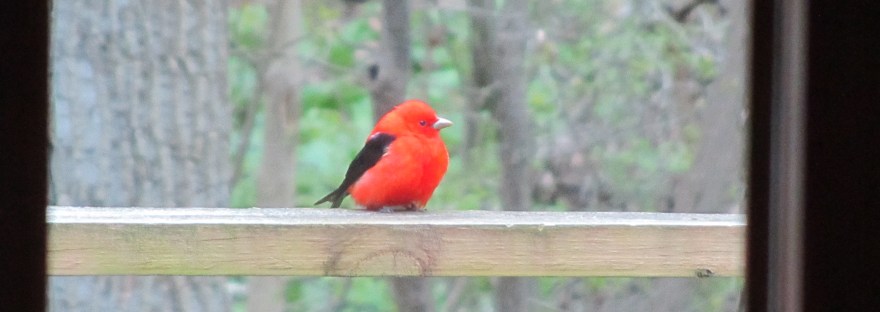
Yes, sweat-shirted and shivering I wait and watch, glad of the trees’ nakedness that I might see the birds better. Soon, all will gratefully hide behinds the leaves’ green screen. I am keen to glimpse a flash of red, the vivid scarlet of the tanager, the royal velvet head of the woodpecker, and its pterodactyl-like pileated cousin already hammering away at a dying ash down the lane. I listen for new songs and the whir of the hummingbird, and thrill to awake before dawn to the insistent hoots of the resident great horned owl calling its newly-fledged owlets to a freshly-killed banquet.

Wait. Ugh. That’s a gritty word that makes me impatient all winter long.”

Watch. A word for thinkers and worshipers and those who hope. Listen. A word to hush me up and be still because there are other voices I need to hear. Spring up north is a signal to be on the lookout. To still the soul enough to hear what God has to tell me. To enfold the unfolding flora into my heart of stone. To laugh at the squirrel’s chase, the weeds’ taunts, and to wrap myself up in my sweatshirt to step out, arms wide, heart a-warming, and thank God for this time of year.

Thanks for reading along!

Julie A.P. Walton, Ph.D.

Jpraywalton.writing@gmail.com

Click on the FOLLOW link to receive future posts in your email. It helps a lot to show potential publishers that a writer actually has a following 🙂

Anishinaabek, beauty, Birds, Blessings, Creation, Creator, Forest, God, Hardiness, joy, Kindred Spirits, Losing yourself in nature, Nature, Peace, Praise, Silence, Spring, The forest and the dune, The sounds of nature, The squirrel and the rabbit, The white cedar, Trees

Losing Yourself

We went exploring yesterday in neighboring Sleeping Bear National Lakeshore https://www.nps.gov/slbe/index.htm, and discovered an old cedar gnarled in grace at the edge of a small lake. It has the typical cedar’s look of a tree in skirts, the deer having browsed the lower vitamin C-laden branches years ago. Underneath a lush, loamy, fragrantly pungent blanket of woodsy compost harbored what I imagine is a million little insects awaking to the spring sun’s warm invitation. The whole scene was one of peace. Calm. Rightness.

An imperial tree rooted securely beside living water.

A stunning preservation of a tree so old I could not reach my arms around it (a white cedar can live to be 800 years old). Who was here in its youth? A young Anishinaabek family collecting nuts and berries, chipping Charlevoix chert for knives and spears, and drying salmon for the winter? An 1800’s logger who somehow missed this section of forest? What birds have taken refuge in its thick gown? How many fawns have bedded down with their mothers underneath its umbrella?

Any thought of the forest and its inhabitants awakens my imagination. Just today I watched a robin pair building a nest in the Frasier fir out back, using stuffed beakfuls of bluestem grass cut back in March and laid along the split rail fence for a bird salad bar. How pleasant to see the old grasses carpeting the fluff and cheep of new bird life. Still, the robins will have to be wary of the lazy cowbirds lurking nearby. We have heard and seen the trumpeting sandhill cranes flying over, gawky and loud like they’ve had too much to drink. An evening grosbeak came to the feeder two weeks ago for a two-day layover; he has an appointment further north. Then we were thrilled to see a pair of ruby crowned kinglets snipping in and out of the white pine. Now we await the hummingbirds and orioles and rose breasted grosbeaks, our very best friends of summer here at the bluff.

The other day a heavy, pregnant doe crossed my path down the lane. She wasn’t much bothered by me, so I talked with her a few minutes. I wanted to tell her to leave my red osier dogwoods alone, and she wanted to thank me for my hospitality in planting things she finds tasty.

In the end, I live in her world, not she in mine, and I must concede the right of way for browsing when there will be little ones to feed and fatten.

The squirrel and the rabbit have signed a truce under the bird feeder, where we often spill a little seed for the ground feeders. Those two, black and gray, sleek and fluffed, poke around in the sand for breakfast, sometimes surprised to come nose to nose. Yet no fight ensues. Neither chases the other away. They bow their heads and keep on feeding. Do I really own this land? I think not. It is theirs and always was. Their descendants will long outlive my own family line.

I am headed out to plant more lettuces, to transplant several balsam fir out of the little nursery where I have been babying them, and to soak my being in the sights and sounds of forest and dune. The newest catchphrase for getting out into nature is “outervention”-a sort of psycho-babble for letting God’s creation soothe your soul, and bring peace to your anxious heart.  My prayer for you this spring is that you too can get outside, lose yourself in watching the birds and flowers and trees and creeks and lakes in a way that nudges you to remember, always, to praise their Maker.

Thanks for reading along! Sorry it has taken so long to write something for you!! 

J.A.P. Walton

Email me with comments: jpraywalton.writing@gmail.com

Being resilient, Emigrating to America from Wales, Faithful Living, Family ties, Having hope about the future, How to get a hand up, How to start with nothing, Learning from our ancestors, Life in Winslow Arizona in 1930

Building the Ladder, Starting to Climb

We recently trekked west in the general direction of Route 66 for a winter sojourn in Arizona. The journey was filled with the ghosts and memories of my mother’s parents who grew up in Iowa in the shadow of World War I, finished their schooling and got married in the 1920’s, then hit the high, unyielding wall of the Great Depression.  With a baby on the way, they joined thousands of others headed west in search of work.

From this side of the story, I can tell you that they were resilient, adventuresome, optimistic, and robust, with a peculiar grace that sanded off sharp corners that worry might produce. They were not temperamental, argumentative, or condescending-although I do clearly remember my grandmother, when frustrated, saying in a peculiarly clipped way, “Isn’t that the LIMIT?”

They were kind. My grandmother was particularly creative and resourceful. Her mother Sarah, my great-grandmother, was born to a family of Welsh slate miners in Blaenau Ffestiniog, Wales, a hard-scrabble life at best. In the 1880’s, Sarah’s family emigrated through Ellis Island to Illinois, then on to Williamsburg, Iowa to farm the fertile, loamy black dirt of the Midwest. From slate to soil, from roofing the tenements of London to feeding the new Americans. Dust to dust. 

My grandmother Ella, Sarah’s third daughter, was born in 1902 into a farm life that did not suit her. She was a reader and a dreamer, with an early flair for drama and fun, and music and pageantry. Once, when she just couldn’t put down a book, she climbed a tree to read instead of doing her farm chores, “tickled” when no one could find her. She became a teacher, one who was much-loved by her students over a 50-year career. She was also a writer-today we’d call it a side-hustle-so apropos for the hustler she was. She produced hundreds of Sunday School circulars and 5 novels for young adults. Ella was the first in her family to go to college. To work off the farm. To seek out opportunities to develop her skillset and shape her character. She took almost any work she could find after she married (In 1928, Iowa did not allow female teachers to be married, so she lost her teaching job). She taught piano, was the camp director at Crystallaire Camp for Girls in Michigan, and directed the girls’ choir at her Congregational Church for nearly 30 years.

But it was Ella’s time in the American southwest that really made her who she was. My grandfather found work in Gallup, NM with the Santa Fe railroad, then was transferred to the Winslow, AZ office in 1930. My mother was born at the doctor’s office above the drugstore (yes on a corner in Winslow Arizona!), and they lived in a little duplex that is still there. What a time they had exploring New Mexico and Arizona! Long car trips, picnic lunches, keeping a shotgun in the car to fend off rattlesnakes. Arizona toughened them up for the long decade ahead.

My grandparents planted seeds and set down roots for a family tree that has cultivated three generations of “can-do” people. A daughter who was one of the first female chemistry majors at her university. A grandson who became a merchant marine captain on a supertanker. A granddaughter in the first generation of Ph.D. females in exercise physiology. And now the great-grandchildren have accepted the family mantle of hard work, deep faith, optimistic outlook, and plain old grit.  True, each successive generation had more privilege that the one before it. But my grandparents themselves began with little but dreams in the high desert of Arizona and the humility of moving back in with Ella’s mother in 1934 when work on the railroad dried up.

I have been nudged into thinking about where resiliency comes from. Surely it is a gift from the same God who promises us a hope and a future. But our inherited outlook also comes from the people he sends us to show a way. How else does one family go from the abject poverty of Welsh mines to the hardscrabble work of farming, to college, then graduate school, and even to sea? To becoming a professor, a published author, an energy expert in France? And all in just a few generations? 

This is not pie-in-the-sky pride at having a ladder to climb or from climbing it resolutely. It is about the faith and diligence and persistence it took our forebears to build the ladder.

From there they reached down to successive generations for a hand up. At my grandmother’s funeral, we were stunned by the dozens of people who told us stories of how Ella had influenced the trajectory of their lives. That’s the other half of the story-it wasn’t just Ella’s immediate family who benefitted from her drive. She mentored and influenced hundreds of children out there who came to believe in themselves and wanted to be just like her. She had that rare ripple effect that seeded generations of hard-working, civic minded people. Just think what she might have accomplished today as a social influencer.

Are you a ladder-builder? Ready to set it up, make the climb rung by rung, then turn around to give a hand to the next climber?  What a world we could have if we all did that.

Thanks for reading along,

J.A.P. Walton

Email me with comments: jpraywalton.writing@gmail.com